Qixia Formation gas reservoir in Shuangyushi area is a complex carbonate gas reservoir with ultra-deep layer in the northwestern Sichuan Basin. The gas reservoir characterization of different reservoir infiltration types and their development response models are not clear, which restricts the scientific and efficient development of gas reservoir. In this study, core observation and thin section identification were used to identify the basic reservoir characteristics. Firstly, cluster analysis was carried out using conventional logging curves which are highly sensitive to reservoirs to classify the reservoirs. Secondly, combined with the quantitative characterization parameters of macro and micro static pores, cavities and fractures, such as CT scan and mercury injection, the reservoir and permeability characteristics can be divided into three categories. Finally, based on the static and dynamic response characteristics of the reservoir and seepage type, a targeted development response model is formed. The research shows that: (1) Four types of dolomite reservoir develop in Qixia Formation, and the fracture-cave type, fracture-pore type are high-quality reservoir types. (2) The reservoir classification index and spatial distribution characteristics of high-quality reservoirs are defined, and the reservoir and permeability types of gas reservoirs are further divided into three types, among which the first and second types of reservoir infiltration characteristics are medium-high production wells. (3) There are two kinds of gas reservoir development response modes: macro heterogeneous, micro heterogeneous and macro visual homogeneous. The production capacity of the two modes is strong, but the production effect is different, the gas reservoir scientific development can be realized. The research method of the combination of gas logging-geological-development and static-dynamic development is of reference significance for the description of reservoir infiltration type and the optimization of the development mode of the same type of ultra-deep layer carbonate gas reservoir.
Keywords:Shuangyushi area in Sichuan Basin
;
Lower Permian Qixia Formation
;
Ultra-deep reservoir
;
Cluster analysis
;
Reservoir infiltration types
;
Response patterns development
WANG Bei, PENG Xian, LI Qian, WANG Juan, FENG Xi, SHE Juan, LI Tao, CAI Junjun. Type of infiltration and development response pattern of ultra-deep gas reservoir in the Qixia Formation, northwestern Sichuan Basin. Natural Gas Geoscience[J], 2022, 33(4): 520-532 doi:10.11764/j.issn.1672-1926.2021.09.013
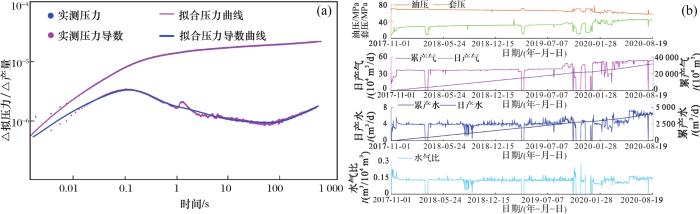
Fig.6
The log-log curve of pressure recovery well test(a) and typical well production curve(b) of near well physical property are worse than those of far well physical property
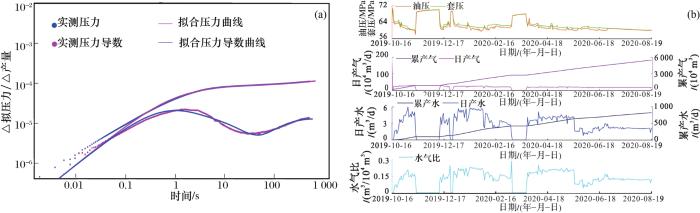
Fig.7
The log-log curve of pressure recovery well test(a) and typical well production curve(b) of near well physical property are better than those of far well physical property
MENG X H, ZHANG S N, LI L B, et al. Character and distribution about the reservoir and permeable body in Ordovician weathering crust in Tabamiao of north Ordos Basin, China[J]. Journal of Chengdu University of Technology (Science & Technology Edition),2006,33(3):233-239.
MACHEL H G. Concepts and Models of Dolomitization: A Critical Reappraisal[M]//BRAITHWAITE C J R, RIZZI G, DARKE G. The Geometry and Petrogenesis of Dolomite Hydrocarbon Reservoirs. London: Geological Society (London) Special Publication,235,2004:7-63.
WANG X Z, MU S G, HUANG J X, et al. The traps of the Dengying Formation reserviors in Ziyang of Sichuan[J].China Offshore Oil and Gas,1998,12(6):386-389.
CHEN Z H, DAI Y, LANG Z X. Storage-percolation modes and production performance of the karst reservoirs in Tahe Oilfield[J].Petroleum Exploration and Development,2005,32(3):101-105.
LIU H, TAN X C, LI L, et al. Characteristics and main controlling factors of porous carbonate reservoirs: A case from the Jia 5 Member of the Jialingjiang Formation, southwest Sichuan Basin[J].Petroleum Exploration and Development,2011,38(3):275-281.
LI X Z, GUO Z H, HU Y, et al. Efficient development strategies for large ultra-deep structural gas fields in China[J].Petroleum Exploration and Development,2018,45(1):111-118.
WANG B, LIU X J, SIMA L Q. Grading evaluation and prediction of fracture-cavity reservoirs in Cambrian Longwangmiao Formation of Moxi area, Sichuan Basin,SW China[J].Pe-troleum Exploration and Development,2019,46(2):290-301.
TANG C, TANG H M, WANG J J, et al. Reservoir types of gas reservoirs and contribution rates of different reservoirs to productivity: A case study of Qixia Formation in northwest Sichuan[J]. Contributions to Geology and Mineral Resources Research,2020,35(1):64-72.
BAI X L, YANG Y M, YANG Y, et al. Characteristics and controlling factors of high-quality dolomite reservoirs in the Permian Qixia Formation, northwestern Sichuan[J].Journal of Southwest Petroleum University (Science & Technology Edition),2019,41(1):47-56.
PENG X, PENG J, ZHANG L J, et al. Characteristics and main controlling factors of the Middle Permian Qixia Formation reservoir in Shuangyushi structure[J].Journal of Southwest Petroleum University (Science & Technology Edition),2020,42(5):1-12.
ZHANG B J. The Origin and Reservoir Characteristics of Middle Permian Qixia Formation Sucrosic Dolomite in the Northwestern Sichuan Basin[D].Chengdu: Southwest Petroleum University,2019.
LU F F, TAN X C, ZHONG Y, et al. Origin of the penecontemporaneous sucrosic dolomite in the Permian Qixia Formation, northwestern Sichuan Basin, SW China[J]. Journal of Southwest Petroleum University: Science & Technology Edition,2020,47(6):1-16.
JIANG Y Q, GU Y F, LI K H, et al. Space types and origins of hydrothermal dolomite reservoirs in the Middle Permian strata, central Sichuan Basin[J].Natural Gas Industry,2018,38(2):16-24.
WANG H, SHEN H, HUANG D, et al. Origin and distribution of hydrothermal dolomites of the Middle Permian in the Sichuan Basin[J].Natural Gas Industry,2014,34(9):25-32.
WANG D G, LI Y, HU Y L, et al. Comprehensive clustering evaluation of fractured vuggy carbonate reservoirs by depletion drive process[J].Xinjiang Petroleum Geology,2016,37(2):192-198.
SUN X X. On classification and evaluation of extra-low porosity and permeability reservoir in Yongjin Oilfield, Dzungaria Basin[J].Well Logging Technology,2012,36(5):479-484.
The State Economic and Trade Commission,SY/T6110-2002 The People’s Republic of China Standard of Petroleum and Natural Gas Industry:The Description of Exploitation Geologic Characteristics for Carbonate Gas Reservoir[S].Beijing: Standards Press of China,2002:6-7.
WANG J J, HU Y, LIU Y C, et al. Identification and characterization of multi-scale pores, vugs and fractures in carbonate reservoirs: A case study of the Middle Permian Qixia dolomite reservoir in the Shuangyushi structure of the northwestern Sichuan Basin[J].Natural Gas Industry,2020,40(3):48-57.
FENG X, PENG X, LI Q, et al. A new method for evaluating the unstable deliverability of gas wells in gas formation testing phase[J].Natural Gas Industry,2020,40(4):59-68.
SHEN P, ZHANG J, SONG J R, et al. Significance of new breakthrough in and favorable targets of gas exploration in the Middle Permian system, Sichuan Basin[J].Natural Gas Industry,2015,35(7):1-9.
JIA A L, YAN H J. Problems and countermeasures for various types of typical carbonate gas reservoirs development[J].Acta Petrolei Sinica,2014,35(3):519-527.




 甘公网安备 62010202000678号


