天然气地质学

四川盆地含硫气藏硫化氢差异性分布及其控制因素——以川中震旦系—寒武系以及川东北二叠系—三叠系气藏为例

  • 徐豪 , 1, 2, 3 ,
  • 张天怡 3, 4 ,
  • 黄士鹏 , 3 ,
  • 李贤庆 1, 2 ,
  • 姜华 3 ,
  • 武赛军 3
展开
  • 1. 中国矿业大学(北京)煤炭精细勘探与智能开发全国重点实验室,北京 100083
  • 2. 中国矿业大学(北京)地球科学与测绘工程学院,北京 100083
  • 3. 中国石油勘探开发研究院,北京 100083
  • 4. 油气资源与工程全国重点实验室,中国石油大学(北京),北京 102249
黄士鹏(1984-),男,山东泰安人,博士,高级工程师,主要从事油气成藏与勘探评价研究. E-mail:.

徐豪(2001-),男,湖南邵阳人, 硕士研究生,主要从事油气地质研究. E-mail:.

收稿日期: 2025-08-19

  修回日期: 2025-10-27

  网络出版日期: 2025-12-09

基金资助

国家自然科学基金项目(42372165)

Differential distribution of hydrogen sulfide and its controlling factors in sour gas reservoirs in the Sichuan Basin: Case study of the Sinian-Cambrian reservoirs in the central Sichuan and the Permian-Triassic reservoirs in the northeastern Sichuan

  • Hao XU , 1, 2, 3 ,
  • Tianyi ZHANG 3, 4 ,
  • Shipeng HUANG , 3 ,
  • Xianqing LI 1, 2 ,
  • Hua JIANG 3 ,
  • Saijun WU 3
Expand
  • 1. State Key Laboratory for Fine Exploration and Intelligent Development of Coal Resources,China University of Mining and Technology (Beijing),Beijing 100083,China
  • 2. College of Geoscience and Surveying Engineering,China University of Mining and Technology (Beijing),Beijing 100083,China
  • 3. Research Institute of Petroleum Exploration & Development,PetroChina,Beijing 100083,China
  • 4. State Key Laboratory of Petroleum Resources and Engineering,China University of Petroleum (Beijing),Beijing 102249,China

Received date: 2025-08-19

  Revised date: 2025-10-27

  Online published: 2025-12-09

Supported by

The National Natural Science Foundation of China(42372165)

摘要

川中震旦系—寒武系与川东北二叠系—三叠系气藏均为白云岩储层,经历了类似的深埋高温演化及古油藏裂解过程,但前者硫化氢(H₂S)含量却显著低于后者。针对造成该差异的主控因素,当前的认识尚不够系统深入。研究通过采集安岳气田13口井和收集整理前人公开发表的川中震旦系—寒武系气藏以及川东北二叠系—三叠系气藏79口钻井的天然气地球化学、地层水数据,应用天然气组分、碳氢同位素、硫同位素、储层沥青元素、供烃能力、埋藏史、热演化史和地层水硫酸根离子浓度组成等综合分析了上述2个地区硫化氢含量差异原因,取得4点认识:①两地H2S均主要源于热化学硫酸盐还原作用(TSR);②两地烃类供给能力与油气成藏演化差异均不是控制含硫化氢气藏分布的主要因素;③两地SO₄²⁻来源存在差异,川东北地区飞仙关组气藏硫源主要为储层中发育的硬石膏层或结核,而长兴组气藏与川中震旦系—寒武系气藏硫源则主要为白云岩化作用释放的硫酸盐,由于川中地区晶格硫酸盐(CAS)含量明显低于长兴组,导致其硫酸根供给相对不足,TSR反应强度相对较弱;④川东北二叠系—三叠系气藏SO₄²⁻浓度普遍偏高,且高H₂S含量气藏分布与SO₄²⁻富集地层具有空间对应关系,而川中震旦系—寒武系地层水SO₄²⁻浓度多低于检测限,因此地层水中SO₄²⁻浓度不同是造成两地H₂S含量差异的主要原因。相关认识对于判识含硫气藏硫化氢含量差异的控制因素、TSR反应及其强度具有重要理论指导意义,同时对于该类气藏的安全勘探也具有重要裨益。

本文引用格式

徐豪 , 张天怡 , 黄士鹏 , 李贤庆 , 姜华 , 武赛军 . 四川盆地含硫气藏硫化氢差异性分布及其控制因素——以川中震旦系—寒武系以及川东北二叠系—三叠系气藏为例[J]. 天然气地球科学, 2026 , 37(4) : 705 -723 . DOI: 10.11764/j.issn.1672-1926.2025.10.016

Abstract

Both the Sinian-Cambrian reservoirs in the Anyue Gas Field and the Permian-Triassic reservoirs in northeastern Sichuan are hosted in dolomite formations. They have undergone comparable deep burial and high-temperature evolution, as well as paleo-oil cracking processes; however, compared with the latter, the former exhibits a notably lower H₂S concentration. The controlling factors responsible for this discrepancy remain insufficiently and unsystematically understood. In this study, gas geochemical and formation water data were obtained from 13 wells in the Anyue Gas Field and compiled from 79 wells previously reported from the Sinian-Cambrian reservoirs in central Sichuan and the Permian-Triassic reservoirs in northeastern Sichuan. By integrating analyses of gas composition, carbon and hydrogen isotopes, sulfur isotopes, elemental composition of reservoir bitumen, hydrocarbon generation potential, burial and thermal histories, and sulfate ion concentrations in formation water, the causes of H₂S content differences between the two regions were systematically investigated. Four major conclusions were drawn: (1) In both regions, H₂S is primarily generated through thermochemical sulfate reduction (TSR). (2) Differences in hydrocarbon supply capacity and petroleum system evolution are not the dominant controls on the distribution of H₂S-bearing reservoirs. (3) The sources of SO₄²⁻ differ between the two areas. In the northeastern Sichuan Feixianguan Formation, sulfur is mainly derived from anhydrite layers or nodules within the reservoir, whereas in the Changxing Formation and the Sinian-Cambrian reservoirs of central Sichuan, sulfur predominantly originates from sulfate released during dolomitization. Because the lattice-bound sulfate (CAS) content in central Sichuan dolomites is significantly lower than that in the Changxing Formation, the sulfate supply is relatively limited, resulting in weaker TSR intensity. (4) Formation waters in the northeastern Sichuan Permian-Triassic reservoirs generally exhibit higher SO₄²⁻ concentrations, and high-H₂S reservoirs spatially correspond to sulfate-enriched strata. In contrast, formation waters in the Anyue Gas Field often contain SO₄²⁻ concentrations below detection limits. Thus, variation in SO₄²⁻ concentration in formation water is the principal cause of H₂S content differences between the two regions. These findings provide critical theoretical insights into the controlling factors of H₂S variability and TSR intensity in sulfur-bearing gas reservoirs, and offer valuable guidance for the safety exploration of such reservoirs.

0 引言

硫化氢是一种剧毒气体,不仅对井下管柱、输气管道产生腐蚀作用,同时严重危害人民生命健康,因此含硫化氢气藏(以下简称含硫气藏)的形成机制是地质和地球化学学术界研究的热点1-6。全球已经在美国密西西比州的上侏罗统Smackover组7-8、加拿大西部的上泥盆统和石炭系—二叠系9-10及阿布扎比的上二叠统Khuff组11-12发现了高含硫气藏,针对不同气田硫化氢的成因及来源、热化学硫酸盐还原作用(TSR)程度前人均开展了大量研究13-16
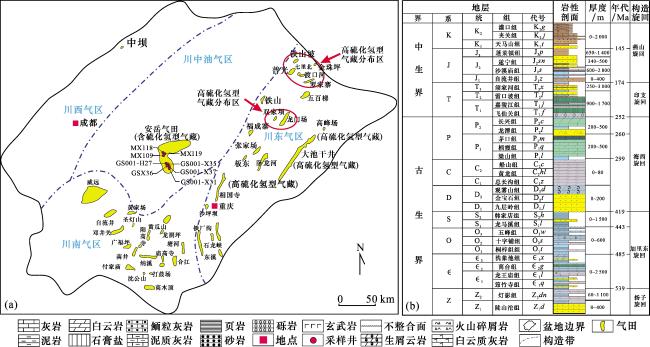
研究表明硫化氢主要来源有以下3种:①生物成因(BSR);②含硫化合物的热裂解(TDS);③热化学硫酸盐还原作用(TSR)17-18,其中 TSR反应是在120 ~180 ℃之间热动力条件下,硫酸盐与烃类发生的氧化还原反应,该过程被广泛认为是高含H₂S(>5%)油气藏形成的重要原因之一1-10。TSR反应通常发生在深层碳酸盐岩储层,尤其是含有硫酸盐矿物(如石膏、硬石膏)的碳酸盐岩储层中。四川盆地在川东—川北地区发现了普光、罗家寨、元坝,在川中地区发现了安岳等大型含硫气田(图1)。不同含硫气藏硫化氢差异性分布及其控制因素近年来受到越来越多学者的关注。一般认为川中安岳气田发生了较低程度的TSR反应19-21,而川东北普光、罗家寨等气田则发生了较高程度的TSR反应1622-23。同为白云岩储层,同样经历深埋高温条件,同样经历古油藏裂解,但川中地区的硫化氢含量显著低于川东北地区,表明二者的TSR反应程度存在显著差异,然而当前针对相关成因机制的系统研究仍然相对薄弱。
图1 四川盆地含硫化氢气田分布(a)及地层综合柱状图(b)(据文献[24-25]修改)

Fig. 1 Distribution of hydrogen sulfide-bearing gas fields (a) and generalized stratigraphic column (b), Sichuan Basin(modified from Refs.[24-25])

本文通过采集安岳气田13口井和收集整理已公开发表文章中的四川盆地川中地区震旦系—寒武系气藏以及川东北二叠系—三叠系气藏79口钻井的天然气地球化学、地层水、沥青元素组成等数据,分析安岳、普光、罗家寨等典型气田硫化氢含量及TSR反应差异机制,以期对高含硫化氢天然气藏的预测和勘探提供理论和技术依据。

1 四川盆地典型含硫气藏地质特征

1.1 川中震旦系—寒武系气藏

德阳—安岳裂陷槽周缘震旦系—寒武系是四川盆地当前勘探热点领域,潜力巨大。安岳气田位于四川盆地中部隆起带轴部高石梯—磨溪地区,烃源岩以德阳—安岳裂陷槽内部下寒武统筇竹寺组为主,震旦系灯影组灯三段为辅,其中筇竹寺组烃源岩主要为泥岩,厚度介于120~150 m之间,有机质丰度高,TOC值介于1.7%~8.49%之间,R O值介于1.84%~3.16%之间26。灯影组三段泥岩在区域内分布稳定,烃源岩厚度在30 m左右,TOC值介于0.5%~4.7%之间,R O值介于3.1%~3.2%之间。上述2套烃源岩目前均已达到过成熟阶段且以腐泥型有机质为主27
寒武系龙王庙组储层岩性主要为砂屑云岩和白云岩,储层厚度为20~70 m,储集空间以粒间溶孔、晶间溶孔为主,孔隙度为4%~5%,渗透率为(1~5)×10-3 μm2[28。震旦系灯影组储层岩性主要为藻凝块云岩、藻叠层石云岩、砂屑云岩等,储层厚度为120~210 m,储集空间以粒间溶孔、晶间溶孔和中小溶洞为主,孔隙度为3%~4%,渗透率为(1~6)×10-3 μm2[28。川中地区筇竹寺组厚层泥岩是灯影组气藏的直接盖层,高台组致密云岩是龙王庙组的直接盖层,同时上覆三叠系嘉陵江组—雷口坡组中厚层膏岩发育,构成多级复合盖层29表1)。
表1 川中震旦系—寒武系与川东北二叠系—三叠系地质特征对比

Table 1 Comparison of geological characteristics between the Sinian-Cambrian reservoirs in central Sichuan and the Permian-Triassic reservoirs in northeastern Sichuan

地区 层位 主要岩性 主要烃源岩 储层厚度/m 孔隙度/% 渗透率/(10-3 μm2 膏盐厚度/m 圈闭类型
川中 寒武系龙王庙组 砂屑云岩、白云岩 筇竹寺组泥岩 20~70 4~5 1~5 不发育膏盐 构造—岩性复合圈闭
震旦系灯影组 藻凝块云岩 筇竹寺组泥岩 120~210 3~4 1~6 不发育膏盐
川东北 二叠系长兴组 生物礁灰岩、白云岩 吴家坪组和龙马溪组泥岩 20~50 5~15 1~2 不发育膏盐
三叠系飞仙关组 白云岩、灰岩 10~80 4~10 1~3 15~30
川中震旦系—寒武系气藏主要为构造—岩性气藏,两者在气藏压力和气体组成上存在较大差异,震旦系气藏的压力系数为1.10~1.12,为常压气藏;而寒武系龙王庙组气藏的压力系数为1.56~1.65,为超压气藏30。油气藏的形成可分为:加里东期、海西期、印支—燕山期和喜马拉雅期这4个阶段31。川中磨溪—高石梯地区一直位于四川盆地中部隆起带轴部,虽历经印支—燕山—喜马拉雅期多期构造演化,地壳应力集中度低,区域构造变形弱,核心区未见贯穿性断裂发育,古今地史保持了较为稳定的构造特征,为古老气藏保存下来提供了稳定构造条件32

1.2 川东北二叠系—三叠系气藏

开江—梁平海槽东侧宣汉、开县地区已经探明多个高含H₂S气田,如渡口河、铁山坡、罗家寨、普光等,平均H₂S含量分别达6%、14%、12%和16%,区域面积约为4 000 km2[5。飞仙关组碳酸盐岩本身几乎不具生烃能力,但上二叠统吴家坪组海槽内部盆地相、深缓坡相的暗色泥岩,以及下伏志留系龙马溪组厚层泥页岩为该气藏提供了主要烃源,上述2套烃源岩目前均已达到过成熟阶段33-34
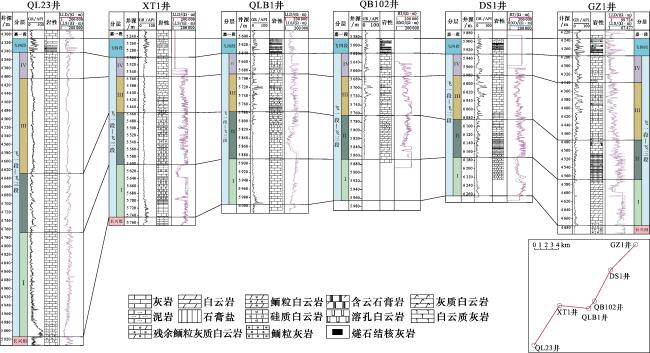
长兴组的生物礁储集层岩性以生物礁灰岩、颗粒灰岩和白云岩为主,储层厚度在20~50 m之间,孔隙度为5%~15%,平均为6.4%,渗透率为(1~2)×10-3 μm2 [35-36。飞仙关组沉积期继承了晚二叠世古地理格局,属于典型蒸发台地相环境,飞仙关组沉积晚期开江—梁平海槽填平补齐,飞仙关组与下伏二叠系长兴组、上覆三叠系嘉陵江组整合接触37,自下而上发育鲕粒溶孔云岩、粉晶鲕粒灰岩以及泥—粉晶灰岩、泥质白云岩,中上部沉积为15~30 m厚的石膏层和白云质膏岩(图2),储层厚度在10~80 m之间,孔隙度为4%~10%,渗透率为(1~3)×10-3 μm2[38,其中飞仙关组中部以鲕粒溶蚀孔洞白云岩为主,构成了H₂S富集的核心储层39。其上方泥质岩与嘉陵江组地层中发育的膏盐岩层,共同构建了优质的区域盖层体系16
图2 川东北地区三叠系飞仙关组QL23井—XT1井—QLB1井—QB102井—DS1井—GZ1井连井剖面

Fig.2 Well correlation profile of Wells QL23-XT1-QLB1-QB102-DS1-GZ1 in the Triassic Feixianguan Formation, northeastern Sichuan Basin

长兴组—飞仙关组气藏主要圈闭类型为构造—岩性复合圈闭和岩性圈闭40-42,其发育受台缘礁滩相、古隆起及断裂系统联合控制。其油气藏的形成可分为:中三叠世原油充注期、侏罗纪—白垩纪原油裂解期和新生代构造抬升调整期3个阶段5

2 四川盆地典型含硫气藏及地层水地球化学特征

2.1 样品采集及测试方法

本文研究在川中震旦系灯影组、寒武系龙王庙组共采集13井次天然气样品,分析测试数据见表2。天然气组分及同位素测试分析均在中国石油勘探开发研究院油气地球化学重点实验室测定,分析流程同文献[43-44]。
表2 川中震旦系—寒武系与川东北二叠系—三叠系典型气藏天然气地球化学组成

​Table 2 Geochemical composition of natural gas from typical reservoirs in the Sinian-Cambrian formations in central Sichuan and the Permian-Triassic formations in northeastern Sichuan

井号 层位 深度/m 主要组分/% δ¹³C/‰ (VPDB) δ2H/‰(V-SMOW) δ³⁴S/‰ (VCDT)

数据

来源

(文献)

CH4 C2H6 C₃H8 CO₂ H₂S N2 He CH4 C₂H6 CO₂ CH4 C₂H6 H₂S
高石001-H27 Z₂dn 5 180~6 550 92.152 0.034 0 4.848 1.760 1.162 0.044 -31.8 -139 本文
高石001-X31 Z₂dn 5 253~6 098 92.211 0.034 0 5.029 1.530 1.140 0.057 -32.6 -143 本文
高石001-X35 Z₂dn 5 217~6 118 92.307 0.032 0 5.051 1.471 1.095 0.043 -31.3 -138 本文
高石001-X37 Z₂dn 5 215~6 147 92.218 0.030 0 5.116 0.547 2.026 0.053 -33.1 -139 本文
高石6 Z₂dn 4 986~5 431 90.913 0.055 0 2.645 5.062 1.281 0.044 -31.7 -133 本文
高石X36 Z₂dn 5 204~6 165 92.153 0.030 0 5.194 0.877 1.691 0.042 本文
磨溪022-X1 Z₂dn 5 527~6 304 92.576 0.048 0 4.871 1.731 0.736 0.039 -33.8 -140 本文
磨溪109 Z₂dn 5 110~5 180 92.420 0.034 0 4.897 1.704 0.888 0.046 -33.7 -29.5 -145 本文
磨溪118 Z₂dn 5 058~5 138 92.348 0.035 0 5.030 1.667 0.845 0.048 -33.7 -30.7 -142 本文
磨溪009-X6 ∈₁l 5 090~6 170 96.65 0.118 0 1.86 0.46 0.87 0.03 -33.2 本文
磨溪119 ∈₁l 5 033~5 123 94.77 0.081 0 3.65 0.68 0.73 0.04 -33.3 -39.0 -142 本文
磨溪204 ∈₁l 4 648~4 752.2 96.82 0.121 0 1.69 0.18 1.10 0.03 -33.4 -138 本文
磨溪204 ∈₁l 4 648~4 752.2 96.99 0.121 0 1.70 0.00 1.11 0.03 -33.4 本文
天然气组分的分析采用HP 6890型气相色谱仪完成。烃类单组分气体使用Plot Al₂O₃(50 m×0.53 mm)毛细柱进行分离,稀有气体的检测通过2根不同的毛细柱分离Plot 5 Å(30 m×0.53 mm)和Plot Q(30 m×0.53 mm)分子筛柱分离。甲烷等主要组分的测定误差小于±1%,而微量组分分析误差通常控制在±5%以内。
天然气碳同位素的测定使用Delta S型GC/C/IRMS同位素质谱仪完成。单个烷烃组分(C₁—C₅)及CO₂采用Plot Q(30 m)色谱柱实现分离。每个样品均重复测定3次。碳同位素测试以VPDB标准为参照,采用δ表示,单位为‰,测定精度优于±0.5‰。
烷烃气氢同位素的测定使用配备Ultra TM色谱系统的MAT 253同位素质谱仪完成。以氦气为载气,采用HP-PLOT Q(30 m×0.32 mm×20 μm)毛细柱,流速保持在1.4 mL/min。氢同位素测试以VSMOW为标准,采用δ表示,单位为‰,测定精度优于±3‰。实验所使用的碳氢同位素标准气NG1(煤成气)与NG3(油型气)均由中国石油勘探开发研究院及国际权威实验室校正43-44
同时,本文还整理汇总了前人已发表文献中普光45、元坝2346-47、罗家寨1648、安岳192849-53等气田共79井次天然气地球化学数据,并用于对比分析。

2.2 天然气地球化学特征

2.2.1 天然气组分

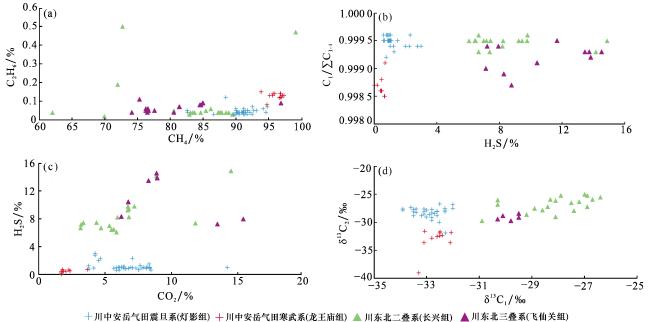
川中震旦系气藏甲烷含量为82.56%~94.80%,平均为90.76%;乙烷含量为0.03%~0.12%,平均为0.045%[图3(a)];干燥系数(C1/C1-4)为0.998 6~0.999 6[图3(b)]。非烃气中CO2含量最高,为3.74%~14.19%,平均为6.73%;H2S含量次之,为0.58%~2.98%,平均为1.19%[图3(c)]。寒武系气藏甲烷含量为93.88%~97.35%,平均为96.12%;乙烷含量为0.08%~0.15%,平均为0.13%;干燥系数为0.998 4~0.999 1。非烃气中CO2含量最高,为1.69%~3.65%,平均为2.13%;H2S含量次之,为0~0.68%,平均为0.42%。安岳气田震旦系灯影组H2S含量高于寒武系龙王庙组。
图3 川中地区震旦系—寒武系与川东北二叠系—三叠系典型气藏天然气组分及碳同位素组成相关图(数据引自文献[1619232845-53])

(a) CH4—C2H6组分相关图;(b) H2S—C1/∑C1-4组分相关图;(c) CO2—H2S组分相关图;(d) δ13C1—δ13C2组分相关图

Fig.3 Crossplot of natural gas compositions and carbon isotope ratios from typical reservoirs in the Sinian-Cambrian formations in central Sichuan and the Permian-Triassic formations in northeastern Sichuan ( data sourced from Refs. [1619232845-53] )

川东北地区二叠系—三叠系气藏甲烷含量为61.98%~99.15%,平均为81.89%;乙烷含量为0.02%~0.50%,平均为0.07%;干燥系数为0.995 0~0.999 6;非烃气中H2S含量最高,为6.06%~14.88%,平均为9.52%;CO2含量次之,为0.07%~22.9%,平均为8.15%。
总体上川中震旦系—寒武系气藏的烷烃气含量要高于川东北地区二叠系—三叠系气藏,而前者的硫化氢含量要显著低于后者(表2)。

2.2.2 烷烃气和二氧化碳碳同位素

川中震旦系气藏甲烷碳同位素值分布范围为-33.9‰~-32.0‰,平均值为-32.9‰;乙烷碳同位素值为-31.9‰~-26.7‰,平均值为-28.3‰;二氧化碳碳同位素值为-9.3‰~7.9‰,平均值为-0.59‰[图3(d)]。寒武系气藏甲烷碳同位素值为-33.4‰~-32.1‰,平均值为-32.8‰;乙烷碳同位素值为-39.0‰~-31.5‰,平均值为-33.4‰;二氧化碳碳同位素值为-2.0‰~3.9‰,平均值为1.9‰。
川东北二叠系—三叠系气藏甲烷碳同位素值分布范围为-31.0‰~-26.4‰,平均值为-28.9‰;乙烷碳同位素值分布区间为-32.1‰~-22.5‰,平均值为-27.0‰;二氧化碳碳同位素值为-8.1‰~4.4‰,平均值为-0.5‰。
总体上川东北二叠系—三叠系气藏δ13C1值要高于川中震旦系—寒武系气藏,前者δ13C2值要明显高于川中寒武系气藏。

2.2.3 甲烷氢同位素

川中震旦系—寒武系气藏甲烷氢同位素值为-145‰~-124‰,平均值为-135‰;川东北二叠系—三叠系气藏甲烷氢同位素值为-156‰~-107‰,平均值为-129‰,川中气藏δ2H1要偏低。
表2 川中震旦系—寒武系与川东北二叠系—三叠系典型气藏天然气地球化学组成(续)

​Table 2 Geochemical composition of natural gas from typical reservoirs in the Sinian-Cambrian formations in central Sichuan and the Permian-Triassic formations in northeastern Sichuan ( continued )

井号 层位 深度/m 主要组分/% δ¹³C/‰ (VPDB) δ2H/‰(V-SMOW) δ34S/‰ (VCDT)

数据

来源

(文献)

CH4 C₂H6 C₃H8 CO₂ H₂S N2 He CH4 C₂H6 CO₂ CH4 C₂H6 H₂S
普光6-1 P₂ch 5 295~5 385 76.17 0.05 0 8.86 14.16 28.1 -29.0 0.3 -145 -102 14.3 45
普光8 P₂ch—T₁f 5 502~5 592 71.96 0.19 0.08 7.23 14.57 -29.6 -30.6 -1.1 -138 -112 15.9 45
普光9 P₂ch 6 110~6 130 72.71 0.5 0.25 11.8 13.68 -30.0 -31.5 -1.3 -138 -99 13.5 45
普光6-2 T₁f 5 030~5 158 76.34 0.05 0 8.87 14.53 -29.5 -28.4 -0.4 -147 -101 14 45
普光7 T₁f 5 484~5 546 76.57 0.06 0 8.93 13.83 -29.8 -29.7 -134 -148 13.4 45
普光7 T₁f 5 571~5 590 76.25 0.06 0 8.91 13.83 -29.5 -29.1 -133 12.4 45
普光5 T₁f 5 141~5 243 77.58 0.05 0 8.26 13.46 -30.1 -28.8 4.4 -139 -84 15.8 45
元坝221 P₃ch 2 6 686~6 720 61.98 0.04 0 22.9 15.06 -29.2 -28.6 -0.4 -156 46
元坝222 P₃ch 2 7 020~7 030 99.15 0.47 0.02 0.07 0.28 -30.9 -29.7 -8.1 -131 -103 46
元坝224 P₃ch 2 6 625~6 636 86.17 0.06 0 4.68 6.67 -28.3 -25.9 -1.0 -129 46
元坝9 P₂ch 6 836~6 857 69.91 0.02 0.01 14.48 14.88 0.7 -28.4 2.5 -107 23
元坝11 P₂ch 6 797~6 917 80.55 0.05 0 11.8 7.37 0.23 -27.9 -25.2 3.3 -114 23
元坝12 T₁f¹⁻² 6 456~6 555 76.48 0.04 0 13.46 7.21 2.81 -27.9 -113 23
元坝12 T₁f¹⁻² 6 692~6 780 74.11 0.04 0 15.4 7.93 2.52 -28.9 2.9 -114 23
元坝10- 1H P₂ch 7 215~7 749 84.64 0.04 6.79 8.24 0.28 -30.3 -26.8 -1.3 22.8 47
元坝10- C1 P₂ch 7 011~7 180 83.09 0.04 6.71 9.77 0.38 -26.9 -27.2 2.2 23.6 47
元坝103H P₂ch 7 047~7 696 83.42 0.04 6.77 9.44 0.32 -27.4 -27.9 2.3 21.7 47
元坝27- 1H P₂ch 6 315~7 468 89.5 0.03 3.14 6.66 0.65 -26.7 -25.9 0.1 20.1 47
元坝29 P₂ch 6 636~6 698 87.31 0.04 5.32 6.99 0.34 -26.9 -25.2 2.2 24.7 47
元坝29- 2H P₂ch 6 994~7 686 87.42 0.04 5.64 6.47 0.44 -28.1 -26.1 1.2 23.7 47
元坝101 - 1H P₂ch 6 969~7 950 82.92 0.03 7.19 9.79 0.06 -28.6 -27.8 -0.1 25.6 22
元坝102 - 2H P₂ch 7 100~7 500 87.68 0.04 5.47 6.43 0.37 -27.5 -26.5 2.8 23.4 22
元坝103 - 1H P₂ch 6 883~7 508 83.71 0.04 6.7 9.23 0.32 -28.9 -27.5 1.5 22.3 22
元坝104 P₂ch 6 700~6 750 85.45 0.05 5.92 8.19 0.39 -28.4 -27.2 -0.6 21.5 22
元坝205 P₂ch 6 448~6 711 87.67 0.04 5.86 6.06 0.36 -27.2 -26.3 1.4 23.3 22
元坝271 P₂ch 6 320~6 370 88.92 0.04 3.19 7.17 0.68 -27.0 -25.0 -1.6 20.5 22
元坝272H P₂ch 6 636~6 699 88.49 0.04 3.36 7.42 0.69 -26.4 -25.5 1.3 19.7 22
元坝273 P₂ch 6 806~6 915 87.88 0.04 4.35 7.43 0.29 -30.3 -26.0 0.6 20.6 22
元坝273 P₂ch 6 806~6 915 87.88 0.04 4.35 7.43 0.29 -30.3 -26.0 0.6 20.6 47
罗家1 T1 f 75.29 0.11 0.06 10.49 3.45 16
罗家2 T1 f 84.68 0.08 0.03 8.77 0.27 16
罗家4 T1 f 84.5 0.08 0 7.13 2.59 16
罗家5 T1 f 76.66 0.05 0 13.74 0.01 16
罗家6 T1 f 84.95 0.09 0 6.21 8.28 0.45 0.02 -30.4 16
罗家9 T1 f 80.52 0.04 0 11.68 0.02 16
罗家7 T1 f 81.37 0.07 0 6.74 10.41 1.34 0.02 -30.3 16
罗家16 T₁f 96.9 0.09 2.53 -30.7 48
罗家6 T₁f 85 0.09 6.21 8.28 0.45 -30.4 48
罗家7 T₁f 81.4 0.07 6.74 10.4 1.34 -30.3 -29.4 48
高石1 Z₂dn 3 5 130~5 196 91.01 0.04 0 7.52 0.64 0.77 0.02 0.4 28
Z₂dn 3 5 130~5 196 91.01 0.04 0 7.52 0.64 0.77 0.02 -0.1 28
Z₂dn 3 5 130~5 196 91.01 0.04 0 7.52 0.64 0.77 0.02 -0.2 28
Z₂dn 3 5 130~5 196 91.01 0.04 0 7.52 0.64 0.77 0.02 -2.0 28
Z₂dn 4 91.22 0.04 6.35 1.04 1.36 0.03 -32.3 -28.1 -137 49
Z₂dn 4 90.11 0.04 8.36 0.95 0.44 0.02 -32.7 -28.4 -135 49
高石1 Z₂dn 2 82.65 0.04 14.19 0.96 2.12 0.04 -32.3 -27.8 -137 49
高石2 Z₂dn 92.14 0.04 6.42 1.07 0.7 0.02 -33.1 -27.6 -139 49
高石3 Z₂dn 90.19 0.04 8.3 1.48 0.73 0.06 -33.1 -28.1 -138 49
表2 川中震旦系—寒武系与川东北二叠系—三叠系典型气藏天然气地球化学组成(续)

​Table 2 Geochemical composition of natural gas from typical reservoirs in the Sinian-Cambrian formations in central Sichuan and the Permian-Triassic formations in northeastern Sichuan ( continued )

井号 层位 深度/m 主要组分/% δ¹³C/‰ (VPDB) δ2H/‰(V-SMOW) δ34S/‰ (VCDT)

数据

来源

(文献)

CH4 C₂H6 C₃H8 CO₂ H₂S N2 He CH4 C₂H6 CO₂ CH4 C₂H6 H₂S
高石6 Z₂dn² 86.62 0.03 7.05 2.29 4.56 0.11 -32.6 -28.0 -149 49
Z₂dn 90.12 0.04 8.36 0.97 0.81 0.02 -33.0 -27.8 -139 49
Z₂dn 90.29 0.04 8.38 0.85 0.8 0.02 -32.9 -28.6 -139 49
Z₂dn² 94.61 0.04 4.14 0.88 0.93 0.02 -32.8 -29.1 -140 49
高石9 Z₂dn² 5 504~5 871 91.4 0.04 0 5.65 0.85 2 0.05 -32.0 -27.5 -152 50
高石9 Z₂dn 5 090~5 188 90.41 0.04 0 7.77 0.88 0.85 0.03 -33.1 -28.5 -134 50
高石6 Z₂dn 4 958~5 210 90.93 0.04 0.01 7.91 1 0.09 0.03 -32.6 -28.8 -137 50
高石18 Z₂dn 5 150 92.15 0.04 0 6.04 0.6 1.1 0.03 -32.8 -29.6 -144 50
高石122 Z₂dn 5 556~6 579 90.59 0.04 0 8.45 0.59 0.3 0.02 -32.5 -26.7 -134 50
高石8 Z₂dn 92.49 0.03 5.85 0.58 0.92 0.02 -32.8 -27.7 -144 19
Z₂dn 91.49 0.04 6.75 0.85 0.73 0.02 -33.2 -28.8 -136 19
高石9 Z₂dn 91.71 0.03 6.55 0.77 0.63 0.03 -33.5 -27.7 -136 19
Z₂dn² 91.21 0.03 6.41 0.80 1.72 0.04 -33.6 -27.3 -146 19
高石9 Z₂dn 89.63 0.03 8.09 0.82 0.67 0.02 -33.5 -28.1 -142 19
高石10 Z₂dn 90.04 0.03 8.15 1.04 0.81 0.02 -33.4 -28.2 -144 19
高石3 Z₂dn² 91.37 0.03 6.88 0.99 0.67 0.01 -33.4 -27.6 -142 19
磨溪11 Z₂dn 4 5 445~5 486 90.49 0.03 0.01 7.05 0.91 1.45 0.05 0.5 28
磨溪11 Z₂dn 4 5 445~5 486 90.49 0.03 0.01 7.05 0.91 1.45 0.05 0.3 28
磨溪8 Z₂dn 2 5 422~5 459 91.4 0.04 0 5.87 0.96 1.66 0.05 0.6 28
磨溪8 Z₂dn 2 5 422~5 459 91.42 0.04 0 6.01 2.46 0.1 28
磨溪8 Z₂dn 2 5 422~5 459 90.88 0.04 0 6.23 1.03 1.76 0.06 0.6 28
磨溪8 Z₂dn 2 5 422~5 459 90.88 0.04 0 6.23 1.03 1.76 0.06 -4.1 28
磨溪8 Z₂dn 4 5 102~5 172 91.12 0.04 0 6.07 0.96 1.72 0.05 -0.6 28
磨溪9 Z₂dn 2 5 423~5 459 91.82 0.05 0 4.24 2.75 0.96 0.02 -2.0 28
磨溪9 Z₂dn 2 5 423~5 459 91.82 0.05 0 4.24 2.75 0.96 0.02 -1.6 28
磨溪9 Z₂dn 2 5 423~5 459 91.82 0.05 0 4.24 2.75 0.96 0.02 -1.4 28
磨溪146 Z₂dn 5 409~6 169 90.01 0.06 7.63 1.26 0.94 0.03 -7.1 51
磨溪126 Z₂dn 5 260~6 353 88.46 0.12 10.8 0.47 0.02 -1.2 51
磨溪131 Z₂dn 5 387~6 310 82.56 0.05 9.32 4.1 0.16 -7.7 51
磨溪130 Z₂dn 5 446~6 650 94.8 0.07 3.78 0.75 0.51 0.02 -9.3 51
磨溪157 Z₂dn 5 451~6 892 90.06 0.05 3.74 1.22 4.87 0.08 -6.2 51
磨溪008-H8 ∈₁l 95.59 0.13 2.07 1.58 -32.1 -31.8 3.7 -129 -94 52
磨溪116 ∈₁l 93.88 0.15 2.21 3.24 -33.1 -31.6 3.9 -133 -139 52
磨溪009-8-X1 ∈₁l 95.69 0.14 1.69 2.14 -32.5 -31.7 -2.0 -124 -79 52
磨溪102 ∈₁l 95.95 0.14 2.02 1.43 -32.5 -31.9 3.6 -133 -96 52
磨溪22 Z₂dn 92.53 0.07 5.38 1.21 -32.3 -31.9 7.7 -128 -148 52
磨溪105 Z₂dn 91.42 0.05 5.72 2.02 -32.5 -30.0 7.5 -133 -97 52
磨溪022-X1 Z₂dn 94.19 0.06 4.85 0.72 -32.6 -28.1 4.6 -133 -103 52
磨溪108 Z₂dn 91.22 0.06 5.15 2.38 -33.0 -29.0 7.9 -127 -83 52
磨溪8 ∈₁l 1-∈l 96.8 0.14 2.26 0.63 0.6 0.01 -32.4 -32.3 -133 53
∈₁l2-∈l 96.85 0.14 1.78 0.65 0.6 0.01 -33.1 -33.6 -134 53
Z₂dn 91.4 0.04 5.87 0.97 1.65 0.05 -32.8 -28.3 -147 53
Z₂dn² 91.42 0.04 6.01 0.99 2.46 0.05 -32.3 -27.5 -147 53
磨溪9 l 95.16 0.13 2.35 0.47 2.35 0.01 -32.8 -32.8 -134 53
Z₂dn² 91.82 0.05 4.24 2.98 0.96 0.02 -33.5 -28.8 -141 53
磨溪10 l 97.35 0.13 1.8 0.39 0.69 0.02 -32.1 -33.6 -134 53
Z₂dn² 93.13 0.05 4.64 2.24 0.86 0.02 -33.9 -27.8 -139 53
磨溪11 ∈₁l 1-∈l 97.09 0.13 2.04 0.43 0.67 0.01 -32.5 -32.4 -133 53
∈₁l 2-∈l 97.12 0.13 1.69 0.44 0.65 0.01 -32.6 -32.5 -132 53
Z₂dn 92.75 0.05 4.49 1.98 0.88 0.02 -33.9 -27.6 -138 53
Z₂dn² 89.87 0.03 7.32 0.88 2.32 0.05 -32 -26.8 -150 53

注:“—”代表无数据

3 不同气藏硫化氢来源与TSR反应强度

3.1 硫同位素证据

川中震旦系—寒武系气藏以及川东北二叠系—三叠系气藏中均存在一定丰度的H2S。川中地区H2S含量为0~2.98%,平均为1.11%,川东北地区H2S含量在6.06%~14.88%之间,平均为9.52%(表2)。
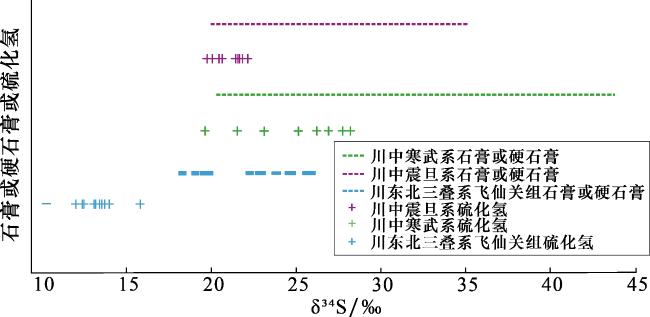
目前多数学者认为硫化氢来源主要有以下3种:①生物成因(BSR),②含硫化合物的热裂解(TDS)以及③热化学硫酸盐还原作用(TSR)17-18。BSR通常在浅层、温度低于80 ℃的环境中发生,而研究区地层埋藏较深,不利于BSR反应的发生且所形成的H2S难以保存下来。有机质裂解产生的H₂S丰度往往较低,一般不超过1%21,而研究区大多天然气H2S含量都超过了1%19。川中震旦系—寒武系气藏H2S的δ³⁴S值介于19.6‰~28.2‰之间,与硬石膏的δ³⁴S差值较小(图4),即H₂S与同层系蒸发岩之间的硫同位素分馏程度较弱,反映气藏经历了较弱的TSR蚀变54-60。而三叠系飞仙关组硬石膏的δ³⁴S值介于18.1‰~25.8‰之间,气藏H₂S的δ³⁴S值则比硬石膏低10.3‰~13.7‰,即H₂S与同层系蒸发岩之间的硫同位素分馏程度较强,反映气藏经历了较强的TSR蚀变。且两地H₂S的δ³⁴S值都较高(>10‰),为典型的无机来源特征28,表明两地H2S应以TSR反应来源为主。
图4 川中震旦系—寒武系与川东北二叠系—三叠系H₂S与石膏或硬石膏硫同位素组成对比图(数据引自文献[26284161])

Fig.4 Comparative sulfur isotopic compositions of H₂S and gypsum or anhydrite from the Sinian-Cambrian formations in central Sichuan and the Permian-Triassic formations in northeastern Sichuan ( data sourced from Refs.[26284161] )

3.2 沥青元素证据

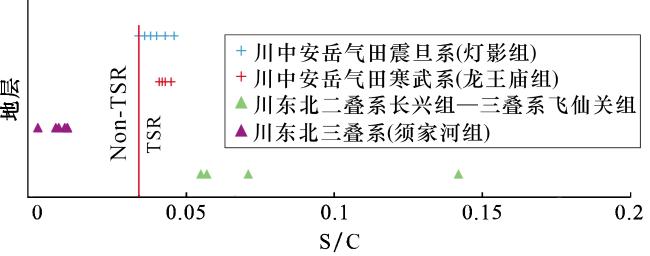
储层沥青的高S/C原子比值通常是发生TSR作用的重要证据62,热裂解成因固体沥青的S/C值常低于0.03463。川东北须家河组储层中的沥青通常呈现极低的S/C值(0.005~0.01)。若储层经历过TSR作用,无机硫的加入将导致该比值显著上升(图5)。川东北二叠系飞仙关组—三叠系长兴组储层沥青S/C值普遍偏高,介于0.055~0.142之间(表3)。川中震旦系—寒武系储层沥青S/C值介于0.034~0.046之间,高于有机质或原油热裂解的S/C值(0.034),反映古油藏遭受了TSR作用的影响,且川东北地区所受TSR反应较强。
图5 川中震旦系—寒武系与川东北二叠系—三叠系储层沥青S/C相关图(数据引自文献[23254-55])

Fig.5 Cross-plot of sulfur-to-carbon (S/C) ratios of reservoir asphalts from the Sinian-Cambrian formations in central Sichuan, and the Permian-Triassic formations in northeastern Sichuan(data sourced from Refs.[23254-55])

表3 川中震旦系—寒武系与川东北二叠系—三叠系沥青有机元素组成

​ Table 3 Organic elemental composition of asphalts from the Sinian-Cambrian formations in the central Sichuan and the Permian-Triassic formations in northeastern Sichuan

井号 层位 深度/m 岩性 N/% C/% H/% S/% S/C 数据来源(文献)
元坝102 P₂ch 6 776 沥青 0.93 47.52 2 17.99 0.142 55
元坝2 P₂ch 6 554 沥青 1.51 76.94 2.42 11.37 0.055 55
元坝2 P₂ch 6 588 沥青 1.15 74.77 2.42 11.34 0.057 55
元坝9 P₂ch 6 930 沥青 1.09 76.42 1.64 14.48 0.071 55
普光6 P₂ch 5 306 沥青 0.85 66.32 1.17 11.75 0.066 2
普光6 P₂ch 5 329 沥青 0.61 60.21 0.69 11.75 0.073 2
毛坝3 T₁f 4 380 沥青 1.1 59.62 0.91 11.99 0.075 2
元坝204 T₃x 4 634 沥青 0.61 84.75 3.64 1.46 0.006 55
元坝4 T₃x 4 776 沥青 0.44 81.16 3.82 1.42 0.007 55
元坝16 T₃x 4 640 沥青 0.62 81.43 4.23 1.95 0.009 55
官5 T₃x 2 680 沥青 1.4 85.43 4.36 2.28 0.01 54
毛坝3 T₃x 2 135 沥青 1.31 89.5 4.06 1.46 0.01 54
普光1 T₃x 3 435 沥青 1.29 82.76 3.52 1.55 0.01 54
普光2 T₃x 3 408 沥青 1.07 80.18 3.81 1.06 0 54
普光2 T₃x 3 027 沥青 1 58.4 2.18 1.15 0.01 54
磨溪12-8 ∈₁l 4 629 沥青 0.045 32
磨溪13-3 ∈₁l 4 581~4 581 沥青 0.042 32
磨溪23-4 ∈₁l 4 803 沥青 0.043 32
磨溪26-5 ∈₁l 4 924~4 924 沥青 0.041 32
磨溪3-15 ∈₁l 4 669~4 669 沥青 0.041 32
磨溪205-4 ∈₁l 4 600 沥青 0.045 32
磨溪9-10 Z₂dn 5 033~5 033 沥青 0.04 32
磨溪9-11 Z₂dn 5 045~5 046 沥青 0.038 32
磨溪9-23 Z₂dn³ 5 316~5 316 沥青 0.043 32
磨溪9-29 Z₂dn³ 5 318 沥青 0.036 32
磨溪9-44 Z₂dn² 5 443~5 443 沥青 0.046 32
高石18-2 Z₂dn 5 135~5 135 沥青 0.034 32

注:“—”代表无数据

3.3 TSR反应程度

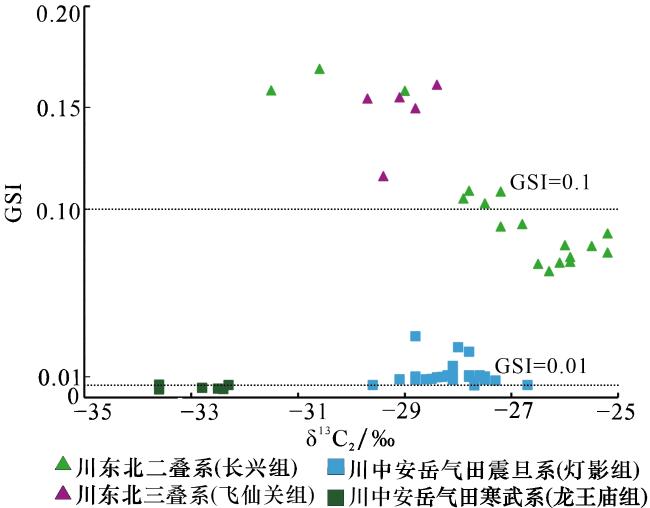
天然气酸性系数[GSI=H2S/(H2S+CnH2n+2)]是指示TSR反应程度的良好指标60。当GSI值约为0.01时,一般被视为TSR反应启动的临界点;指数介于0.01~0.10之间说明反应尚处于初期阶段,而若超过0.10则表明气藏TSR反应进入高级阶段1764-65。川中震旦系—寒武系气藏与川东北二叠系—三叠系气藏硫化氢含量的高低差异反映出TSR反应强度存在显著区别(图6)。川中震旦系—寒武系气藏GSI值范围为0~0.031,平均值为0.012,表明气藏TSR反应强度比较低。川东北二叠系—三叠系气藏GSI值范围为0.064~0.168,平均值为0.107,是川中地区的9倍,指示川东北地区发生了较强烈的TSR反应。​
图6 川中震旦系—寒武系与川东北二叠系—三叠系天然气气体酸性指数(GSI)与δ13C2对比图(数据引自文献[1619233045-53])

Fig.6 Crossplot of Gas Sourness Index (GSI) versus δ¹³C₂ of natural gas from the Sinian-Cambrian formations in central Sichuan, and the Permian-Triassic formations in northeastern Sichuan (data sourced from Refs.[1619232845-53])

乙烷碳同位素组成会随着TSR反应程度增加逐渐变重2565。东岳寨气田长兴组—飞仙关组天然气δ13C2均值为-31.9‰66,遭受强烈TSR反应的普光气田长兴组—飞仙关组天然气δ13C2均值为-27.0‰,相对于前者,δ13C2值增高幅度达4.9‰[图3(b)]。而川中地区震旦系灯影组与寒武系龙王庙组气源存在部分差异导致δ¹³C₂存在差异67-69,龙王庙组天然气来源于干酪根同位素值偏低的筇竹寺组泥岩(-30.0‰~-36.4‰,平均为-33.5‰),而灯影组天然气除了主要来源于筇竹寺组泥岩以外,部分混有干酪根碳同位素值较高的灯三段烃源岩(-33.4‰~-28.5‰,平均为-32.0‰)贡献。同时从GSI值对比来看,震旦系灯影组经历的TSR反应程度要稍高于寒武系,因此气源差异和TSR作用共同作用下导致灯影组乙烷碳同位素值要普遍高于寒武系,其δ13C2值增高幅度达4.5‰。

4 硫化氢差异性分布成因

4.1 烃类供给能力

川东北二叠系吴家坪—大隆组深水陆棚相黑色泥页岩在早侏罗世达到生油高峰,大规模古油藏在台缘鲕滩—礁体储层聚集并被膏盐封盖,原始油柱高度常逾150 m58。此后深埋 > 4 km、140~180 °C的热演化史促使古油藏裂解,使储层持续获得烃类供给。吴家坪组生气强度达(20 ~40)×108 m3/km2,为高强度TSR提供充裕还原剂70。川中震旦系—寒武系气藏的烃源岩主要为下寒武统筇竹寺组页岩,烃源岩热演化程度高、生烃强度达(20~200)×108 m3/km2[71。由此可见,川中震旦系—寒武系及川东北二叠系—三叠系气藏均具备良好的供烃条件,TSR反应所需还原剂充足。因此,供烃能力不是影响川中震旦系—寒武系和川东北二叠系—三叠系TSR反应程度的主要原因。

4.2 油气成藏演化

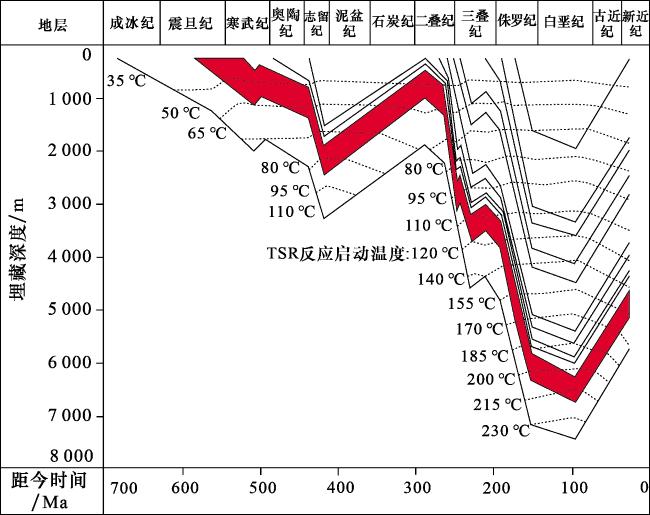
从震旦纪晚期至早寒武世,高石梯—磨溪地区处于沉积古地貌高带,灯影组藻丘相白云岩发育,优质白云岩储集体环绕古裂陷槽两侧呈带状分布72,灯二末期及灯四末期2幕桐湾运动形成灯影组二段和灯影组四段2套大面积岩溶储层。下寒武统烃源岩在晚二叠世—中三叠世达到生油高峰,油气开始向古隆起高部位和上斜坡带运移,形成大型古油藏。四川盆地在印支—燕山—喜马拉雅多幕构造作用下,经历了快速沉降与高热流期73-74。深井热史研究表明75,中侏罗世至早白垩世期间,盆地埋深普遍增加至7 000~9 000 m,对应温度超过200 ℃2876,为TSR反应提供了长期稳定的热力学条件。这与本文所述的川中震旦系—寒武系古油藏在高温下裂解并伴生TSR的时间窗口高度吻合77,古油藏在此过程中规模裂解产生大量天然气,并形成古气藏(图7)。较高的储层温度引起了TSR作用,并生成大量硫化氢。从晚白垩世开始,盆地抬升剥蚀,储层温度降低,TSR反应减弱并逐渐停止78,因此H2S主要形成于侏罗纪—早白垩世。
图7 川中震旦系—寒武系埋藏史和热演化史(据文献[77]修改)

Fig.7 Burial and thermal evolution history of the Sinian-Cambrian formations, central Sichuan(modified from Ref.[77])

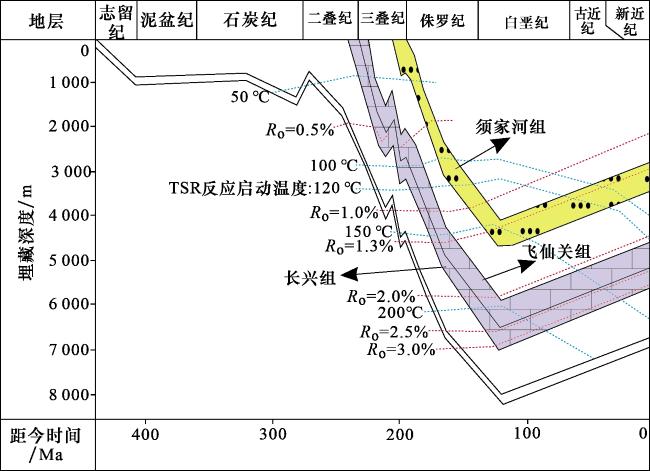
四川盆地东北部经历了复杂的构造历史,先后受到加里东—海西、印支—早燕山、晚燕山—喜马拉雅等造山运动的影响,其中燕山—喜马拉雅构造运动的侧向挤压作用最为强烈79,形成了多条褶皱带80和飞仙关组硬石膏层内的逆冲断层81。最新的源岩热演化模拟显示82,四川盆地东部二叠系—三叠系烃源岩在中侏罗世—早白垩世普遍进入高熟—过熟阶段83,长兴组—飞仙关组储层温度达到150 ℃开始发生TSR反应并且在此之后埋深与地温持续增加84,该阶段是主要的天然气生成阶段与TSR反应的动力学条件(>120 ℃)完全重叠(图8表4),因此在盆地快速沉降深埋的阶段,TSR反应发生并大量生成H₂S85
图8 四川盆地川东北气区普光2井埋藏史和热演化史(据文献[2]修改)

Fig.8 Burial and thermal evolution history of Well PG2 in the northeastern Sichuan Basin(modified from Ref.[2])

表4 川中震旦系—寒武系与川东北二叠系—三叠系地层水离子组成与天然气酸性系数(GSI)

​Table 4 Ion composition of formation water and natural gas souring index (GSI) from the Sinian-Cambrian formations in the central Sichuan and the Permian-Triassic formations in northeastern Sichuan

井号 层位 深度/m 离子含量/(mg/L) GSI 水型 数据来源
K⁺+Na⁺ Ca²⁺ Mg²⁺ Cl⁻ SO₄²⁻
普光5 T₁f 4 830~4 868 1.3 16.1 0.6 31.4 1 0.053 CaCl₂ 282
龙岗001-6 T₁f 6 090~6 130 11.654 7.774 3.599 42.37 0.449 0.02 CaCl₂ 79
龙岗6 P₃ch 5 111~5 189 7.579 25.308 5.314 73.724 0.604 0.037 CaCl₂ 79
元坝1 P₃ch 7 081 2.8 54.9 2.8 116.3 0.6 0.2 CaCl₂ 2380
元坝2 P₃ch 6 677 13.1 42.9 1.7 106 0.6 0.05 CaCl₂ 8084
元坝16 P₃ch 6 950~6 974 19.8 12.16 0.6 31.3 0.6 0.125 CaCl₂ 8083
高石1 Z₂dn 4 4 956~5 130 5.949 11.451 5.301 54.68 0 0.01 CaCl₂ 28
高石6 Z₂dn 2 5 334~5 431 21.354 7.302 2.552 49.785 0 0.002 CaCl₂ 28
高石11 Z₂dn₂ 5 402~5 467 15,451 10,985 5763 42,534 0 0.008 CaCl₂ 28
高石18 Z₂dn 4 5 117~5 205 12.523 9.073 5.394 62.645 0 0.006 CaCl₂ 28
磨溪8 Z₂dn 2 5 422~5 459 1.204 3.681 1.742 49.045 0 0.011 CaCl₂ 28
磨溪8 Z₂dn 2 5 102~5 172 5.7 27.205 16.748 73.517 0 0.01 CaCl₂ 28
综合对比川中震旦系—寒武系与川东北二叠系—三叠系的埋深—温度演化曲线可知,两区均经历“侏罗纪—早白垩世快速沉降深埋—长期高温—中晚白垩世抬升冷却”的三段式热史86:前者在侏罗纪埋深达到7 000~9 000 m、储层温度>200 ℃,灯影组气藏段亦长期保持≥140 ℃;后者自165 Ma起温度已达150 ℃,其后持续升至170~190 ℃,高温时窗均在25~35 Ma之间,显著超过TSR反应所需的120~150 ℃阈值和动力学时限87。这表明,两区的热力演化条件同样满足H₂S生成的热力学与动力学要求,因而地层温度并非造成硫化氢含量差异的主控因素。

4.3 硫酸盐来源与供给差异

由于TSR反应是烃类与硫酸盐中SO₄²⁻发生的反应,其反应程度受地层水硫酸根浓度控制,因此多集中于富含膏盐岩的沉积体系。
川东北地区飞仙关组气藏储层中发育的硬石膏层或结核,为TSR反应的进行提供了充足的硫酸盐来源。然而川东北二叠系长兴组与川中震旦系灯影组—寒武系龙王庙组地层中并无类似于飞仙关组蒸发台地相沉积的膏岩层或硬石膏结核发育2488。研究表明,长兴组H₂S主要为TSR反应作用的产物,且主要为原地生成,而非来自飞仙关组或其他层位的“倒灌”迁移1561,碳酸盐矿物中晶格硫酸盐(CAS)可以为TSR提供反应物来源89,川东北长兴组白云岩样品CAS含量介于(90~263)×10-6之间,平均为193×10-6,生物灰岩CAS含量为1 035×10-6[57;川中震旦系灯影组—寒武系龙王庙组白云岩样品CAS含量介于(35.6~208.1)×10-6之间,平均为93.4×10⁻⁶,灰岩样品的CAS含量介于(76~549)×10-6之间,平均为286.4×10⁻⁶[90表5)。灰岩与白云岩中CAS 含量所存在的这种显著差异,或许反映了灰岩在白云岩化过程中释放出了大量硫酸盐,为成岩后期TSR的发生提供硫源15。而川中震旦系灯影组—寒武系龙王庙组灰岩与白云岩CAS含量差值较低,表明白云岩化过程所释放的硫酸盐供给不足可能是其TSR反应程度较低的一个重要原因。
表5 川中震旦系—寒武系与川东北二叠系—三叠系灰岩和白云岩晶格硫酸盐含量

Table 5 Carbonate-associated sulfate contents of bulk limestone and dolomite from the Sinian-Cambrian of Central Sichuan and the Permian-Triassic of northeastern Sichuan

样品编号 层位 深度/m 岩性 SO4 2-含量/10-6 数据来源
盘龙-10 P₃ch 细晶白云岩 218.3 15
盘龙-33 P₃ch 细晶白云岩 90.1 15
盘龙-40 P₃ch 细晶白云岩 202.2 15
盘龙-62 P₃ch 泥晶白云岩 262.9 15
盘龙-13 P₃ch 生物碎屑灰岩 1 034.5 15
磨溪13-10 ∈₁l 4 590 粉晶白云岩 14.2 80
磨溪13-18 ∈₁l 4 629 粉晶白云岩 17.5 80
高石18-3 Z₂dn 5 139 泥晶白云岩 63.8 80
高石18-15 Z₂dn 5 209 泥晶白云岩 66.1 80
高石1-37 Z₂dn³ 5 179 藻白云岩 35.6 80
高石1-45 Z₂dn³ 5 357 泥质白云岩 208.1 80
Y20 石板滩段 细晶石灰岩 331 82
Y23 石板滩段 细晶石灰岩 549 82
Y24 石板滩段 细晶石灰岩 104 82
Y28 石板滩段 细晶石灰岩 189 82
Y31 石板滩段 细晶石灰岩 266 82
Y38 石板滩段 细晶石灰岩 371 82
Y41 石板滩段 细晶石灰岩 405 82
Y44 石板滩段 细晶石灰岩 76 82

4.4 地层水SO4 2-和H2S分布规律

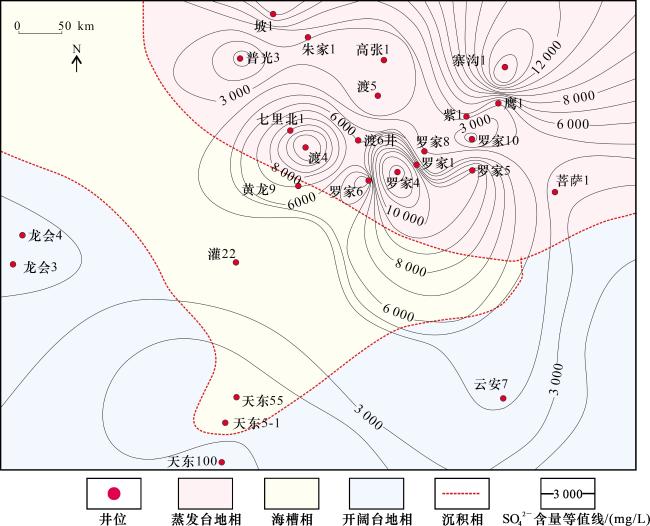
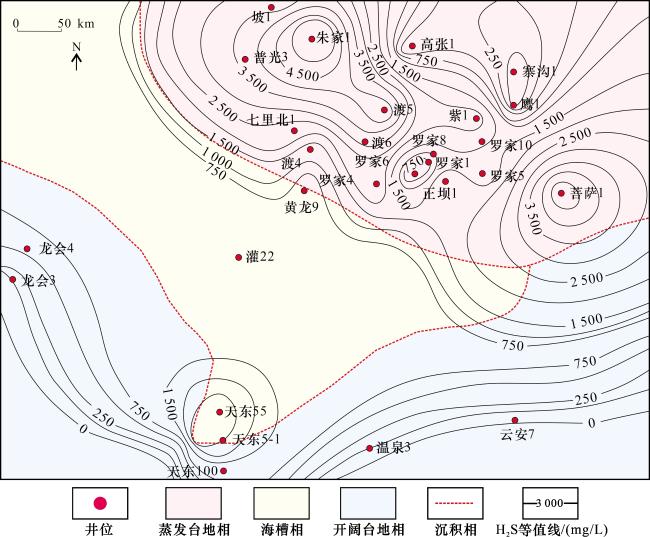
从地层水中SO₄²⁻以及气藏中H₂S的质量浓度分布来看(图9图10),川东北地区高H₂S含量气藏多分布于SO₄²⁻富集的地层区,两者在空间上呈高度一致性。高含H₂S气藏主要集中于海槽东缘的蒸发台地相,该区域不仅SO₄²⁻含量较高,气藏中H₂S含量也显著偏高;海槽相及其西侧开阔台地相则表现为SO₄²⁻浓度偏低,H₂S含量亦随之降低。这种空间对应关系表明,硫酸根离子的分布在很大程度上控制了油气藏内H₂S的生成与富集。
图9 四川盆地川东北飞仙关组地层水SO₄²⁻含量等值线 (据文献[91]修改)

Fig.9 Contour of SO₄²⁻ concentrations in formation water from the Feixianguan Formation in northeastern Sichuan(modified from Ref.[91])

图10 四川盆地川东北飞仙关组地层水H₂S含量等值线(据文献[91]修改)

Fig.10 Contour map of H₂S concentrations in formation water from the Feixianguan Formation in the northeastern Sichuan Basin ( modified from Ref.[91])

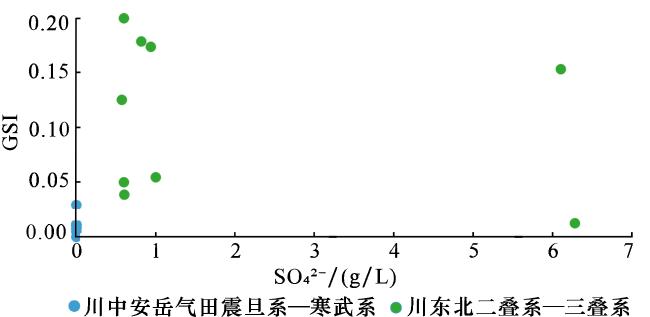
同时,对比川中与川东北2个地区出水井段地层水SO₄²⁻离子浓度发现,川中安岳气田震旦系—寒武系地层水中基本检测不到SO₄²⁻,同时川东北二叠系—三叠系气藏SO₄²⁻浓度与GSI普遍偏高(表4图11)。川中地区中SO₄²⁻耗尽可能是其TSR反应中断重要原因。因此,川中地区TSR反应程度受到地层水中硫酸根离子含量的制约,SO₄²⁻离子耗尽,导致TSR反应中断,故未能生成更高浓度的H2S。
图11 川中震旦系—寒武系与川东北二叠系—三叠系典型气藏地层水SO₄²⁻离子浓度与气体酸性指数(GSI)对比图(数据引自文献[2232891-97])

Fig.11 Crossplot of formation SO₄²⁻ ion concentrations and Gas Sourness Index(GSI) in representative gas reservoirs from the Sinian-Cambrian formations,central Sichuan,and the Permian-Triassic formations in northeastern Sichuan(data sourced from Refs.[2232891-97])

5 结论

通过对川中震旦系灯影组—寒武系龙王庙组与川东北二叠系长兴组—三叠系飞仙关组典型含硫气藏天然气组分、碳氢同位素、硫同位素、储层沥青元素、供烃能力、埋藏史和热演化史、地层水硫酸根离子浓度等综合分析,取得结论如下:
(1)川中地区H2S分布区间为0%~2.98%,平均为1.11%;川东北地区H2S分布区间为6.06%~14.88%,平均达9.52%,川东北地区硫化氢含量显著高于川中地区。
(2)川中震旦系—寒武系和川东北二叠系—三叠系H₂S与石膏或硬石膏硫同位素以及沥青元素组成均指示其H2S主要为TSR成因;同时,GSI指数表明川中TSR反应程度较低,川东北较高。
(3)川东北地区二叠系—三叠系储层中发育的硬石膏层或结核以及足量的CAS为TSR反应提供了充足的硫酸盐来源,川中地区震旦系—寒武系膏盐岩不发育及较低的CAS含量导致其硫酸盐供给不足,最终表现为地层水中硫酸根离子的悬殊差异。川中地区TSR反应过程中SO₄²⁻离子耗尽,导致反应中断,未能生成更高浓度的H2S。因此,地层水中SO₄²⁻浓度差异是造成2个地区H2S含量差异的主要原因。
[1]
TORGHABEH A K, KALANTARIASL A, GHORBANI M R, et al. Multivariate thermochemical sulphate reduction (TSR) low temperature origin for H2S production: A fars Provenance gas field[J].Journal of Natural Gas Science and Engineering, 2021, 88: 103795.

[2]
HAO F,GUO T,ZHU G Y,et al. Evidence for multiple stages of oil cracking and thermochemical sulfate reduction in the Puguang Gas Field, Sichuan Basin,China[J].AAPG Bulletin, 2008, 92(5): 611-637.

[3]
LIU Y,ZHANG C M,DING K,et al. Thermochemical sulfate reduction by pyrobitumen:Review and experiments[J].ACS Earth and Space Chemistry, 2022,6(2): 308-321.

[4]
WANG R Y, LU L B, CHEN J, et al. Combining experiment and density functional theory to study the mechanism of thermochemical sulfate reduction by hydrogen in supercritical water[J]. Journal of Molecular Liquids, 2021, 330: 115654.

[5]
朱光有, 张水昌, 梁英波, 等. 四川盆地高含H2S天然气的分布与TSR成因证据[J]. 地质学报,2006,80(8):1208-1218.

ZHU G Y, ZHANG S C, LIANG Y B, et al. Distribution of high H2S-bearing natural gas and evidence of TSR origin in the Sichuan Basin[J]. Acta Geologica Sinica, 2006, 80(8): 1208-1218.

[6]
ZHANG S C, YAN S H, HUANG K, et al. Research on the initiation mechanism of thermo chemical sulfate reduction(TSR)[J]. Acta Petrologica Sinica, 2012, 28(3): 739-748.

[7]
KING H E,WALTERS C C,HORN W C,et al.Sulfur isotope analysis of bitumen and pyrite associated with thermal sulfate reduction in reservoir carbonates at the Big Piney-La Barge production complex[J].Geochimica et Cosmochimica Acta,2014,134: 210-220.

[8]
GUO H J, LIU M, WANG Y P, et al. Characterization of chemical and carbon isotopic compositions of gases during thermochemical sulfate reduction and implications for gas origin and content[J]. Scientific Reports, 2022, 12(1): 9118.

[9]
YANG C, HUTCHEON I, KROUSE H R. Fluid inclusion and stable isotopic studies of thermochemical sulphate reduction from Burnt Timber and Crossfield East gas fields in Alberta,Canada[J].Bulletin of Canadian Petroleum Geology,2001, 49(1): 149-164.

[10]
ZHANG H, CHEN Y, WANG M, et al. Thermal evolution differences of reservoir bitumen and their implications: A case study of the Moxi area in the central Sichuan Basin[J]. Marine and Petroleum Geology, 2024, 169: 107039.

[11]
WORDEN R H, SMALLEY P C, CROSS M M. The influence of rock fabric and mineralogy on thermochemical sulfate reduction: Khuff Formation, Abu Dhabi[J].Journal of Sedimentary Research, 2000, 70(5): 1210-1221.

[12]
CARRIGAN W J, JONES P J, TOBEY M H, et al. Geochemical variations among eastern Saudi Arabian Paleozoic condensates related to different source kitchen areas[J]. Organic Geochemistry, 1998, 29(1-3): 785-798.

[13]
刘强, 鲁雪松, 范俊佳, 等. 四川盆地震旦系气藏TSR证据及控制因素[J]. 天然气地球科学, 2022, 33(6): 929-943.

LIU Q, LU X S, FAN J J, et al. Evidence and controlling factors of thermochemical sulfate reduction in the Sinian gas reservoirs,Sichuan Basin[J].Natural Gas Geoscience,2022,33(6): 929-943.

[14]
CAI C F, LI H X, LI K K, et al. Thermochemical sulfate reduction in sedimentary basins and beyond:A review[J].Chemical Geology, 2022, 607: 121018.

[15]
LI K K, CAI C F, HOU D J, et al. Origin of high H2S concentrations in the Upper Permian Changxing reservoirs of the Northeast Sichuan Basin,China[J].Marine and Petroleum Geology, 2014, 57: 233-243.

[16]
ZHU G Y,ZHANG S C,LIANG Y B,et al. Isotopic evidence of TSR origin for natural gas bearing high H2S contents within the Feixianguan Formation of the northeastern Sichuan Basin,southwestern China[J].Science in China(Series D:Earth Sciences), 2005, 48: 1960-1971.

[17]
LIU Q Y, WORDEN R H, JIN Z J, et al. TSR versus non-TSR processes and their impact on gas geochemistry and carbon stable isotopes in Carboniferous, Permian and Lower Triassic marine carbonate gas reservoirs in the Eastern Sichuan Basin,China[J].Geochimica et Cosmochimica Acta,2013,100: 96-115.

[18]
ZHU G Y XIE Z Y. Methane-dominated thermochemical sulphate reduction in the Triassic Feixianguan Formation east Sichuan Basin, China: Towards prediction of fatal H2S concentrations[J].Marine and Petroleum Geology, 2004, 21(10): 1265-1279.

[19]
魏国齐, 谢增业, 宋家荣, 等. 四川盆地川中古隆起震旦系—寒武系天然气特征及成因[J]. 石油勘探与开发, 2015, 42(6): 702-711.

WEI G Q, XIE Z Y, SONG J R, et al. Features and origin of natural gas in the Sinian-Cambrian of central Sichuan paleo-uplift, Sichuan Basin, SW China[J]. Petroleum Exploration and Development, 2015, 42(6): 702-711.

[20]
ZHU G Y, WANG M J, LIU D W, et al. Re-Os dating of gas accumulation in Upper Ediacaran to Lower Cambrian dolostone reservoirs,Central Sichuan Basin,China[J].Chemical Geology, 2023, 620: 121342.

[21]
帅燕华, 张水昌, 胡国艺, 等. 四川盆地高石梯—磨溪地区震旦系—寒武系天然气TSR效应及气源启示[J]. 地质学报, 2019, 93(7): 1754-1766.

YAN S H, ZHANG S C, HU G Y. Thermochemical sulphate reduction of Sinian and Cambrian natural gases in the Gaoshiti-Moxi area,Sichuan Basin,and its enlightment for gas sources[J].Acta Geologica Sinica, 2019, 93(7): 1754-1766.

[22]
ZHANG S C, ZHU G Y, CHEN J P, et al. A discussion on gas sources of the Feixianguan Formation H2S -rich giant gas fields in the northeastern Sichuan Basin[J].Chinese Science Bul-letin, 2007, 52: 113-124.

[23]
HU G Y, YU C, GONG D, et al. The origin of natural gas and influence on hydrogen isotope of methane by TSR in the Upper Permian Changxing and the Lower Triassic Feixianguan Formations in northern Sichuan Basin,SW China[J].Energy Exploration & Exploitation, 2014, 32(1): 139-158.

[24]
黄士鹏, 廖凤蓉, 吴小奇, 等. 四川盆地含硫化氢气藏分布特征及硫化氢成因探讨[J]. 天然气地球科学, 2010, 21(5): 705-714.

HUANG S P, LIAO F R, WU X Q, et al. Distribution characteristics of hydrogen sulphide-bearing gas pools and the genesis of hydrogen sulphide in Sichuan Basin[J]. Natural Gas Geoscience, 2010, 21(5): 705-714.

[25]
金之钧, 龙胜祥, 周雁, 等. 中国南方膏盐岩分布特征[J]. 石油与天然气地质, 2006,27(5): 571-583,593.

JIN Z J, LONG S X, ZHOU Y, et al. A study on the distribution of saline-deposit in southern China[J].Oil & Gas Geology, 2006, 27(5): 571-583,593.

[26]
魏国齐, 王志宏, 李剑, 等. 四川盆地震旦系、寒武系烃源岩特征、资源潜力与勘探方向[J]. 天然气地球科学, 2017, 28(1): 1-13.

WEI G Q, WANG Z H, LI J, et al. Characteristics of source rocks, resource potentia land exploration direction of Sinian and Cambrian in Sichuan Basin[J].Natural Gas Geoscience,2017, 28(1): 1-13.

[27]
曹玉顺. 川中地区震旦系—下寒武统气藏烃源对比研究[D]. 北京: 中国石油大学(北京), 2022.

CAO Y S. Hydrocarbon-source Correlation of the Sinian-lower Cambriangas Reservoir in the Central Sichuan Basin[D].Beijing: China University of Petroleum(Beijing), 2022.

[28]
ZHU G Y, WANG T, XIE Z Y, et al. Giant gas discovery in the Precambrian deeply buried reservoirs in the Sichuan Basin, China: Implications for gas exploration in old cratonic basins[J]. Precambrian Research, 2015, 262: 45-66.

[29]
WEI G Q, DU J H, ZOU C N, et al. The Anyue Giant Gas Field in the Sichuan Basin as the Largest Gas Field in Marine Carbonate Deposits from Domestic China[J].Russian Geology and Geophysics, 2020, 61(9): 1015-1027.

[30]
鲁雪松, 柳少波, 田华, 等. 深层背斜圈闭中泥岩盖层完整性评价方法及其应用——以四川盆地川中地区震旦系气藏为例[J]. 石油学报, 2021, 42(4): 415-427.

LU X S, LIU S B, TIAN H, et al. An evaluation method for the integrity of mudstone caprock in deep anticlinal traps and its application: A case study of the Sinian gas reservoirs in the central Sichuan Basin[J].Acta Petrolei Sinica, 2021, 42(4): 415-427.

[31]
徐昉昊. 川中地区震旦系灯影组和寒武系龙王庙组流体系统与油气成藏[D].成都:成都理工大学, 2017.

XU F H. Fluid System and Hydrocarbon Accumulation of Sinian Dengying Formation and Cambrian Longwangmiao Formation in central Sichuan[D].Chengdu:Chengdu University of Te-chnology, 2017.

[32]
张鹏伟. 川中地区震旦—寒武系气藏硫化氢成因机制研究[D]. 北京: 中国石油大学(北京), 2019.

ZHANG P W. Origin of Hydrogen Sulfide in the Ediacaranand Cambrian in the Central Sichuan Basin[D].Beijing:China University of Petroleum(Beijing), 2019.

[33]
左银辉, 文华国, 廖义沙, 等. 川东地区下三叠统嘉陵江组天然气特征及气源分析[J].东北石油大学学报,2021,45(1):62-72, 9-10.

ZUO Y H,WEN H G,LIAO Y S,et al. Natural gas characteristics and gas-source comparisons of the Lower Triassic Jialingjiang Formation, Eastern Sichuan Basin[J].Geoenergy Science and Engineering,2021,45(1):62-72,9-10.

[34]
马永生,傅强,郭彤楼,等. 川东北地区普光气田长兴—飞仙关气藏成藏模式与成藏过程[J].石油实验地质,2005,27(5): 35-41.

MA Y S, FU Q, GUO T L, et al. Pool forming pattern and process of the Upper Permian-Lower Triassic,the Puguang Gas Field,Northeast Sichuan Basin[J].Petroleum Geology and Experiment, 2005,27(5): 35-41.

[35]
焦增玉, 张帆, 曾德铭, 等. 川东北温泉井及邻区长兴组生物礁储层特征研究[J]. 岩性油气藏, 2011, 23(6): 79-83,88.

JIAO Z Y, ZHANG F, ZENG D M, et al. haracteristics of reef reservoir of Changxing Formation in Wenquanjing and adjacent areas of northeastern Sichuan[J].Lithologic Reservoirs, 2011, 23(6): 79-83,88.

[36]
何文渊, 云建兵, 钟建华. 川东北二叠系长兴组碳酸盐岩云化成储机制[J]. 岩性油气藏, 2022, 34(5): 1-25.

HE W Y, YUN J B, ZHONG J H. Reservoirforming mechanism of carbonate dolomitization of Permian Changxing Formation in northeastern Sichuan Basin[J]. Lithologic Reservoirs, 2022, 34(5): 1-25.

[37]
JIANG L, WORDEN R H, CAI C F, et al. Dolomitization of gas reservoirs: The Upper Permian Changxing and Lower Triassic Feixianguan formations,Northeast Sichuan Basin, China[J].Journal of Sedimentary Research,2014,84(10):792-815.

[38]
刘冉, 霍飞, 王鑫, 等. 普光气田下三叠统飞仙关组碳酸盐岩储层特征及主控因素分析[J]. 中国石油勘探, 2017, 22(6): 34-46.

LIU R, HUO F, WANG X, et al. Characteristics and main controlling factors of Lower Triassic Feixianguan Formation carbonate reservoir in Puguang Gas Field[J].China Petroleum Exploration, 2017, 22(6): 34-46.

[39]
程锦翔, 郭彤楼, 谭钦银, 等. 川东北宣汉—达县地区长兴组—飞仙关组礁滩储层特征及其控制因素[J]. 沉积与特提斯地质, 2011, 31(3): 64-70.

CHENG J X, GUO T L, TAN Q Y, et al. Characteristics and controlling factors of the reef shoal reservoirs from the Changxing Formation-Feixianguan Formation in the Xuanhan-Daxian zone, northeastern Sichuan[J].Sedimentary Geology and Tethyan Geology, 2011, 31(3): 64-70.

[40]
詹仲伦, 詹鑫, 殷樱子. 川东北飞仙关组—长兴组气藏成藏条件及其富集规律[J]. 石油实验地质, 2014, 36(2): 165-170, 175.

ZHAN Z L, ZHAN X, YIN Y Z. Reservoir condition and enrichment regulation in Changxing-Feixianguan Formations, northeastern Sichuan Basin[J].Petroleum Geology & Experiment, 2014, 36(2): 165-170, 175.

[41]
郭彤楼. 川东北地区台地边缘礁、滩气藏沉积与储层特征[J]. 地学前缘, 2011, 18(4): 201-211.

GUO T L.The characteristics of sedimentation and reservoirs of reef-beach gas fields in carbonate platform margins,northeastern Sichuan Basin[J].Earth Science Frontiers,2011,18(4): 201-211.

[42]
周敏, 向阳, 张伟, 等. 川东地区长兴组生物礁气藏开发特征及技术对策[J]. 天然气勘探与开发, 2020, 43(1): 44-51.

ZHOU M, XIANG Y, ZHANG W, et al. Development features of Chuangxing bioreef gas reservoirs in eastern Sichuan Basin and technical countermeasures[J].Natural Gas Exploration and Development, 2020, 43(1): 44-51.

[43]
DAI J X, ZOU C N, LIAO S M, et al. Geochemistry of the extremely high thermal maturity Longmaxi shale gas, southern Sichuan Basin[J]. Organic Geochemistry,2014, 74: 3-12.

[44]
戴金星, 倪云燕, 胡国艺, 等. 中国致密砂岩大气田的稳定碳氢同位素组成特征[J]. 中国科学(地球科学), 2014, 44(4): 563-578.

DAI J X,NI Y Y,HU G Y, et al. Stable carbon and hydrogen isotopes of gases from the large tight gas fields in China[J]. Science China(Earth Sciences), 2014, 44(4): 563-578.

[45]
WANG G W, HAO F, ZOU H Y, et al. Causes of variation in the concentration and distribution of H2S in carbonate reservoirs of the Feixianguan Formation, Lower Triassic in the eastern Sichuan Basin[J].Geoenergy Science and Engineering, 2023, 221: 211381.

[46]
吴小奇, 刘光祥, 刘全有, 等. 四川盆地元坝气田长兴组—飞仙关组天然气地球化学特征及成因类型[J]. 天然气地球科学, 2015, 26(11): 2155-2165.

WU X Q, LIU G X, LIU Q Y, et al. Geochemical characteristics and genetic types of natural gas in the Changxing-Feixianguan Formations from the Yuanba Gas Field in the Sichuan Basin,China[J].Natural Gas Geoscience,2015,26(11):2155-2165.

[47]
LI P P, LI B S, DUAN J B, et al. Sulfate sources of thermochemical sulfate reduction and hydrogen sulfide distributions in the Permian Changxing and Triassic Feixianguan formations, Sichuan Basin, SW China[J].Marine and Petroleum Geology, 2022, 145: 105892.

[48]
ZHANG S C, HE K, HU G Y, et al. Unique chemical and isotopic characteristics and origins of natural gases in the Paleozoic marine formations in the Sichuan Basin, SW China: Isotope fractionation of deep and high mature carbonate reservoir gases[J]. Marine and Petroleum Geology, 2018, 89: 68-82.

[49]
魏国齐, 谢增业, 白贵林, 等. 四川盆地震旦系—下古生界天然气地球化学特征及成因判识[J]. 天然气工业, 2014, 34(3): 44-49.

WEI G Q, XIE Z Y, BAI G L, et al. Geochemical characteristics and origin of Sinian-Lower Paleozoic natural gas in the Sichuan Basin[J]. Natural Gas Industry, 2014, 34(3): 44-49.

[50]
宋泽章, 金世贵, 罗冰, 等. 四川盆地德阳—安岳裂陷槽东西两侧震旦系灯影组天然气地球化学特征差异及其成因[J]. 石油勘探与开发, 2025, 52(2): 374-384.

SONG Z Z, JIN S G, LUO B, et al. Geochemical differences in natural gas of Sinian Dengying Formation on the east and west sides of the Deyang-Anyue rift trough and their genesis, Sichuan Basin, SW China[J]. Petroleum Exploration and Development, 2025, 52(2): 374-384.

[51]
付娆. 四川盆地中部地区深层天然气地球化学特征及地质意义[D]. 北京: 中国石油大学(北京), 2023.

FU R. Geochemical Characteristics and Geological Significance of DeepGas in the Central Sichuan Basin[D].Beijing: China University of Petroleum(Beijing), 2023.

[52]
杨晋东, 于振锋, 宋新亚, 等. 川中安岳气田震旦—寒武系天然气地球化学特征及气源分析[J]. 能源技术与管理, 2023, 48(1): 141-144, 196.

YANG J D, YU Z F, SONG X Y, et al. Geochemical characteristics and gas source analysis of Sinian-Cambrian natural Gas in Anyue Gas Field, Central Sichuan[J]. Energy Technology and Management, 2023, 48(1): 141-144, 196.

[53]
ZOU C N, WEI G Q, XU C C, et al. Geochemistry of the Sinian-Cambrian gas system in the Sichuan Basin,China[J]. Organic Geochemistry, 2014, 74: 13-21.

[54]
钟荣春. 川东储层沥青地球化学特征及成因[D]. 杭州: 浙江大学, 2007.

ZHONG R C. Geochemical Behaviors and Origin of Reservoir Bitumen in Eastern Sichuan basin[D].Hangzhou:Zhejiang University, 2007.

[55]
LI P P, HAO F, GUO X S, et al. Origin and distribution of hydrogen sulfide in the Yuanba Gas Field, Sichuan Basin, Southwest China[J].Marine and Petroleum Geology,2016,75:220-239.

[56]
BARRÉ G, THOMASSOT É, MICHELS R, et al. Multiple sulfur isotopes signature of thermochemical sulfate reduction (TSR): Insights from Alpine Triassic evaporites[J].Earth and Planetary Science Letters, 2021, 576: 117231.

[57]
GUIBOURDENCHE L, CARTIGNY P, PIERRE F D, et al. Cryptic sulfur cycling during the formation of giant gypsum deposits[J]. Earth and Planetary Science Letters, 2022, 593: 117676.

[58]
WEI W, LU P, LUO P. Predicting thermochemical sulfate reduction reaction process and H2S generation in carbonate reservoirs using comprehensive kinetics modeling[J].Geoenergy Sci-ence and Engineering, 2024, 243: 213308.

[59]
CAI C F, WORDEN R H, BOTTRELL S H, et al. Thermochemical sulphate reduction and the generation of hydrogen sulphide and thiols (mercaptans) in Triassic carbonate reservoirs from the Sichuan Basin,China[J].Chemical Geology,2003, 202(1-2):39-57.

[60]
WORDEN R H, SMALLEY P C. H2S-producing reactions in deep carbonate gas reservoirs: Khuff Formation, Abu Dhabi[J]. Chemical Geology, 1996, 133(1-4): 157-171.

[61]
李开开, 蔡春芳, 姜磊, 等. 川东北地区长兴组酸性气藏中硫化氢来源及成因[J].石油与天然气地质,2015,36(2): 183-192.

LI K K, CAI C F, JIANG L, et al. Origin of H2S in sour gas reservoirs in the Upper Permian Changxing Formation in northeastern Sichuan Basin[J].Oil & Gas Geology,2015,36(2): 183-192.

[62]
HU A P, LI M W, WONG J, et al. Chemical and petrographic evidence for thermal cracking and thermochemical sulfate reduction of paleo-oil accumulations in the NE Sichuan Basin, China[J]. Organic Geochemistry, 2010, 41(9): 924-929.

[63]
朱扬明, 李颖, 郝芳, 等. 四川盆地东北部海、陆相储层沥青组成特征及来源[J]. 岩石学报, 2012, 28(3): 870-878.

ZHU Y M, LI Y, HAO F, et al. Compositional characteristics and origin of marine and terrestrial solid reservoir bitumen in the northeast Sichuan Basin[J].Acta Petrologica Sinica, 2012, 28(3): 870-878.

[64]
刘全有, 金之钧, 王毅, 等. 四川盆地海相层系天然气成因类型与TSR改造沥青证据[J]. 天然气地球科学, 2009, 20(5): 759-762.

LIU Q Y,JIN Z J,WANG Y,et al.Genesis of natural gas in ma-rine carbonate of Sichuan Basin and bitumen evidence of TSR alteration[J].Natural Gas Geoscience,2009,20(5):759-762.

[65]
LIU Q Y, WU X Q, WANG X F, et al. Carbon and hydrogen isotopes of methane, ethane, and propane: A review of genetic identification of natural gas[J].Earth-Science Reviews, 2019, 190: 247-272.

[66]
黄士鹏, 赵振宇, 艾悦, 等. 四川盆地开江—梁平海槽周缘长兴组—飞仙关组气源差异及龙潭组煤成气有利勘探方向[J]. 天然气地球科学, 2024, 35(5): 799-809.

HUANG S P, ZHAO Z Y, AI Y, et al. Differences in gas sources of the Changxing-Feixianguan formations around the Kaijiang-Liangping trough and favorable exploration directions for coal-formed gas generated by the Upper Permian Longtan Formation,Sichuan Basin[J].Natural Gas Geoscience, 2024, 35(5): 799-809.

[67]
ZHAO W Z, XIE Z Y, WANG X M, et al. Sinian gas sources and effectiveness of primary gas-bearing system in Sichuan Basin,SW China[J].Petroleum Exploration and Development,2021, 48(6): 1260-1270.

[68]
DAI J X, NI Y Y, LIU Q Y, et al. Carbon dioxide and its carbon isotopic composition of natural gas in the Sichuan Basin, SW China[J]. Frontiers in Earth Science, 2022, 10: 857876.

[69]
张水昌, 何坤, 王晓梅, 等. 深层多途径复合生气模式及潜在成藏贡献[J]. 天然气地球科学, 2021, 32(10): 1421-1435.

ZHANG S C, HE K, WANG X M, et al. The multi-path gas generation model and its potential contribution to petroleum accumulation in deep formations[J].Natural Gas Geoscience, 2021, 32(10): 1421-1435.

[70]
WANG X P, CHEN S P, FENG G M, et al. Delaminated fracturing and its controls on hydrocarbon accumulation in carbonate reservoirs of weak deformation regions: A case study of the Yuanba Ultra-Deep Gas Field in Sichuan Basin, China[J]. Frontiers in Earth Science, 2022, 10: 884935.

[71]
WEI G Q, XIE Z Y, YANG Y, et al. Formation conditions of Sinian-Cambrian large lithologic gas reservoirs in the north slope area of central Sichuan Basin,SW China[J].Petroleum Exploration and Development, 2022, 49(5): 963-976.

[72]
汪泽成, 姜华, 王铜山, 等. 四川盆地桐湾期古地貌特征及成藏意义[J]. 石油勘探与开发, 2014, 41(3): 305-312.

WANG Z C, JIANG H, WANG T S, et al. Paleo-geomorphology formed during Tongwan tectonization in Sichuan Basin and its significance for hydrocarbon accumulation[J]. Petroleum Exploration and Development, 2014, 41(3): 305-312.

[73]
SHI S Y,WANG Y P,CHEN C S, et al. Influence of tectonic evolution processes on burial, thermal maturation and gas generation histories of the Wufeng-Longmaxi shale in the Sichuan Basin and adjacent areas[J].International Journal of Coal Geology, 2024, 295: 104642.

[74]
YANG Y Y, LI X C, WANG Z Q, et al. Tectonic movements of the Yanshan-Himalayan Period in the northern Longmenshan and their impact on tight gas accumulation of the Shaximiao Formation in the Qiulin structure,China[J].Frontiers in Earth Science, 2023, 11: 1296459.

[75]
ZHU C Q,XU T,QIU N S,et al.Distribution characteristics of the deep geothermal field in the Sichuan Basin and its main controlling factors[J].Frontiers in Earth Science,2022,10: 824056.

[76]
CHANG J, LI D, QIU N S, et al. Differential thermal regimes of the Tarim and Sichuan Basins in China:Implications for hydrocarbon generation and conservation[J]. Acta Geologica Sinica‐English Edition, 2022, 96(4): 1308-1322.

[77]
邹才能, 杜金虎, 徐春春, 等. 四川盆地震旦系—寒武系特大型气田形成分布、资源潜力及勘探发现[J]. 石油勘探与开发, 2014, 41(3): 278-293.

ZOU C N, DU J H, XU C C, et al. Formation, distribution, resource potential and discovery of the Sinian- Cambrian giant gas field, SichuanBasin,SW China[J].Petroleum Exploration and Development, 2014, 41(3): 278-293.

[78]
LI J, XIE Z Y, DAI J X, et al. Geochemistry and origin of sour gas accumulations in the northeastern Sichuan Basin, SW China[J]. Organic Geochemistry, 2005, 36(12): 1703-1716.

[79]
BAI X F, WANG X D, WANG Z G, et al. Characteristics and evolution of tectonic fractures in the Jurassic Lianggaoshan Formation shale in the Northeast Sichuan Basin[J]. Minerals, 2023, 13(7): 946.

[80]
MA Y S, GUO X S, GUO T L, et al. The Puguang gas field: New giant discovery in the mature Sichuan Basin, southwest China[J]. AAPG Bulletin, 2007, 91(5): 627-643.

[81]
毛黎光, 肖安成, 魏国齐, 等. 扬子地块北缘晚古生代—早中生代裂谷系统的分布及成因分析[J].岩石学报,2011,27(3):721-731.

MAO L G, XIAO A C, WEI G Q, et al. Distribution and origin of the Late Paleozoic-Mesozoic rift systems in the northern margin of the Yangtze block[J].Acta Petrologica Sinica,2011, 27(3): 721-731.

[82]
杜金虎, 邹才能, 徐春春, 等. 川中古隆起龙王庙组特大型气田战略发现与理论技术创新[J]. 石油勘探与开发, 2014, 41(3): 268-277.

DU J H,ZOU C N,XU C C,et al.Theoretical and technical innovations in strategic discovery of a giant gas field in Cambrian Longwangmiao Formation of central Sichuan paleo-uplift,Sichuan Basin[J].Petroleum Exploration and Development,2014, 41(3): 268-277.

[83]
ZHANG J Z, ZUO Y H, YANG M H, et al. Hydrocarbon generation and expulsion histories of the Upper Permian Longtan Formation in the eastern Sichuan Basin,Southwest China[J]. ACS Omega, 2023, 8(22): 19329-19340.

[84]
WANG G W, HAO F, ZOU H Y, et al. Influence of thermochemical sulfate reduction on oxygen isotopic composition of calcite cements in carbonates of the Triassic Feixianguan and Permian Changxing formations in the Sichuan Basin,China[J]. Frontiers in Earth Science, 2023, 10: 1030472.

[85]
蔡春芳, 李宏涛. 沉积盆地热化学硫酸盐还原作用评述[J]. 地球科学进展, 2005,20(10): 1100-1105.

CAI C F, LI H T. Thermochemical sulfate reduction in sedimentary basins and beyond: A review[J].Advances in Earth Science, 2005,20(10): 1100-1105.

[86]
GUO Z Q, ZHAO W Z, WEI G Q, et al. Characteristics, evolution, and formation of pressure in the Sinian-Cambrian gas reservoirs of the Anyue gas field,Sichuan Basin,China[J]. AAPG Bulletin, 2022, 106(10): 1939-1973.

[87]
LI S F,LIU X X,ZHANG P X,et al.Natural gas origin and accumulation of the Changxing-Feixianguan Formation in the Puguang area,China[J].Open Geosciences,2025,17(1):20220658.

[88]
马永生, 牟传龙, 郭旭升, 等. 四川盆地东北部长兴期沉积特征与沉积格局[J].地质论评, 2006,52(1): 25-29, 153-154.

MA Y S,MU C L,GUO X S,et al.Characteristic and framework of the Changxingian sedimentation in the northeastern Sichuan Basin[J].Geological Review,2006,52(1):25-29,153-154.

[89]
WYNN J G, SUMRALL J B, ONAC B P. Sulfur isotopic composition and the source of dissolved sulfur species in thermo-mineral springs of the Cerna Valley, Romania[J]. Chemical Geology, 2010, 271(1-2): 31-43.

[90]
张同刚. 中—新元古代古海洋的硫和碳同位素演化[D]. 北京: 中国科学院大学, 2003.

ZHANG T G. The Evolution of Sulfur and Carbon Isotopes in the Mesoproterozoic Paleoocean[D].Beijing:University of Chinese Academy of Sciences, 2003.

[91]
赵兴齐, 陈践发, 郭望, 等. 川东北飞仙关组高含H2S气藏油田水地球化学特征[J]. 中南大学学报(自然科学版), 2014, 45(10): 3477-3488.

ZHAO X Q, CHEN J F, GUO W, et al. Geochemical characteristics of oilfield waters with high H2S gas reservoirs in Feixianguan Formation, Northeastern Sichuan Basin[J].Journal of Central South University (Science and Technology), 2014, 45(10): 3477-3488.

[92]
邓焱, 胡国艺, 赵长毅. 四川盆地龙岗气田长兴组—飞仙关组天然气地球化学特征及成因[J]. 天然气地球科学, 2018, 29(6): 892-907.

DENG Y,HU G Y,ZHAO C Y, et al. The origin of gas in the Changxing-Feixianguan gas pools in the Longgang gas field in the Sichuan Basin, China[J]. Journal of Natural Gas Geoscience, 2018, 29(6): 892-907.

[93]
LI K K, CAI C F, TAN X, et al. Massive dolomitization driven by MgSO4-rich seawater and its effects on thermochemical sulfate reduction,Upper Permian Changxing Formation,northeastern Sichuan,China[J].Energy Exploration & Exploitation, 2022, 40(5): 1315-1343.

[94]
沈平. 川东北地区下三叠统飞仙关组天然气成藏条件研究及目标评价[D]. 成都: 西南石油学院, 2005.

SHEN P. The Research on Condition of Gas Pool and Target Evaluation of Feixianguan Formation,Lower Triassic,Northeast Sichuan[D].Chengdu:Southwest Petroleum University, 2005.

[95]
LI K K,GEORGE S C,CAI C F,et al.Fluid inclusion and stable isotopic studies of thermochemical sulfate reduction:Upper Permian and Lower Triassic gasfields,northeast Sichuan Basin,China[J].Geochimica et Cosmochimica Acta,2019,246:86-108.

[96]
WU X Q, LIU Q Y, LIU G X, et al. Genetic types of natural gas and gas-source correlation in different strata of the Yuanba Gas Field,Sichuan Basin,SW China[J].Journal of Asian Earth Sciences, 2019, 181: 103906.

[97]
LI P P, HAO F, GUO X S, et al. Processes involved in the origin and accumulation of hydrocarbon gases in the Yuanba gas field,Sichuan Basin,southwest China[J].Marine and Petroleum Geology, 2015, 59: 150-165.

文章导航

/