Sedimentary geochemical characteristics and organic matter enrichment of the Lower Cambrian Qiongzhusi Formation in the Sichuan Basin

  • Tianyi ZHANG , 1, 2, 3 ,
  • Shipeng HUANG , 3 ,
  • Xianqing LI , 1, 2 ,
  • Hua JIANG 3 ,
  • Fuying ZENG 3 ,
  • Yile MA 1, 2
Expand
  • 1. State Key Laboratory for Fine Exploration and Intelligent Development of Coal Resources,China University of Mining and Technology ( Beijing),Beijing 100083,China
  • 2. College of Geoscience and Surveying Engineering,China University of Mining and Technology (Beijing),Beijing 100083,China
  • 3. Research Institute of Petroleum Exploration & Development,PetroChina,Beijing 100083,China

Received date: 2023-07-17

  Revised date: 2023-09-20

  Online published: 2023-10-16

Supported by

The PetroChina Scientific and Technological Project(2021DJ0504)

the National Natural Science Foundation of China(42030804)

the Special Fund for Basic Scientific Research of Central Universities(2022YJSMT03)

Abstract

The depositional environments of the Lower Cambrian Qiongzhusi Formation in different regions of the Sichuan Basin exhibit significant variations due to structural-sedimentary heterogeneities. However, there has been a lack of systematic comparison and understanding of the geochemical characteristics of deposition in different areas of the Qiongzhusi Formation. By collecting and organizing published geochemical data from 16 wells and nine outcrop sections of the Lower Cambrian Qiongzhusi Formation in the Sichuan Basin, and integrating previous knowledge, a comparative analysis of the sedimentary geochemical characteristics of the Qiongzhusi Formation in different regions of the Sichuan Basin was conducted. The following understandings were obtained with regards to the enrichment of organic matter: (1)The northern section of the Deyang-Anyue rift had a more reducing paleo-environment compared to the southern section, which was more conducive to the enrichment of organic matter and the formation and preservation of high-quality source rocks. (2)From the deepwater shelf area of the rift to the shallow-water shelf area in the northeast of the Sichuan Basin, there was a transition from anoxic to oxidized paleo-environment. Conversely, from the southwestern shallow-water shelf area to the middle section of the Deyang-Anyue rift area and the southwestern shallow-water shelf area to the southeastern shallow-water shelf area, the sedimentary water bodies got more reducing. (3)The northern and central sections of the rift both reflected a high level of paleo-productivity, and the widespread hydrothermal influence during the Qiongzhusi period in the Sichuan Basin provided highly favorable conditions for organic matter enrichment. (4)The organic matter abundance in the northern section of the Deyang-Anyue rift and the southwestern shallow-water shelf area was mainly influenced by paleo-productivity intensity. In the northeastern and southeastern shallow-water shelf area, organic matter abundance was mainly controlled by paleo-redox conditions. The organic matter enrichment in the middle section of the Deyang-Anyue rift was the result of the combined effects of high paleo-productivity and the anoxic to dysoxic paleo-oxygenation conditions. This research contributes to a deeper understanding of the sedimentary environment and hydrocarbon source rock formation conditions of the Qiongzhusi Formation in the Sichuan Basin, providing important theoretical and practical implications for deep and ultra-deep oil and gas exploration.

Cite this article

Tianyi ZHANG , Shipeng HUANG , Xianqing LI , Hua JIANG , Fuying ZENG , Yile MA . Sedimentary geochemical characteristics and organic matter enrichment of the Lower Cambrian Qiongzhusi Formation in the Sichuan Basin[J]. Natural Gas Geoscience, 2024 , 35(4) : 688 -703 . DOI: 10.11764/j.issn.1672-1926.2023.09.016

0 引言

随着四川盆地天然气勘探逐渐向深层超深层领域拓展以及向深层海相页岩气领域进军,下寒武统筇竹寺组烃源岩受到越来越多学者的关注。
针对四川盆地下寒武统筇竹寺组的沉积地球化学特征及有机质富集机制,前人已进行了大量的研究。筇竹寺组页岩为海相克拉通盆地背景下的陆棚沉积,元素组成、富集特征以及元素之间的关系等沉积地球化学指标指示富有机质页岩主要沉积于早寒武世全球海侵时期长期的海洋缺氧环境下(基于U、Th、V、Cr、Ni、Mo等氧化还原敏感元素)1-7,具有较高的初级生产力水平(基于Ba、Cu、Zn、Ni、P等营养元素)57-8,同时存在广泛的热液活动69-10;有机质富集受古氧化还原环境、古生产力水平、热液影响等多种因素影响,且在不同区域受控因素或有不同511-19。针对筇竹寺组烃源岩沉积地球化学特征,前人大多在单个剖面/钻井或局部地区进行研究,跨盆地尺度的对比分析研究相对薄弱,对盆地不同区域筇竹寺组沉积地球化学特征的差异性研究缺乏系统认识,筇竹寺组烃源岩有机质富集主控因素尚需进一步明确。
本文通过收集整理前人公开发表的四川盆地下寒武统筇竹寺组16 口钻井、9 条野外剖面地球化学数据,结合前人认识,系统对比、分析四川盆地不同区域筇竹寺组的沉积地球化学差异性,明确了不同地区筇竹寺组烃源岩的古沉积氧化—还原环境、古生产力、古气候等地球化学特征及其对有机质富集的控制作用。研究对于深化四川盆地筇竹组沉积环境和烃源岩形成条件认识,支撑深层—超深层油气勘探具有重要的理论和实际意义。

1 地质背景

四川盆地位于上扬子板块西北部,是受扬子地块与周缘地块相互作用影响,在克拉通基础上发展起来的叠合盆地20-21。在新元古代罗迪尼亚超大陆裂解的背景下,四川盆地整体处于拉张构造背景22。晚震旦世至早寒武世,受同沉积断裂控制,古裂陷槽继承性发育,至中寒武世拉张运动结束,在该时期盆地内形成了贯穿盆地中西部、近南北走向、具有“西缓东陡”特征的绵阳—长宁大型克拉通内裂陷,也有称之为绵阳—长宁拉张槽23或者德阳—安岳裂陷槽24-27
下寒武统筇竹寺组在区域上具有不同的命名:其在川西—川中称筇竹寺组,川北—陕南称郭家坝组,川东—渝南—黔北称牛蹄塘组,滇东北—川西南称玉案山组、九老洞组,川东北—鄂西地区称水井沱组28-29。由于其基本表现为一套暗色泥页岩等细粒岩沉积,夹少量石灰岩,而且化石带也相同,下部含小壳类,上部产三叶虫,地层全区可对比29,为便于研究,本文统称为筇竹寺组。
自震旦系沉积末期灯影组至下寒武统麦地坪组沉积期,上扬子地区发生了3幕桐湾运动,其间台地整体上升、海平面下降,台地整体接受暴露剥蚀,导致灯影组二段与四段顶部发育不整合暴露面,下寒武统麦地坪组在裂陷槽两侧缺失、仅在德阳—安岳地区局部残留15172630-32。随后受全球海平面快速上升的影响,整个上扬子地区稳定沉积了一套下寒武统暗色页岩17,形成四川盆地下寒武统筇竹寺组在大部分地区与下伏灯影组白云岩,在裂陷槽内与麦地坪组含磷地层的平行不整合接触33。随着海平面从缓慢上升到下降,筇竹寺组岩性逐渐过渡为灰黄色、灰绿色粉砂质泥岩、钙质页岩23,筇竹寺组沉积晚期,断陷衰亡而被填平补齐34,与上覆沧浪铺组紫红色砂质泥岩、泥质粉砂岩整合接触。
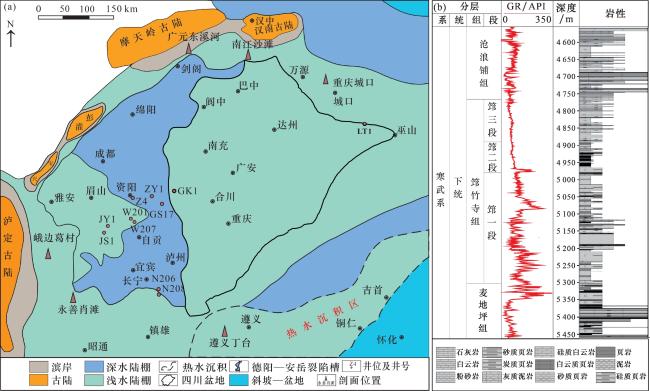
下寒武统筇竹寺组沉积期,上扬子地区海水由东南方向快速侵入,在碳酸盐岩台地的沉积基础上形成了一套海侵沉积序列,在中上扬子地区从西往东大致呈现主体为滨岸—陆棚—斜坡—深水盆地的沉积格局1535-37图1)。受构造分异控制,德阳—安岳裂陷槽内发育一套深水陆棚相巨厚的暗色泥页岩,向上逐渐过渡为浅水陆棚相砂泥岩;在裂陷槽两侧则发育以泥质粉砂岩、粉砂质页岩、页岩和白云岩为特征的浅水陆棚相38。川东北为在被动大陆边缘及克拉通盆地影响下形成的浅水缓斜坡区、川东南为向深部过渡的浅水陆棚区33,厚度相对较薄。纵向上整体沉积水体由深变浅,以快速海侵缓慢海退沉积为特征,沉积物以砂泥质沉积为主15
图1 四川盆地下寒武统筇竹寺组沉积期古地理分布(a)及GS17井下寒武统地层综合柱状图(b)(据文献[3540-41]修改)

Fig.1 Paleogeography of the Lower Cambrian Qiongzhusi Formation in the Sichuan Basin (a), and comprehensive stratigraphic histogram of the Lower Cambrian strata in Well GS17(b) (modified from Refs.[3540-41])

四川盆地下寒武统筇竹寺组除了川西雅安一带受到川中古隆起剧烈隆升导致缺失以外39,全盆地沉积了巨厚的黑色页岩,其埋藏深度多在5 000 m以深,向盆地四周埋藏深度变浅,在盆地北部、北东部、东南边缘有出露33。该套烃源岩受德阳—安岳裂陷槽控制明显:烃源岩在裂陷槽北部的厚度、TOC明显高于南部,裂陷槽内部烃源岩质量明显优于外部;裂陷两侧烃源岩厚度明显减薄,盆地周缘临近海槽区厚度明显增大2940-41。筇竹寺组烃源岩具有雄厚的生烃能力,生气强度达到(20~200)×108 m3 /km2,是广覆式分布的极为优质的一套烃源岩39

2 元素地球化学特征与沉积环境

2.1 古氧化还原环境

还原的水底环境有利于有机质的保存。U、Th、V、Cr、Ni等元素在沉积物中的富集积累受沉积环境的氧化还原条件控制,通常在还原条件下富集42-44;U与Mo的富集系数UEF、MoEF也被应用于氧化还原环境的确定45-46。前人4245-50已提出了多种地球化学判识指标(表1),以分析和重建古氧化还原环境。
表1 沉积水体氧化还原环境的地球化学判识指标

Table 1 Geochemical identification signs of redox environment in sedimentary water

沉积环境判识指标 古氧化还原环境 文献来源
ωV/ω(V+Ni) >0.54 厌氧 0.46~0.54 贫氧 <0.46 富氧 4247-49
ω(V)/ω(Cr) >4.25 厌氧 2.00~4.25 贫氧 <2.00 富氧
ω(Ni)/ω(Co) >7.00 厌氧 5.00~7.00 贫氧 <5.00 富氧
ω(U)/ω(Th) >1.25 厌氧 0.75~1.25 贫氧 <0.75 富氧
ω(V)/ω(Sc) >9.1缺氧 <9.1 氧化 50
MoEF、UEF MoEF>UEF 缺氧 MoEF<UEF 氧化 45-46

2.1.1 深水陆棚区

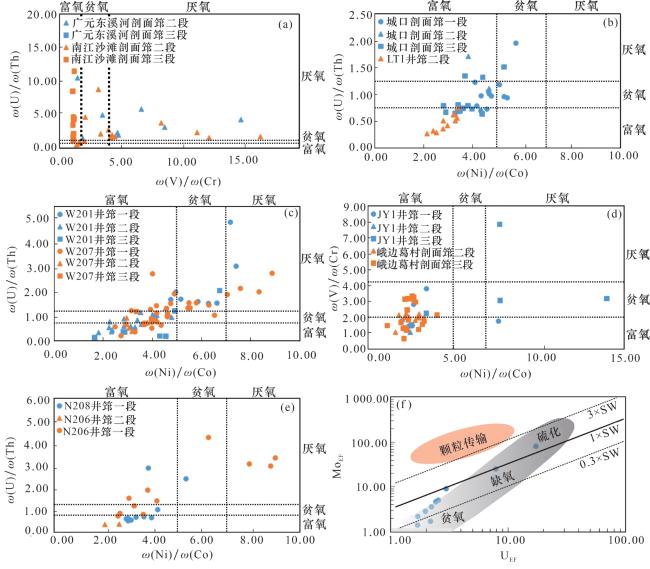
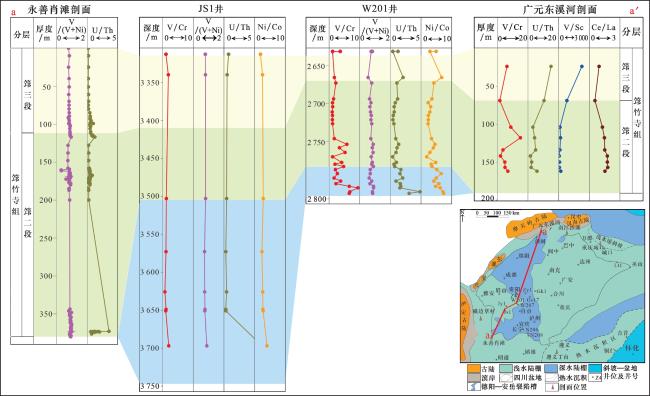
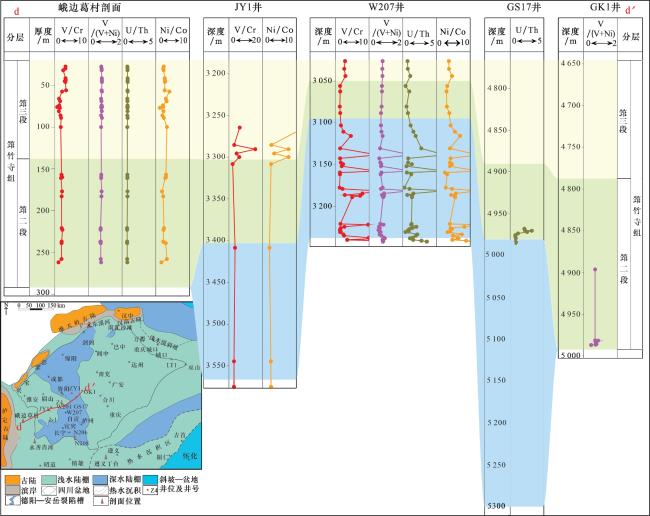
广元东溪河剖面所处的裂陷槽北段,ω(V)/ω(Cr)值为1.52~10.55、平均为6.57,ω(U)/ω(Th)值为1.47~35.25、平均为9.2444,尽管在整个筇竹寺组沉积期氧化还原指标数值波动很大,但整体仍反映出其始终处于极端还原的水体环境之中[图2(a)]。而由ω(V)/ω(Cr)、ω(V)/ω(V+Ni)、ω(U)/ω(Th)、ω(Ni)/ω(Co)及MoEF/UEF所指示的古氧化还原特征表明,位于川中的ZY1井、W201井、W207井在筇竹寺组沉积时期经历了缺氧—次氧化—缺氧—次氧化的沉积环境演化历程,在各阶段沉积环境演化历程中:W207井ω(V)/ω(Cr)平均值分别为4.96、1.57、2.83、2.09,ω(U)/ω(Th)平均值分别为1.49、1.01、1.53、0.79,ω(Ni)/ω(Co)平均值分别为6.02、3.75、5.57、3.5219;ZY1井MoEF/UEF值分别为9.90、7.77、12.42、4.8310。该地区总体在筇竹寺组下段处于厌氧古环境,向上水体逐渐氧化,为贫氧—弱氧化环境[图2(c),图3图4]。
图2 四川盆地不同地区筇竹寺组氧化—还原地球化学指标交会图((a)—(e))(数据引自文献[1,12,15,19,44,53-55)及N208井筇竹寺组MoEF—UEF协变图(f)(图版改自文献[60],数据引自文献[55])

Fig.2 Plots of oxidation-reduction indexes of Qiongzhusi Formation in the Sichuan Basin [(a)-(e)] (data sourced from Refs.[11215194453-55]) and MoEF versus UEF covariation in Qiongzhusi Formation for Well N208 (f) (plate modified from Ref.[60], data sourced from Ref.[55])

图3 四川盆地德阳—安岳裂陷槽北段—裂陷槽中段—裂陷槽南段筇竹寺期沉积水体氧化还原环境对比(数据引自文献[124456-57])

Fig.3 Comparison of redox environments in sedimentary water bodies during the Qiongzhusi period from the northern to the middle and the south section of the Deyang-Anyue rift in the Sichuan Basin (data cited from Refs.[124456-57])

图4 川东北浅水陆棚—裂陷槽中段—裂陷槽南段筇竹寺期沉积水体氧化还原环境对比(数据引自文献[13121719])

Fig.4 Comparison of redox environment of sedimentary water of Qiongzhusi period from the shallow water shelf area in northeastern Sichuan Basin to the middle section and the south section of the Deyang-Anyue rift in the Sichuan Basin (data sourced from Refs.[13121719])

综合连井剖面对比可以看出,横向上,由德阳—安岳裂陷槽北段向南,筇竹寺期沉积水体还原性逐渐变差、由缺氧环境趋于贫氧—弱氧化环境。典型氧化还原环境指标ω(V)/ω(Cr)值由裂陷槽北段东溪河剖面平均6.57的高值降低至平均3.36(W207井)、2.85(W201井),ω(U)/ω(Th)值则从9.24分别降至1.22、1.11。由于四川盆地德阳—安岳裂陷槽向北与川西海盆相连,受张性断层控制,拉张活动具有从NW向SE不断减弱的特点2751,裂陷槽北部(绵阳—乐至地区)的厚度大于南部(隆昌—长宁)的厚度52,因而这种古氧化还原环境的差异可能是裂陷槽北部具有更长的拉张时间和更大的拉张强度,导致其相较南段有更深的水体环境所造成的。

2.1.2 川东北浅水陆棚区

ω(V)/ω(Cr)、ω(U)/ω(Th)、ω(V)/ω(Sc)指标协同指示了沙滩剖面下段整体处于还原性很强的厌氧—贫氧的沉积水体环境中[图2(a)],三项指标平均值分别为5.42、2.33、29.351,为低能厌氧环境,向上自筇二段上部起快速氧化,三项指标分别骤降至平均值1.22、0.42、7.17,指示为富氧环境。城口剖面古氧化还原指标整体表明其黑色页岩沉积水体环境变化经历了4个阶段:贫氧[ω(V)/ω(Cr)平均值为4.01、ω(U)/ω(Th)平均值为1.07]→弱氧化[ω(V)/ω(Cr)平均值为2.65、ω(U)/ω(Th)平均值为0.88]→贫氧[ω(V)/ω(Cr)平均值为3.72、ω(U)/ω(Th)平均值为1.18]→弱氧化[ω(V)/ω(Cr)平均值为1.67、ω(U)/ω(Th)平均值为0.82]53。LT1井ω(Ni)/ω(Co)值分布于2.14~3.41之间,比值均小于5.00,ω(U)/ω(Th)值介于0.27~0.75之间,比值均小于0.7554,二者高度一致地共同指示了该地区在整个筇竹寺组沉积时期都为弱还原—氧化环境[图2(b)]。
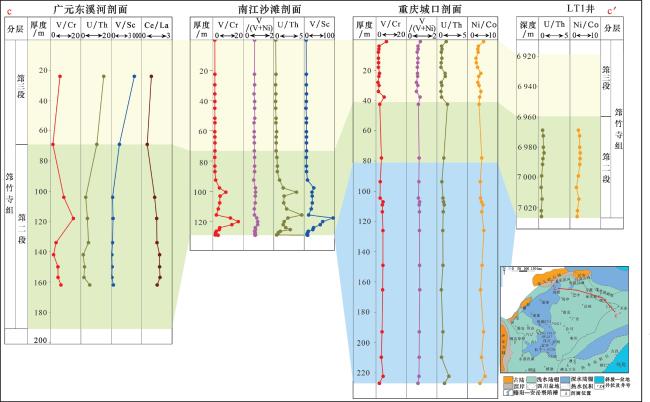
综合而言,由古氧相指标指示的氧化还原条件显示川东北浅水陆棚区在纵向上总体为由强变弱的还原环境,但古氧相指标总体纵向变化较小;在横向上,由深水陆棚到川东北浅水陆棚区,除城口地区可能是由于靠近深水盆地,沉积环境较为还原外,整体呈现由缺氧向贫氧、氧化的古水体环境过渡的演化趋势(图5)。
图5 裂陷槽北段—川东北浅水陆棚筇竹寺期沉积水体氧化还原环境对比(数据引自文献[14453-54])

Fig.5 Comparison of redox environment of sedimentary water of Qiongzhusi period from the north section of the Deyang-Anyue rift to the northeastern Sichuan Basin (data sourced from Refs.[14453-54])

2.1.3 川西南浅水陆棚区

ω(V)/ω(Cr)指标较明晰地反映了川西南峨边葛村剖面筇竹寺组沉积水体从前期较差的还原性(0.66~2.24,平均为1.70)到筇三段沉积中后期还原性迅速上升的波动变化,短期内迅速转变为弱氧化条件的贫氧环境(2.46~3.34,平均为2.97)58。JY1井ω(V)/ω(Cr)值为1.05~7.85、平均值为2.76,ω(Ni)/ω(Co)值为2.00~13.99、平均值为5.29;JS1井ω(V)/ω(Cr)值为0.70~1.94、平均为1.21,ω(V)/ω(V+Ni)值为0.73~0.88、平均为0.78,ω(Ni)/ω(Co)值为1.86~4.02、平均值为2.701556,表明该地区浅水陆棚沉积大部分形成于氧化环境[图2(d)],由于其靠近陆棚内凹陷,晚期小规模的海侵作用形成了局部的深水陆棚沉积15,这可能导致其在筇竹寺组上段短暂缺氧环境的形成。
总体上,由川西南浅水陆棚区向盆地内部,尤其是在裂陷槽发育区域,水体具有还原性不断加强[ω(V)/ω(Cr)、ω(V)/ω(V+Ni)、ω(U)/ω(Th)、ω(Ni)/ω(Co)数值增大]的趋势,这反映川西南地区逐渐由浅水陆棚相到深水陆棚相的沉积环境变化过程(图6)。
图6 川西南—裂陷槽中段筇竹寺期沉积水体氧化还原环境对比(数据引自文献[315171958])

Fig.6 Comparison of redox environment of sedimentary water of Qiongzhusi period from southwestern Sichuan Basin to the middle section of the Deyang-Anyue rift (data sourced from Refs.[315171958])

2.1.4 川东南浅水陆棚区

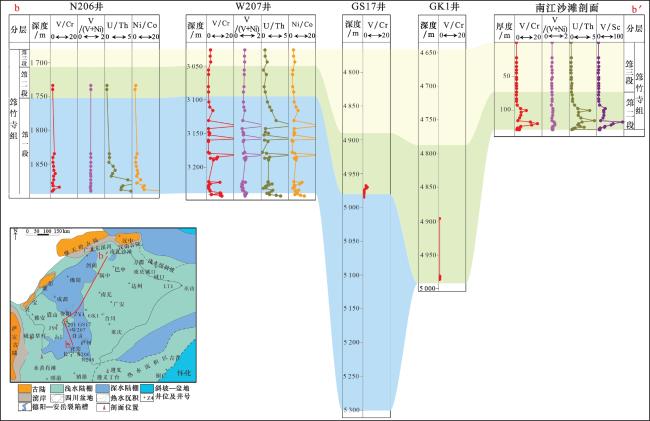
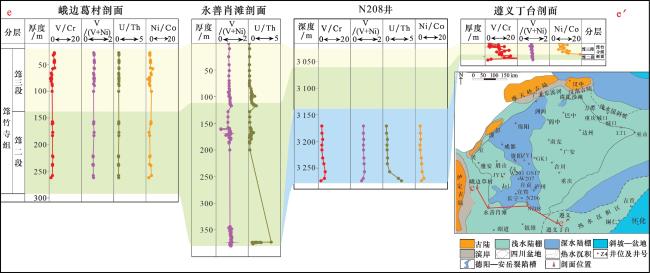
N208井筇一段ω(V)/ω(Cr)、ω(V)/ω(V+Ni)、ω(Ni)/ω(Co)3种氧化还原指标与ω(U)/ω(Th)在纵向上的分布存在较大差异(图7),所指示的沉积水体古氧相变化趋势甚至呈现了相反的结论。前人认为,这可能是由于Ni和Co均为亲硫元素,在含H2S的强还原条件下,容易形成NiS和CoS等不溶物,并以固溶体的形式进入黄铁矿,导致Ni和Co元素都在富含黄铁矿的沉积物中富集4659;而在沉积介质环境中,元素V容易被有机质颗粒吸附并发生沉淀55。因此采用MoEF—UEF协变图[图2(f)]协同分析,协变图结果与ω(U)/ω(Th)指标指示结论相一致,也与N206井ω(U)/ω(Th)、ω(Ni)/ω(Co)指标所指示的古氧化还原环境具有一致性12图2(e)],即四川盆地东南部(N206井、N208井)筇竹寺组底部页岩为贫硫酸盐的厌氧环境,向上还原性迅速降低并逐渐变为稳定的厌氧—贫氧环境。丁台剖面ω(V)/ω(Cr)数值波动较大,但ω(V)/ω(V+Ni)(0.77~0.97,平均为0.91)与ω(Ni)ω(Co)(5.58~69.3,平均为21.13)60均指示了厌氧、还原的古氧化还原特征。
图7 川西南—裂陷槽南段—川东南地区筇竹寺期沉积水体氧化还原环境对比(数据引自文献[55-565860])

Fig.7 Comparison of redox environment of sedimentary water of Qiongzhusi period from the southwestern Sichuan Basin to the south section of the rift and the southeastern Sichuan Basin (data sourced from Refs.[55-565860])

结合连井剖面和古氧化还原环境指标交会图可以看出,四川盆地裂陷槽北部(东溪河剖面)向中部(W207井、W201井),再至南端(N206井、N208井),筇竹寺组页岩的沉积环境整体上还原条件逐渐减弱,氧化程度逐渐增强;盆地南部自西向东,由川西南浅水陆棚到川东南浅水陆棚,在筇竹寺期沉积水体逐渐向更缺氧、还原的方向过渡。

2.2 古生产力特征

由于生源钡的通量与有机碳通量有着显著的正相关性,且自生成因的重晶石(BaSO4)在沉积物中具有较高的保存率61-62,因此生物钡是古生产力的指标。殷鸿福等63根据Baxs(过剩钡)与PP(初级生产力)的直接相关度作出分级,指出当Baxs>100时,相应的PP>400 gC/(m2·a),此时古海洋具有很高的初级生产力。
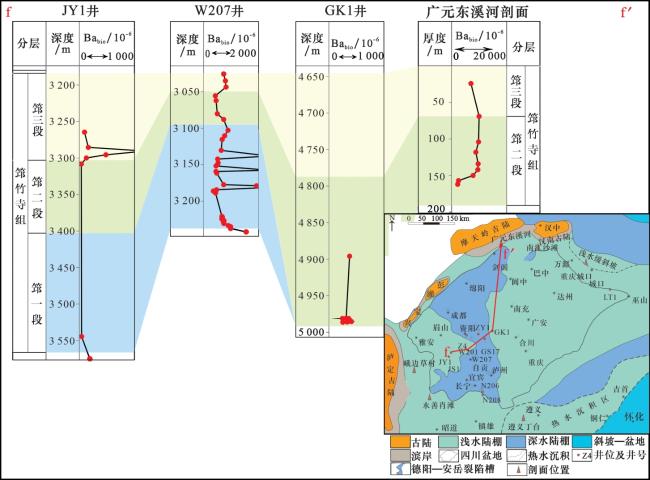
处于裂陷槽中段的W207井区,古生产力数值在筇一段底部和上部较高,Babio均值分别为1 101.54×10⁻⁶和793.24×10⁻⁶[19,其间古生产力指数存在波动,但整体依然处于高生产力区间。这可能是由于在筇竹寺组沉积早期,德阳—安岳裂陷槽西侧乐山—威远边坡与广海相连,在大规模海侵的背景下,伴随着一定程度的海水上涌和从深层海水中涌入的丰富的营养物质,使筇竹寺组在早期沉积期间的生产力较高;在经历了一次海退后,在筇竹寺组的中期沉积阶段,该地区海平面再次上升19,导致了筇竹寺组上端的Babio高值。
由Babio指示的古生产力显示广元东溪河剖面所处的裂陷槽北段筇竹寺期的古生产力极高,Babio平均值为7 456.05×10⁻⁶[44,远高于100×10-6图8)。贾智彬64提出,ω(Sc)/ω(Cr)≤0.120的样品以热水沉积成岩作用为主,东溪河剖面筇竹寺期的ω(Sc)/ω(Cr)值介于0.003~0.100之间、平均值为0.04644,指示Baxs数值受热液干扰十分强烈。但另一古生产力指标ω(Al)/ω(Ti)值(10.36~33.07、平均为19.7844)表明,在过剩Ba中生源钡依然占有很大的比重。
图8 四川盆地筇竹寺期古生产力指标对比(数据引自文献[3151944])

Fig.8 Comparison of paleo-productivity proxies of Qiongzhusi period in the Sichuan Basin(data sourced from Refs.[3151944])

处于浅水陆棚相的JY1井筇竹寺组除中上部筇三段泥质沉积Babio含量大于100×10-6(平均为 213.94×10⁻⁶)、具有相对高的生产力外,其下段对应的古海洋生产力较低,Babio平均值为33.88×10⁻⁶[15。JY1井在麦地坪组至筇竹寺组沉积早期德阳—安岳裂陷迅速发展的背景下,古生物种群和低等藻类与高等小壳类生物在温暖气候下爆发式增长,其迅速繁盛后大量死亡导致海水快速耗氧,造成缺氧的强还原环境49,这可能破坏了生物生存的宜居环境,导致了JY1井下段的低古生产力。
综合而言,处于深水陆棚区的裂陷槽北段广元东溪河剖面以及裂陷槽中段的ZY1井、W207井都整体反映了很高的古生产力水平,且古生产力远好于裂陷槽外川西南JY1井浅水陆棚相烃源岩。

2.3 古气候特征

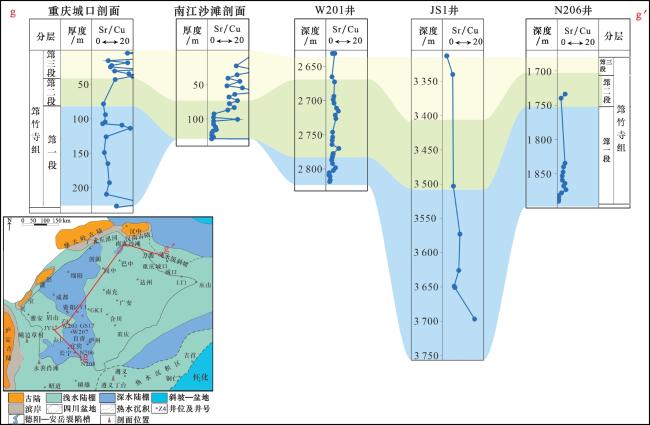
Cu为喜湿型元素,Sr为喜干型元素,其比值可以有效、灵敏地反映古气候的变化,通常而言,较低的ω(Sr)/ω(Cu)值指示相对温湿的气候4865-68。来自城口剖面、沙滩剖面、W201井、JS1井、N206井5处剖面和井位的ω(Sr)/ω(Cu)指标,反映了四川盆地筇竹寺期古气候在纵向上存在较为一致的变化趋势,大致经历了由稳定的温湿→干旱→湿润→干旱4个气候阶段(图9)。
图9 四川盆地筇竹寺期古气候特征对比(数据引自文献[1125356])

Fig.9 Comparison of paleo-climatic characteristics of Qiongzhusi period in the Sichuan Basin (data sourced from Refs.[1125356])

2.4 热液影响

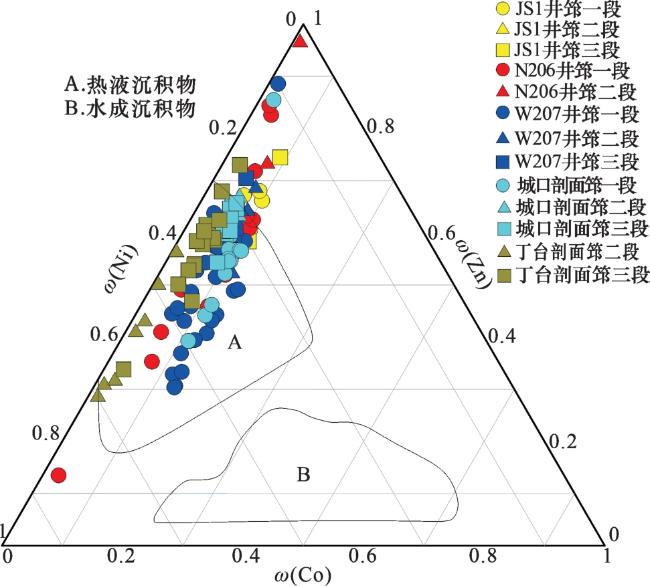
适宜的热液活动因有利于生物繁盛、增强水体的缺氧程度从而对有机质的富集和保存乃至优质页岩的形成具有增益作用,与优质烃源岩的形成有着密切关系155769。由于Co主要是水成来源而Cu、Ni、Zn为热液来源70,导致热液沉积物的ω(Co)/ω(Zn)值较低(平均为0.15,而其他铁锰结核一般在2.5)71,从而,ω(Co)/ω(Zn)值可以作为区分热液来源和正常自生来源的敏感指标。基于这样的认识,将川东北城口剖面、川中W207井、川南N206井、川西南JS1井、川东南丁台剖面的地球化学数据投点于Zn—Ni—Co三角图,可以判断四川盆地筇竹寺组沉积期的沉积背景。
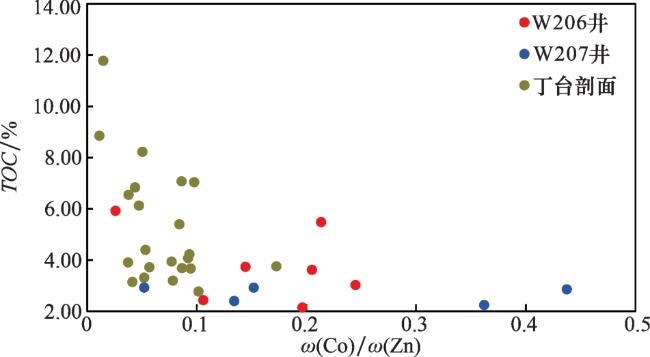
四川盆地筇竹寺组全部5组数据均表示低的ω(Co)/ω(Zn)值,除JS1、N206井区表现为间歇性热液流体扰动外,川东北城口、川东南丁台、川中W207井区均指示在筇竹寺组沉积时期稳定存在不同强度的海底热液活动(图10)。其中,处于四川盆地东南热水沉积区的丁台剖面ω(Co)/ω(Zn)值为0.01~0.17,平均值为0.07,受热液影响最强烈;川东北城口[ω(Co)/ω(Zn)值为0.03~0.29,平均值为0.15]受热液影响效果较川中W207井[ω(Co)/ω(Zn)值为0.04~0.44,平均值为0.19]更为显著195360。分析5组数据可以发现,对于高TOC层,ω(Co)/ω(Zn)值与TOC值呈现良好的负相关关系(图11),表明丰富的热液不仅为筇竹寺组海洋生物的发育贡献了丰沛的营养元素、对筇竹寺期高古生产力提供了物质基础,也为水体缺氧环境的形成提供了有利条件。
图10 四川盆地筇竹寺组Ni—Co—Zn沉积背景判别(图版改自文献[84],数据引自文献[1219535660])

Fig.10 Deposition background discrimination diagram using Ni-Co-Zn of Qiongzhusi Formation, Sichuan Basin (plate modified from Ref.[84], data sourced from Refs.[1219535660])

图11 四川盆地筇竹寺组页岩 ω (Co)/ ω (Zn)与TOC%)相关关系(数据引自文献[12195360])

Fig.11 Correlation plot of Co/Zn vs.TOC%) of Qiongzhusi Formation shales, Sichuan Basin (data from Refs.[12195360])

3 有机质富集机制探讨

海相烃源岩有机质的富集主要受控于古生产力的高低、沉积水体的氧化—还原条件等关键因素54。为探讨四川盆地下寒武统筇竹寺组优质烃源岩有机质富集机制,可利用TOC值代表有机质富集程度,通过建立TOC值与古生产力指标、古氧化还原环境参数之间的相关性分析,对四川盆地不同区域筇竹寺组有机质富集主控因素进行综合探讨。
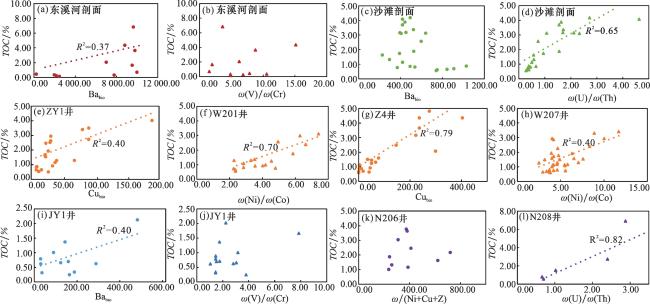
位于裂陷槽北段的东溪河剖面,TOC值与古生产力指数Babio具有明显的正相关关系[图12(a)]且与氧化还原指数ω(V)/ω(Cr)呈弱相关性[图12(b)];而在近川东北浅水陆棚的沙滩剖面,TOC值则表现出与氧化还原指数ω(U)/ω(Th)较强的正相关关系[图12(d)]。这可能是由于东溪河剖面长期沉积于很深的水体环境,极端还原水体条件为有机质的保存提供了始终有利的条件,导致裂陷槽北段筇竹寺组的有机质丰度主要受控于古生产力,而川东北浅水陆棚有机质丰度则主要受古氧化还原环境变化影响。
图12 四川盆地筇竹寺组页岩古生产力、古氧化还原条件与TOC相关关系(数据引自文献[18101215194455])

Fig.12 Correlation between paleo-productivity, paleo-redox conditions and TOC of Qiongzhusi Formation shales, Sichuan Basin (data from Refs.[18101215194455])

处于裂陷槽中段深水陆棚相区的ZY1井、Z4井,TOC值与古生产力指数Cubio表现出强烈的正相关关联;同时,同属该地区的W207井、W201井指示有机质富集受古氧化还原条件控制明显,TOC含量与ω(Ni)/ω(Co)指数呈良好的正相关关系[图12(e)—图12(h)]。该地区筇竹寺组优质烃源岩有机质富集是高古生产力和缺氧—贫氧的良好保存条件共同作用的结果。
下寒武统筇竹寺组沉积时期,川西南浅水陆棚相区由于位于德阳—安岳裂陷槽西侧构造高部位、临近康滇古陆,有物源供给时间长、沉积物以粒度较粗的砂岩为主、持续海退、氧化—还原性波动大、水动力变化频繁、古生产力水平低等特征33。与裂陷槽侧翼的高石梯—磨溪地区相比,其沉积环境受海平面升降影响更为明显,若遇海平面下降,地台相对隆升,易形成浅水环境72。结合该地区古生产力特征、古氧化还原特征与TOC的相关性来看,水体环境的不稳定变化决定了在该地区古氧化还原环境不是有机质富集的主控因素,其有机质富集主要受控于古生产力影响[图12(i),图12(j)]。向东,由N206井与N208井所反映的川东南浅水陆棚区,烃源岩有机质富集主要取决于古氧化还原环境的变化[图12(l)]。

4 结论

(1)四川盆地不同地区筇竹寺组沉积地球化学特征受克拉通盆地构造—沉积分异影响显著。
(2)德阳—安岳裂陷槽北段较南段古环境更为还原,更有利于有机质的富集和优质烃源岩的形成与保存。
(3)四川盆地北部由裂陷槽深水陆棚区到川东北浅水陆棚区,整体呈现由缺氧向贫氧、氧化的古水体环境过渡的趋势;盆地中部由川西南浅水陆棚向川中裂陷槽发育区,沉积水体还原性不断加强,由氧化、弱氧化的古氧相变化为深水陆棚较缺氧的古氧相;盆地南缘由川西南浅水陆棚到川东南浅水陆棚,沉积水体逐渐向更还原的方向过渡为厌氧—贫氧的古氧化还原环境。
(4)德阳—安岳裂陷槽北段及中段整体反映了很高的古生产力水平,且四川盆地筇竹寺期频繁、广泛的热液活动也为筇竹寺组页岩有机质富集提供了十分有利的条件。
(5)德阳—安岳裂陷槽北段筇竹寺组的有机质丰度高低主要取决于古生产力强度;川东北浅水陆棚有机质丰度主要受古氧化还原环境影响;裂陷槽中段筇竹寺组优质烃源岩有机质富集是高古生产力和缺氧—贫氧的古氧相共同作用的结果;川西南浅水陆棚区由于临近康滇古陆,水体环境变化不稳定,其有机质富集主要受古生产力影响;川东南浅水陆棚烃源岩有机质富集则主要取决于古氧化还原环境的变化。

中国石油勘探开发研究院江青春高级工程师、成都理工大学宋金民副教授及四川轻化工大学夏国栋副教授在论文撰写过程中提出了很好的意见和建议,在此表示诚挚谢意;由衷感谢匿名审稿人提出的宝贵修改意见。

1
GUO Q J, SHIELDS G, LIU C Q, et al. Trace element chemostratigraphy of two Ediacaran-Cambrian successions in South China: Implications for organosedimentary metal enrichment and silicification in the Early Cambrian[J]. Palaeogeography Palaeoclimatology Palaeoecology, 2007, 254: 194-216.

2
PI D H, LIU C Q, SHIELDS-ZHOU G A, et al. Trace and rare earth element geochemistry of black shale and kerogen in the Early Cambrian Niutitang Formation in Guizhou Province, South China: Constraints for redox environments and origin of metal enrichments[J].Precambrian Research,2013,225:218-229.

3
GAO P, LIU G D, JIA C Z, et al. Redox variations and organic matter accumulation on the Yangtze carbonate platform during Late Ediacaran-Early Cambrian:Constraints from petrology and geochemistry[J]. Palaeogeography Palaeoclimatology Palaeoecology, 2016, 450: 91-110.

4
JIN C, LI C, ALGEO T J, et al. A highly redox-heterogeneous ocean in South China during the Early Cambrian(~529-514 Ma): Implications for biota-environment co-evolution[J]. Earth and Planetary Science Letters, 2016, 441: 38-51.

5
LIU K, FENG Q, SHEN J, et al. Increased productivity as a primary driver of marine anoxia in the Lower Cambrian[J]. Palaeogeography Palaeoclimatology Palaeoecology,2018,491:1-9.

6
WU Y, TIAN H, GONG D, et al. Paleo-environmental variation and its control on organic matter enrichment of black shales from shallow shelf to slope regions on the Upper Yangtze Platform during Cambrian Stage 3[J]. Palaeogeography Palaeoclimatology Palaeoecology, 2020, 545: 109653.

7
GAO P, LI S J, LASH G G, et al. Stratigraphic framework, redox history, and organic matter accumulation of an Early Cambrian intra-platfrom basin on the Yangtze Platform, South China[J]. Marine and Petroleum Geology,2021,130:105095.

8
WANG N, WEN L, LI M, et al. The origin of abnormally 13C-depleted organic carbon isotope signatures in the Early Cam-brian Yangtze Platform[J].Marine and Petroleum Geology,2021, 128: 105051.

9
STEINER M, WALLIS E, ERDTMANN B D, et al. Submarine hydrothermal exhalative ore layers in black shales from South China and associated fossils-insights into a Lower Cambrian facies and bio-evolution[J]. Palaeogeography Palaeoclimatology Palaeoecology, 2001, 169: 165-191.

10
GAO P, HE Z, LI S, et al. Volcanic and hydrothermal activities recorded in phosphate nodules from the Lower Cambrian Niutitang Formation black shales in South China[J].Palaeoge-ography Palaeoclimatology Palaeoecology,2018,505:381-397.

11
LIU Z H, ZHUANG X G, TENG G E, et al. The Lower Cambrian Niutitang Formation at Yangtiao(Guizhou, SW China):Organic matter enrichment, source rock potential, and hydrothermal influences[J].Journal of Petroleum Geology,2015, 38 (4): 411-432.

12
WANG S F, ZOU C N, DONG D Z, et al. Multiple controls on the paleoenvironment of the Early Cambrian marine black shales in the Sichuan Basin, SW China: Geochemical and organic carbon isotopic evidence[J]. Marine and Petroleum Geology, 2015, 66: 660-672.

13
ZHAI L N, WU C D, YE Y T, et al. Fluctuations in chemical weathering on the Yangtze Block during the Ediacaran-Cambrian transition: Implications for paleoclimatic conditions and the marine carbon cycle[J]. Palaeogeography Palaeoclimatology Palaeoecology, 2018, 490: 280-292.

14
ZHANG K, SONG Y, JIANG S, et al. Mechanism analysis of organic matter enrichment in different sedimentary backgrounds: A case study of the Lower Cambrian and the Upper Ordovician-Lower Silurian, in Yangtze Region[J]. Marine and Petroleum Geology, 2019, 99: 488-497.

15
赵建华, 金之钧, 林畅松, 等. 上扬子地区下寒武统筇竹寺组页岩沉积环境[J]. 石油与天然气地质,2019,40(4):701-715.

ZHAO J H, JIN Z J, LIN C S, et al. Sedimentary environment of the Lower Cambrian Qiongzhusi Formation shale in the Upper Yangtze Region[J].Oil & Gas Geology,2019,40(4):701-715.

16
WANG N, LI M J, TIAN X W, et al. Climate-ocean control on the depositional watermass conditions and organic matter enrichment in Lower Cambrian black shale in the Upper Yangtze Platform[J].Marine and Petroleum Geology,2020,120:104570.

17
杨雨, 罗冰, 张本健, 等. 四川盆地下寒武统筇竹寺组烃源岩有机质差异富集机制与天然气勘探领域[J]. 石油实验地质, 2021, 43( 4): 611-619.

YANG Y, LUO B, ZHANG B J, et al. Differential mechanisms of organic matter accumulation of source rocks in the Lower Cambrian Qiongzhusi Formation and implications for gas exploration fields in Sichuan Basin[J]. Petroleum Geology & Experiment,2021,43(4):611-619.

18
魏国齐,杨威,谢武仁,等. 克拉通内裂陷及周象大型岩性气藏形成机制、潜力与勘探实践——以四川盆地震旦系—赛武系为例[J]. 石油勘探与开发,2022,49(3):465-477.

WEI G Q, YANG W, XIE W R, et al. Formation mechanisms, potentials and exploration practices of large lithologic gas reservoirs in and around an intracratonic rift: Taking the Sinian Cambrian of Sichuan Basin as an example[J].Petroleum Exploration and Development, 2022, 49(3):465-477.

19
ZHAO L, LIU S G, LI G Q, et al. Sedimentary environment and enrichment of organic matter during the deposition of Qiongzhusi Formation in the Upslope areas-A case study of W207 Well in the Weiyuan area,Sichuan Basin,China[J].Frontier in Earth Science, 2022, 10: 867616.

20
郭正吾, 邓康龄, 韩永辉, 等. 四川盆地形成与演化[M]. 北京:地质出版社, 1996:1-200.

GUO Z W, DENG K L, HAN Y H, et al. The Formation and Development of Sichuan Basin[M]. Beijing: Geological Publishing House, 1996: 1-200.

21
姜鹏飞, 吴建发, 朱逸青, 等. 四川盆地海相页岩气富集条件及勘探开发有利区[J], 石油学报, 2023, 44 (1): 91-109.

JIANG P F,WU J F, ZHU Y Q, et al. Enrichment conditions and favorable areas for exploration and development of marine shale gas in Sichuan Basin[J].Acta Petrolei Sinica,2023, 44 (1): 91-109.

22
管树巍, 吴林, 任荣, 等. 中国主要克拉通前襄武纪裂谷分布与油气勘探前景[J]. 石油学报, 2017, 38 (1): 9-22.

GUAN S W, WU L, REN R, et al. Distribution and petroleum prospect of Precambrian rifts in the main cratons, China[J]. Acta Petrolei Sinica, 2017, 38( 1): 9-22.

23
刘树根, 孙玮, 罗志立, 等. 兴凯地裂运动与四川盆地下组合油气勘探[J]. 成都理工大学学报(自然科学版), 2013, 40( 5): 511-520.

LIU S G, SUN W, LUO Z L, et al. Xingkai taphrogenesis and petroleum exploration from Upper Sinian to Cambrian strata in Sichuan Basin, China[J]. Journal of Chengdu University of Technology (Science & Technology Edition),2013,40(5): 511-520.

24
邹才能, 杜金虎, 徐春春, 等. 四川盆地震旦系—寒武系特大型气田形成分布、资源潜力及勘探发现[J]. 石油勘探与开发,2014,41(3):278-293.

ZOU C N, DU J H, XU C C, et al. Formation, distribution, resource potential and discovery of the Sinian Cambrian giant gas field, Sichuan Basin, SW China[J]. Petroleum Exploration and Development, 2014, 41(3): 278-293.

25
杜金虎, 邹才能, 徐春春, 等. 川中古隆起龙王庙组特大型气田战略发现与理论技术创新[J]. 石油勘探与开发, 2014, 41(3): 268-277.

DU J H, ZOU C N, XU C C, et al. Theoretical and technical innovations in strategic discovery of a giant gas field in Cambrian Longwangmiao Formation of central Sichuan paleo-uplift, Sichuan Basin[J].Petroleum Exploration and Development,2014, 41 (3): 268-277.

26
魏国齐, 杨威, 杜金虎, 等. 四川盆地震旦纪—早寒武世克拉通内裂陷地质特征[J]. 天然气工业,2015,35(1):24-35.

WEI G Q, YANG W, DU J H, et al. Geological characteristics of the Sinian-Early Cambrian intracratonic rift, Sichuan Basin[J]. Natural Gas Industry,2015,35(1):24-35.

27
汪泽成, 赵文智, 胡素云, 等. 克拉通盆地构造分异对大油气田形成的控制作用——以四川盆地震旦系—三叠系为例[J]. 天然气工业,2017,37(1):9-23.

WANG Z C, ZHAO W Z, HU S Y, et al. Control of tectonic differentiation on the formation of large oil and gas fields in craton basins:A case study of Sinian-Triassic of the Sichuan Basin[J]. Natural Gas Industry,2017,37(1):9-23.

28
朱茂炎, 孙智新, 杨爱华, 等. 中国襄武纪岩石地层划分和对比[J]. 地层学杂志, 2021, 45(3): 222-249.

ZHU M Y, SUN Z X,YANG A H, et al. Lithostratigraphic subdivision and correlation of the Cambrian in China[J]. Journal of Stratigraphy,2021,45(3):222-249.

29
付小东, 陈娅娜, 罗冰, 等. 中上扬子区下寒武统麦地坪组—筇竹寺组烃源岩与含油气系统评价[J]. 中国石油勘探, 2022,27(4):103-120.

FU X D, CHEN Y N, LUO B, et al. Evaluation of source rocks and petroleum system of the Lower Cambrian Maidiping Formation-Qiongzhusi Formation in the Middle-Upper Yangtze Region[J].China Petroleum Exploration,2022,27(4):103-120.

30
汪泽成, 姜华, 王铜山, 等. 四川盆地桐湾期古地貌特征及成藏意义[J]. 石油勘探与开发,2014,41(3):305-312.

WANG Z C, JIANG H, WANG T S, et al. Paleo-geomorphology formed during Tongwan tectonization in Sichuan Basin and its significance for hydrocarbon accumulation[J]. Petroleum Exploration and Development,2014,41(3):305-312.

31
刘树根,刘殊,孙玮,等.绵阳—长宁拉张槽北设构造—沉积特征[J].成都理工大学学报(自然科学版),2018,45(1):1-13.

LIU S G, LIU S, SUN W, et al. Tectonic and sedimentary features of the northern Mianyang-Changning intracratonic sag Sichuan China[J]. Journal of Chengdu University of Technology( Science & Technology Edition),2018,45(1):1-13.

32
杨威, 魏国齐, 武赛军, 等. 四川盆地区域不整合特征及其对油气成藏的控制作用[J]. 石油勘探与开发,2023,50(3):504-515.

YANG W, WEI G Q, WU S J, et al. Regional unconformities and their controls on hydrocarbon accumulation in Sichuan Basin,SW China[J].Petroleum Exploration and Development, 2023,50(3):504-515.

33
范海经, 邓虎成, 伏美燕, 等. 四川盆地下寒武统筇竹寺组沉积特征及其对构造的响应[J]. 沉积学报,2021,39(4):1004-1019.

FAN H J, DENG H C, FU M Y, et al. Sedimentary characteristics of the Lower Cambrian Qiongzhusi Formation in the Sichuan Basin and its response to construction[J]. Acta Sedmentologica Sinica,2021,39(4):1004-1019.

34
汪泽成, 姜华, 陈志勇, 等. 中上扬子地区晚震旦世构造古地理及油气地质意义[J]. 石油勘探与开发,2020,47(5):884-897.

WANG Z C, JIANG H, CHEN Z Y, et al. Tectonic paleogeography of Late Sinian and its significances for petroleum exploration in the Middle-Upper Yangtze region,South China[J].Petroleum Exploration and Development,2020,47(5):884-897.

35
牟传龙, 周恳恳, 梁薇, 等. 中上扬子地区早古生代烃源岩沉积环境与油气勘探[J]. 地质学报, 2011,85(4):526-532.

MOU C L, ZHOU K K, LIANG W, et al. Early Paleozoic sedimentary environment of hydrocarbon source rocks in the Middle-Upper Yangtze Region and petroleum and gas exploration[J]. Acta Geologica Sinica, 2011,85(4):526-532.

36
洪海涛, 田兴旺, 孙奕婷, 等. 四川盆地海相碳酸盐岩天然气富集规律[J]. 中国地质,2020,47(1):99-110.

HONG H T, TIAN X W, SUN Y T, et al. Hydrocarbon enrichment regularity of marine carbonate in Sichuan Basin[J]. Geology in China,2020,47(1):99-110.

37
魏国齐, 王志宏, 李剑, 等. 四川盆地震旦系、寒武系烃源岩特征、资源潜力与勘探方向[J].天然气地球科学,2016,28(1):1-13.

WEI G Q, WANG Z H, LI J, et al. Characteristics of source rocks, resource potential and exploration direction of Sinian and Cambrian in Sichuan Basin[J]. Natural Gas Geoscience, 2016,28(1):1-13.

38
黄博宇. 四川盆地震旦纪—早寒武世岩相古地理与裂陷槽演化[D]. 北京: 中国石油大学(北京), 2018.

HUANG B Y. The Evolution of Paleogeographic and Rift Trough During Sinian-Early Cambrian in Sichuan Basin[D]. Beijing: China University of Petroleum(Beijing), 2018.

39
黄士鹏, 姜华, 王铜山, 等. 四川盆地8 000 m海相超深层天然气成藏条件及有利勘探区带[J]. 地质学报,2023,97(5):1544-1560.

HUANG S P, JIANG H, WANG T S, et al. Accumulation conditions and favorable exploration zones for natural gas in 8 000 meters marine ultra-deep strata in the Sichuan Basin[J]. Acta Geologica Sinica, 2023, 97 (5): 1544-1560.

40
刘宝珺, 许效松. 中国南方岩相古地理图集[M]. 北京: 科学出版社, 1994.

LIU B J, XU X S. Atlas of Lithofacies and Paleogeography of Southern China[M]. Beijing: Science Press, 1994.

41
刘树根, 冉波, 郭彤楼, 等. 四川盆地及周缘下古生界富有机质黑色页岩:从优质烃源岩到页岩气产层[M]. 北京: 科学出版社, 2015.

LIU S G, RAN B, GUO T L, et al. From Oil-Prone Source Rock to Gas-Producing Shale Reservoir-Lower Palaeozoic Organic-Matter-Rich Black Shale in the Sichuan Basin and Its Periphery[M]. Beijing: Science Press, 2015.

42
HATCH J R, LEVENTHAL J S. Relationship between inferred redox potential of the depositional environment and geochemistry of the Upper Pennsylvanian (Missourian) stark shale member of the Dennis Limestone, Wabaunsee County, Kansas,USA[J]. Chemical Geology,1992,99(1/3):65-82.

43
周道容. 四川盆地威远地区下古生界页岩气成藏条件及有利区优选[D]. 成都: 成都理工大学, 2013.

ZHOU D R. Shale Gas Reservoiring Conditions and Favorable Area Preferred in Lower Paleozoic in Weiyuan, Sichuan[D]. Chengdu: Chengdu University of Technology, 2013.

44
夏国栋. 川西地区下寒武统烃源岩特征研究[D]. 成都: 成都理工大学, 2018.

XIA G D. Characteristics of Hydrocarbon Source Rocks of the Lower Cambrian Formation in Western Sichuan Basin, China[D]. Chengdu: Chengdu University of Technology, 2018.

45
ALGEO T J, TRIBOVILLARD N. Environmental analysis of paleoceanographic systems based on Molybdenum-Uranium covariation[J]. Chemical Geology,2009,268(3/4):211-225.

46
樊秋爽, 夏国清, 李高杰, 等. 古海洋氧化还原条件分析方法与研究进展[J]. 沉积学报, 2022, 40 (5): 1151-1171.

FAN Q S, XIA G Q, LI G J, et al. Analytical methods and research progress of redox conditions[J]. Acta Sedmentologica Sinica, 2022, 40 (5): 1151-1171.

47
JONES B, MANNING D A C. Comparison of geochemical indices used for the interpretation of palaeoredox conditions in ancient mudstones[J].Chemical Geology,1994,111(1/2/3/4):111-129.

48
WIGNALL P B,TWITCHETT R J.Oceanic anoxia and the end Permian mass extinction[J].Science,1996,272:1155-1158.

49
ALGEO T J, MAYNARD J B. Trace-element behavior and redox facies in core shales of Upper Pennsylvanian Kansas-type cyclothems[J]. Chemical Geo1ogy,2004,206(3/4):289-318.

50
韦恒叶. 古海洋生产力与氧化还原指标—元素地球化学综述[J]. 沉积与特提斯地质, 2012,32(2):76-88.

WEI H Y. Productivity and redox proxies of palaeo-oceans:An overview of elementary geochemistry[J]. Sedimentary Geology and Tethyan Geology, 2012,32(2):76-88.

51
杜金虎, 汪泽成, 邹才能, 等.上扬子克拉通内裂陷的发现及对安岳特大型气田形成的控制作用[J]. 石油学报,2016,37(1):1-16.

DU J H, WANG Z C, ZOU C N, et al. Discovery of intra-cratonic rift in the Upper Yangtze and its control effect on the formation of Anyue giant gas field[J].Acta Petrolei Sinica,2016,37(1):1-16.

52
钟勇,李亚林,张晓斌,等.四川盆地下组合张性构造特征[J]. 成都理工大学学报:自然科学版,2013,40(5):498-510.

ZHONG Y, LI Y L, ZHANG X B, et al. Features of extensional structures in Pre-Sinian to Cambrian strata, Sichuan Basin, China[J]. Journal of Chengdu University of Technology (Science & Technology Edition),2013,40(5):498-510.

53
赵坤, 李婷婷, 朱光有, 等. 中国华南渝东北城口地区下寒武统烃源岩发育环境与形成机制[J]. 沉积学报,2020,38(5):1111-1122.

ZHAO K, LI T T, ZHU G Y, et al. Development environment and formation mechanism of Lower Cambrian source rocks in the Chengkou area, Northeast Chongqing South China[J]. Acta Sedimentologica Sinica,2020,38(5):1111-1122.

54
杨帅杰, 王伟锋, 张道亮, 等. 川东北地区筇竹寺组优质烃源岩分布特征及形成环境[J]. 天然气地球科学,2020,31(4):507-517.

YANG S J, WANG W F, ZHANG D L, et al. Distribution characteristics and formation environment of high quality source rocks of Qiangzhusi Formation in northeastern Sichuan Basin[J]. Natural Gas Geoscience, 2020, 31(4): 507-517.

55
张力, 马向贤, 马勇, 等. 基于硫元素化学种等指标的页岩氧化还原条件判识——以N208井筇竹寺组和龙马溪组为例[J]. 沉积学报,2022,40(5):1427-1438.

ZHANG L,MA X X,MA Y, et al. Multiple proxies for redox condition indentification based on sulfur species:A case study of the cored Qiongzhusi and Longmaxi formations of Well N208[J].Acta Sedmentologica Sinica,2022,40(5):1427-1438.

56
陈威振, 田景春, 林小兵, 等. 川西南下寒武统麦地坪组—筇竹寺组元素地球化学特征及其古环境意义——以JS1井为例[J/OL]. 沉积学报:1-21[2023-07-12]. https://doi.org/10.14027/j.issn.1000-0550.2022.101.

CHEN W Z, TIAN J C, LIN X B, et al. Geochemical characteristics and paleoenvironmental significance of Lower Cambrian Maidiping and Qiongzhusi formations in southwestern Sichuan Basin: A case study of Well JS1[J/ OL]. Acta Sedimentologica Sinica:1-21.[2023-07-12].https://doi. org/10. 14027/ j. issn. 1000- 0550. 2022. 101.

57
OCH L M, CREMONESE L, SHIELDS-ZHOU G A, et al. Palaeoceanographic controls on spatial redox distribution over the Yangtze Platform during the Ediacaran-Cambrian transition[J]. Sedimentology, 2016, 63(2): 378-410.

58
李依林, 伏美燕, 邓虎成, 等. 滨岸闭塞环境中有机质富集模式——以川西南峨边葛村剖面筇竹寺组为例[J]. 天然气地球科学, 2022, 33 (4): 588-604.

LI Y L, FU M Y, DENG H C, et al. The enrichment model of organic matter in the coastal detention environment: Case study of the Qiongzhusi Formation in the Gecun section of Ebian in southwestern Sichuan Basin[J]. Natural Gas Geoscience,2022, 33 (4): 588-604.

59
TRIBOVILLARD N, ALGEO T J, LYONS T, et al. Trace metals as paleoredox and paleoproductivity proxies: An update[J]. Chemical Geology, 2006, 232: 12-32.

60
XU L G, LEHMANN B, MAO J W, et al. Mo isotope and trace element patterns of Lower Cambrian black shales in South China:Multi-proxy constraints on the paleoenvironment[J]. Chemical Geology, 2012, 318-319:45-59.

61
尹秀珍. 松辽盆地中部晚白垩世早期古湖泊生产力研究[D]. 北京:中国地质大学(北京),2008.

YIN X Z. Palaeolacustrine Productivity Study of Early Late Cretaceous in the Central Area of Songliao Basin[D]. Beijing: China University of Geoscience(Beijing), 2008.

62
DYMOND J, SUESS E, LYLE M. Barium in deep-sea sediment:A geochemical proxy for paleoproductivity[J].Paleoce-anography, 1992,7(2):163-181.

63
殷鸿福, 谢树成, 颜佳新, 等. 海相碳酸盐烃源岩评价的地球生物学方法[J]. 中国科学:地球科学,2011,41(7):895-909.

YIN H F, XIE S C, YAN J X, et al. Geobiological approach to evaluating marine carbonate source rocks of hydrocarbon[J]. Scientia Sinica(Terrae), 2011, 41 (7): 895-909.

64
贾智彬. 贵州地区牛蹄塘组热水沉积的地球化学特征研究[D]. 北京:中国地质大学(北京), 2018.

JIA Z B. Geochemistry Characteristics of Hydrothermal Sedimentation in the Lower Cambrian Niutitang Formation in Guizhou[D].Beijing:China University of Geoscience(Beijing),2018.

65
LERMAN. A Lakes:Chemistry,Geology,Physics[M]. New York: Springer New York, 1978.

66
刘刚, 周东升. 微量元素分析在判别沉积环境中的应用——以江汉盆地潜江组为例[J]. 石油实验地质,2007,29(3): 307-310.

LIU G, ZHOU D S. Application of microelements analysis in identifying sedimentary environment-Taking Qianjiang Formation in the Jianghan Basin as an example[J]. Petroleum Geology & Experiment, 2007,29(3):307-310.

67
梁文君, 肖传桃, 肖凯, 等. 藏北安多晚侏罗世古环境、古气候与地球化学元素关系研究[J]. 中国地质, 2015,42 (4): 1079-1091.

LIANG W J, XIAO C T, XIAO K, et al. The relationship of Late Jurassic paleoenvironment and paleoclimate with geochemical elements in Amdo country of northern Tibet[J]. Geology in China, 2015, 42(4): 1079-1091.

68
刘鑫, 尚婷, 田景春, 等. 鄂尔多斯盆地镇北地区延长组长4+5段沉积期古环境条件及意义[J].地质学报,2021,95(11): 3501-3518.

LIU X, SHANG T, TIAN J C, et al. Paleo-sedimentary environmental conditions and its significance of Chang 4+5 Member of Triassic Yanchang Formation in the Zhenbei area, Ordos Basin, NW China[J]. Acta Geologica Sinica, 2021, 95(11): 3501-3518.

69
贾智彬, 侯读杰, 孙德强, 等. 热水沉积区黑色页岩稀土元素特征及其地质意义——以贵州中部和东部地区下寒武统牛蹄塘组页岩为例[J]. 天然气工业, 2018, 38(5): 44-51.

JIA Z B, HOU D J, SUN D Q, et al. Genesis and intensity of hydrothermal sedimentation in hydrocarbon source rocks in the Lower Cambrian Niutitang Formation,Guizhou area[J]. Natural Gas Industry, 2018,38(5):44-51.

70
CHOI J H,HARIYA Y.Geochemistry and depositional environ-ment of Mn oxide deposits in the Tokoro Belt, northeastern Hok-kaido, Japan[J]. Economic Geology, 1992, 87: 1265-1274.

71
李娟, 于炳松, 郭峰,等. 黔北地区下寒武统底部黑色页岩沉积环境条件与源区构造背景分析[J]. 沉积学报,2013,31(1):20-31.

LI J, YU B S, GUO F, et al. Depositional setting and tectonic background analysis on Lower Cambrian black shales in the North of Guizhou Province[J]. Acta Sedmentologica Sinica, 2013,31(1):20-31.

72
程建, 郑伦举. 川南地区金页1井早寒武世烃源岩沉积地球化学特征[J]. 石油与天然气地质, 2020,41(4):800-810.

CHENG J, ZHENG L J. Sedimentary geochemical characteristics of the Early Cambrian source rocks in Well Jinye 1 in southern Sichuan Basin[J]. Oil & Gas Geology,2020,41(4): 800-810.

Outlines

/