Sedimentary environment and formation mechanism of organic-rich mudstone in the third member of Shahejie Formation in the southwestern Bozhong Sag, Bohai Bay Basin

  • Xing HUANG , 1, 2 ,
  • Haifeng YANG 3 ,
  • Feilong WANG 3 ,
  • Yaohui XU 1, 2 ,
  • Guomin TANG 3 ,
  • Ning WANG , 1, 2
Expand
  • 1. College of Resources and Environment, Yangtze University/Hubei Key Laboratory of Petroleum Geochemistry and Environment, Wuhan 430100, China
  • 2. Key Laboratory of Exploration Technologies for Oil and Gas Resources, Ministry of Education, Yangtze University, Wuhan 430100, China
  • 3. Bohai Oil Research, Tianjin Branch of CNOOC (China) Co. , Ltd. , Tianjin 300459, China

Received date: 2022-07-10

  Revised date: 2022-08-15

  Online published: 2022-12-29

Supported by

The Project of Tianjin Branch of CNOOC(CCL2020TJT0NST1956)

Highlights

The enrichment of organic matter is affected by many factors. It is of great significance to analyze the controlling factors of the development of organic-rich mudstone for shale oil and gas exploration. Based on the geochemical analysis of total organic carbon (TOC), major and trace elements of mudstone core samples from Middle-Lower Shahejie Formation (Es 3 m—l) in southwestern Bozhong Sag, the effects of paleoclimate, sedimentary water environment, sedimentation rate and paleoproductivity on organic matter enrichment during Es 3 m—l deposition were discussed, and the organic matter enrichment model of Es 3 m—l was established. The results show that Es 3 m—l mudstone has a high abundance of organic matter, with TOC content ranging from 1.05% to 6.37%. The CIA corr reflects the overall warm and humid paleoclimate. The lower part of Es 3 l is relatively dry, and the middle and upper parts of Es 3 l to Es 3 m climate become warmer and wetter. B content and B/Ga reflect that the overall salinity is low, which is fresh-brackish water, and the salinity increases from the middle and upper parts of Es 3 l to Es 3 m The Mo-U covariation pattern and Corg/P molar ratio reflect the fluctuation of Es 3 m—l bottom water preservation conditions, and the overall environment is a weak redox environment. Ti/Al, K/Al, Zr/Al indicate that the terrigenous detritus input was strong during Es 3 m—l, with a high deposition rate, and the deposition rate decreased from the lower part Es 3 l to Es 3 m. The quantitative recovery of paleo-productivity showed that the paleo-productivity of the lake in Es 3 m—l period was high. The enrichment of organic matter in Es 3 m—l mudstone in southwestern Bozhong Sag is the result of the combined effects of paleoclimate, preservation conditions, sedimentation rate and paleoproductivity.

Cite this article

Xing HUANG , Haifeng YANG , Feilong WANG , Yaohui XU , Guomin TANG , Ning WANG . Sedimentary environment and formation mechanism of organic-rich mudstone in the third member of Shahejie Formation in the southwestern Bozhong Sag, Bohai Bay Basin[J]. Natural Gas Geoscience, 2022 , 33(12) : 2032 -2048 . DOI: 10.11764/j.issn.1672-1926.2022.08.007

0 引言

我国页岩油气资源潜力巨大,页岩油资源量为397.5×10⁸ t,页岩气资源量为121.9×10¹² m3[1,但受沉积环境、矿物组成、有机质丰度、类型和成熟度等多种因素影响,页岩油气的开采受到很大限制2。页岩油气生成后,在烃源岩或夹层就近聚集,具有原位“滞留成藏”的形成机制和自生自储的特点,烃源岩中有机质丰度对于页岩油气量具有重要的控制作用2-3。因此,了解泥页岩中有机质富集的控制因素,明确其富有机质层段分布规律,对于页岩油气勘探具有重要意义4-5
有机质富集是以缺氧保存模式为主导,还是以高生产力模式为主导曾引起广泛的讨论。缺氧保存模式强调,缺氧底水极大地增强了有机质的保存能力,导致有机质的富集;而高生产力模式则强调,高生产力下丰富的有机质沉降导致了底水缺氧,有机质的富集是因为湖泊或海洋具有较高的生产力6-7。另外,沉积速率也会影响有机质的富集8-11。如今,大多数学者12-17普遍认为有机质富集受生产力、保存条件以及沉积速率等多种因素共同控制。海相和湖相沉积环境存在一定的差异,湖泊相当于一个缩小的海洋模型,沉积规模更小,更易受构造演化和气候变化的影响,由于近物源区的特点,湖相沉积一般具有更高的沉积速率,有机质富集的受控因素也更加复杂,湖相烃源岩有机质富集主控因素仍需进行特定的分析1316。古近系沙河街组三段(沙三段)是渤海湾盆地渤中凹陷重要的烃源岩层,其有机质丰度高、类型好,对渤中凹陷常规油气资源具有重要贡献18-19,此外,渤中凹陷沙三段也是页岩油气资源勘探开发的潜在目的层18。前人19-23对于渤中凹陷沙三段优质烃源岩形成机理进行了较为深入的研究:普遍认为其有机质富集受构造演化和气候影响较大,具有较高的古生产力。HAO等19认为中—高初级生产力和稳定的水体分层是沙三段优质烃源岩形成的主控因素;姜雪等20认为古生产力是沙三段烃源岩有机质富集的主控因素,构造沉降也对优质烃源岩的发育具有重要影响;LIU等21和刘伟22认为沙三段较高的古生产力是有机质富集的主控因素,并指出较高的沉积速率稀释了有机质的浓度;耿名扬等23认为温暖湿润气候条件下形成的高古生产力和缺氧的底水是沙三段有机质富集的控制因素;YIN等24认为古气候并不是控制渤中凹陷西南部沙河街组湖泊环境变化的主要因素,热液活动和高生产力是有机质富集的主控因素。但在以往研究中,多以单因素与烃源岩发育的耦合关系判断有机质富集的影响因素,缺乏多种因素对有机质富集影响的相关性分析,且较少讨论沉积速率对有机质富集的具体影响,前人研究样品多以岩屑为主,对实验结果可能存在较大的影响。因此,本文研究以BZ25油田2口井Es 3 m—l泥岩岩心TOC含量和主微量元素数据为支撑,对Es 3 m—l泥岩沉积环境和古生产力进行了恢复,揭示沉积环境、古生产力及沉积速率对有机质富集的影响,并在此基础上建立了Es 3 m—l泥岩有机质富集模式,进一步完善研究区有机质富集机理,为页岩油气勘探提供方向。

1 地质背景

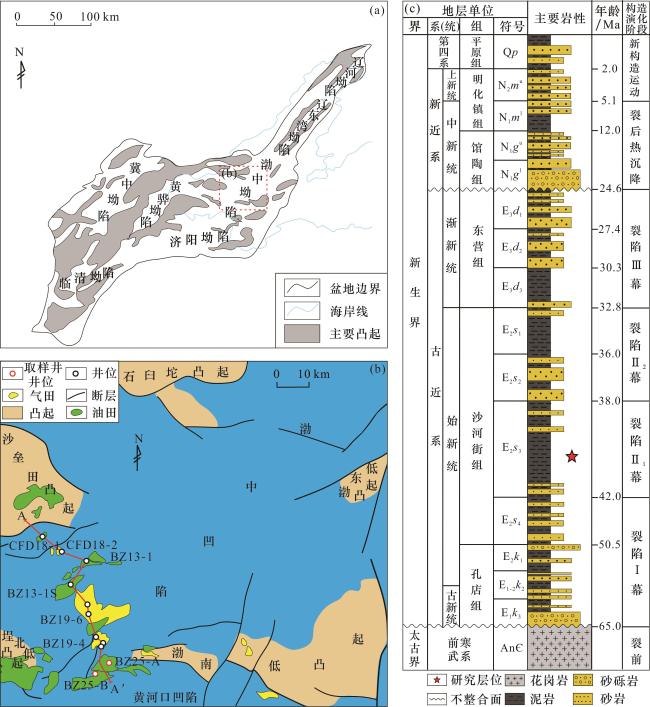
渤海湾盆地位于中国东部海岸[图1(a)],是新生代形成的含油气盆地19。渤中凹陷是渤海湾盆地最大的生烃凹陷,面积约为8 660 km2,页岩油气资源量潜力巨大,BZ19-6大型气田的发现也证实该区域深层烃源岩具有巨大的生气潜力1825
图1 渤海湾盆地地理位置(a)与渤中凹陷主要构造单元及部分油气田分布(b)及地层综合柱状图(c)[(a)和(b)底图据文献[24]修改]

Fig.1 Geographical location of Bohai Bay Basin(a) and distribution of main tectonic units and some oil and gas fields(b) and comprehensive stratigraphic histogram(c) of Bozhong Sag [(a) and (b) base maps are modified according to ref.[24]]

渤海湾盆地成因复杂,经历多期次构造运动,目前较多学者解释为受同步走滑断裂改造的新生代裂谷盆地,裂陷期发育古近系孔店组(Ek)、沙河街组(Es)和东营组(Ed),裂后热沉降及新构造运动时期发育新近系馆陶组(Ng)和明化镇组(Nm)以及第四系平原组(Qp26-27图1(c)]。沙河街组自上而下可细分为沙一段(Es 1)、沙二段(Es 2)、沙三段(Es 3)及沙四段(Es 4),是渤中凹陷烃源岩发育的主要层位,其中沙一段、沙三段及东营组三段(东三段)是渤中凹陷的3套主力烃源岩28。沙三段沉积期地壳拉张减薄,凹陷快速沉降,与其邻近凹陷广泛互通,周围凸起是主要的物源区29。沙三段沉积期半深湖—深湖相广泛发育,局部为碎屑沉积,优质烃源岩最大厚度超过400 m,岩性以灰色、深灰色泥岩夹砂岩、油页岩为主。自东营组沉积以来,渤中凹陷成为渤海湾盆地的沉积中心和沉降中心,是渤海湾盆地持续沉积最厚的凹陷30
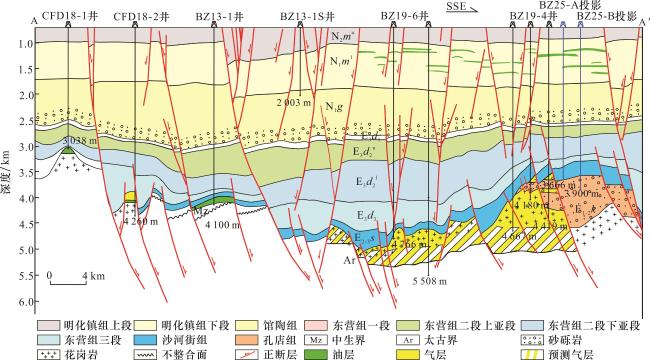
研究区位于渤中凹陷西南部,其东邻渤南低凸起西部,西邻埕北低凸起,位于渤中凹陷和黄河口凹陷交界处,是一个受断层控制的断背斜构造,地层发育较为完整[图1(b),图2]。沙三段自下而上可以分为3个亚段,分别为沙三下亚段(Es 3 l)、沙三中亚段(Es 3 m)、沙三上亚段(Es 3 u),研究区沙三中—下亚段较为发育,普遍缺失沙三上亚段,与上部沙二段呈不整合接触31。沙三段沉积时期BZ25油田地区古地貌地形西南高东北低,物源主要来源于埕北低凸起,沉积了一套半深湖—深湖相沉积物32
图2 渤中凹陷西南部地层剖面图[剖面位置见图1(b),底图据文献[25]修改]

Fig.2 Stratum profile in the southwestern Bozhong Sag (the profile location is shown in Fig.1(b), the base map is modified according to Ref.[25])

2 样品与方法

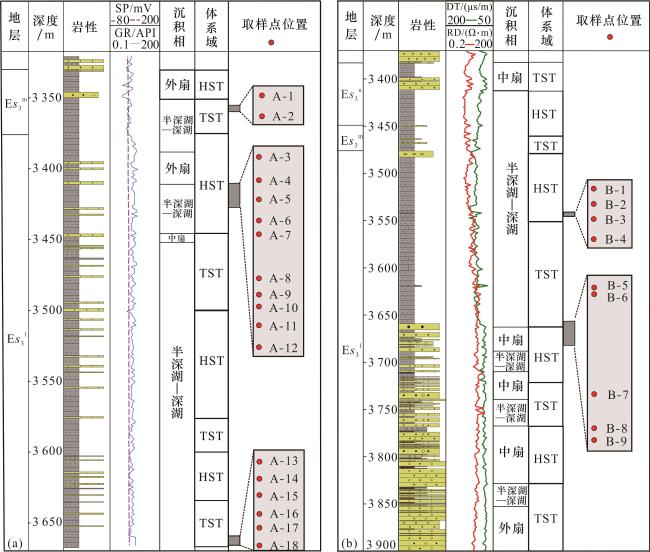
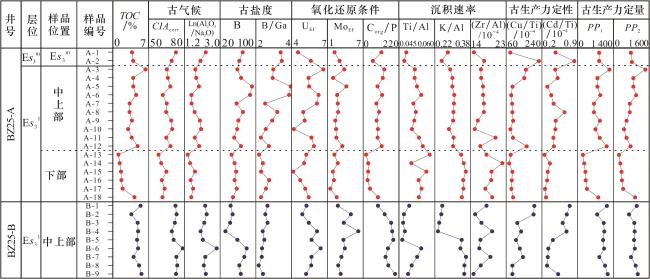
本文研究选取了渤中凹陷西南部的2口井(BZ25-A井和BZ25-B井)沙三段泥岩岩心样品,取样深度为3 356.05~3 683.54 m,共计27块岩心样品。其中BZ25-A井样品18个,样品A-1和A-2位于Es 3 m,样品A-3到A-12靠近Es 3 l上部,样品A-13到A-18靠近Es 3 l下部;BZ25-B井样品9个,样品B-1到B-4靠近Es 3 l上部,样品B-5到B-9靠近Es 3 l中上部(图3)。本文研究将Es 3 l分为2个部分,Es 3 l下部(样品A-13到A-18)和Es 3 l中上部(样品A-3到A-12和样品B-1到B-9)。所有样品都进行了TOC含量和主微量元素分析,实验前除去了岩心表面可能存在污染的部分,以减少外部污染对实验结果的影响。
图3 研究区沙三段BZ25-A(a)、BZ25-B(b)单井柱状图

Fig.3 Histogram of single Wells BZ25-A(a) and BZ25-B(b) in Es 3 in the study area

2.1 有机碳含量测定

TOC含量测定在长江大学油气地球化学与环境湖北省重点实验室完成。TOC含量测定前,用分析天平称取80~90 mg粉碎至200目的粉末样品置于坩埚中,加入过量稀盐酸溶液(分析纯盐酸按体积比HCl∶H2O=1∶7配制)浸泡12 h,充分反应除去样品中的碳酸盐,再用去离子水冲洗至中性,除去残余的HCl,待样品晾干后放入60 ℃的烘箱内彻底烘干,烘样时间大于48 h,处理后的样品通过LECO-CS230碳硫分析仪测定样品中的有机碳,具体方法参考国家标准《沉积岩中总有机碳的测定》(GB/T 19145—2003)。

2.2 主微量元素测定

主微量元素分析由核工业北京地质研究院完成,主量元素测定前,先称取一定量粉碎后的样品放入干净的陶瓷坩埚中置于马弗炉中灼烧,计算得到烧失量,称取烧失后的粉末加入无水四硼酸锂、氟化锂和硝酸铵混合均匀,放入熔样机进行熔融后铸模,制成玻璃样片,随后通过Axios-mAX波长色散X射线荧光光谱仪测定,分析精度优于5%,具体方法参考国家标准《硅酸盐岩石化学分析方法第28部分:16个主次成分量测定》(GB/T 14506.28—2010)。微量元素测定前先称取一定量粉末样品加入氢氟酸和硝酸加热到190 ℃并恒温24 h进行消解,冷却后取出,加热蒸发多余试剂,加入2 mL硝酸后蒸发至干,再加入1 mL硝酸密封放入烘箱130 ℃加热3 h,冷却后进行转移并定容,再通过ELEMENT XR等离子体质谱仪测定,分析精度优于5%,具体方法参考国家标准《硅酸盐岩石化学分析方法第30部分:44个元素量测定》(GB/T 14506.30—2010)。

3 地球化学特征

3.1 有机碳含量

TOC含量可以代表岩石中有机质的丰度,27块泥岩岩心样品TOC含量介于1.05%~6.37%之间,平均值为3.80%(表1),样品TOC含量存在较大差异,Es 3 l下部TOC含量较低,介于1.05%~4.19%之间,平均值为1.94%;Es 3 l中上部和Es 3 m样品TOC含量普遍较高,平均值为4.34%。
表1 Es 3 m—l泥岩TOC和主量元素含量(FeT表示全铁)

Table 1 TOC content and major element content of mudstone in Es 3 m—l (FeT represents total iron)

样品编号 深度/m TOC/% 主量元素/%
SiO2 Al2O3 FeT MgO CaO Na2O K2O MnO TiO2 P2O5 烧失量 FeO
A-1 3 356.05 3.71 47.90 15.02 7.39 2.88 5.72 0.94 2.67 0.08 0.64 0.19 16.54 4.31
A-2 3 359.20 3.94 57.00 14.19 7.02 1.51 2.35 1.16 2.27 0.12 0.59 0.39 13.27 3.27
A-3 3 412.60 6.37 50.78 13.99 4.35 1.55 6.63 1.48 2.58 0.17 0.64 0.29 17.41 1.96
A-4 3 414.00 3.95 56.10 16.20 5.31 1.50 2.61 1.63 3.09 0.17 0.74 0.19 12.33 3.13
A-5 3 415.20 3.96 50.77 15.66 8.23 1.99 3.12 1.38 2.98 0.22 0.73 0.26 14.64 4.47
A-6 3 416.40 4.52 56.30 15.97 4.21 1.66 3.53 2.05 3.13 0.13 0.77 0.23 11.95 2.73
A-7 3 417.30 3.25 59.62 16.31 3.88 1.34 1.55 2.09 3.18 0.25 0.73 0.24 10.33 2.64
A-8 3 419.90 3.24 57.10 15.86 4.00 1.73 3.68 1.74 3.07 0.10 0.73 0.20 11.46 2.70
A-9 3 420.90 3.69 49.99 15.40 8.60 1.73 3.54 1.29 2.97 0.26 0.70 0.26 15.25 5.73
A-10 3 421.60 2.95 50.95 15.66 5.42 2.67 4.26 1.24 2.83 0.11 0.70 0.19 15.92 3.85
A-11 3 422.75 3.66 53.53 15.26 6.33 1.59 3.64 1.66 2.96 0.22 0.72 0.24 13.72 3.89
A-12 3 423.99 4.82 50.42 15.37 8.56 2.07 3.31 1.34 2.96 0.38 0.75 0.25 14.58 5.52
A-13 3 660.20 1.05 59.60 15.30 4.23 2.04 3.88 2.37 3.30 0.04 0.78 0.35 7.98 3.05
A-14 3 661.20 1.31 61.63 15.34 3.51 1.54 3.62 2.11 3.42 0.03 0.68 0.25 7.76 2.37
A-15 3 662.20 1.56 56.63 16.55 4.36 1.88 3.68 1.78 3.79 0.03 0.82 0.30 10.05 3.33
A-16 3 663.25 1.62 55.07 14.66 5.18 1.73 6.18 1.96 3.25 0.04 0.69 0.36 10.84 4.14
A-17 3 664.10 1.88 58.55 16.08 4.09 1.82 3.73 1.90 3.57 0.03 0.77 0.26 9.13 3.17
A-18 3 665.20 4.19 57.21 14.93 4.42 1.81 4.95 1.94 3.25 0.03 0.70 0.27 10.43 3.82
B-1 3 543.80 5.40 43.37 11.63 3.37 2.14 13.48 0.75 1.88 0.10 0.51 0.35 22.35 2.04
B-2 3 544.75 3.59 52.33 13.21 4.42 1.50 7.73 0.79 2.10 0.24 0.55 0.16 16.96 2.11
B-3 3 545.73 4.82 47.75 11.51 4.19 1.99 11.30 0.78 1.76 0.16 0.47 0.16 19.86 2.14
B-4 3 547.00 4.91 48.04 9.45 4.42 1.86 12.76 0.76 1.41 0.17 0.40 0.16 20.50 2.15
B-5 3 659.77 4.72 52.82 16.26 6.93 1.32 1.58 1.18 3.53 0.11 0.66 0.15 15.42 4.10
B-6 3 660.60 4.91 46.88 19.80 7.49 1.54 1.53 0.71 4.23 0.08 0.95 0.19 16.56 3.39
B-7 3 677.50 4.03 54.12 19.58 5.29 1.22 1.25 1.25 4.49 0.04 0.91 0.17 11.65 2.49
B-8 3 682.00 5.10 51.87 18.58 7.30 1.30 1.01 1.28 4.18 0.08 0.82 0.19 13.24 4.01
B-9 3 683.54 5.57 56.64 18.18 4.87 1.28 1.51 1.13 4.08 0.07 0.78 0.17 11.25 2.37

3.2 主微量元素特征

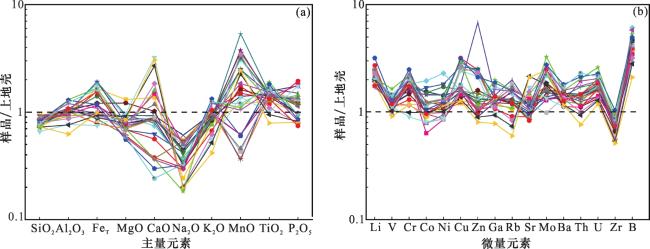
样品中主要成分SiO2含量最高,Al2O3含量次之,SiO2含量介于43.37%~61.63%之间,平均值为53.44%;Al2O3含量介于9.45%~19.80%之间,平均值为15.41%(表1)。FeT(全铁)和CaO也有较高含量,其中FeT含量介于3.37%~8.60%之间,平均值为5.46%;CaO含量介于1.01%~13.48%之间,平均值为4.52%;MnO、TiO2和P2O5含量均低于1%(表1)。相比于上地壳,主量元素SiO2、Al2O3、FeT、MgO、K2O、TiO2和P2O5富集或亏损程度变化较小,CaO和MnO富集和亏损程度变化较大,Na2O整体明显亏损[图4(a)]。
图4 主量元素(a)和微量元素(b)相对上地壳分布特征(上地壳数据来自参考文献[41])

Fig.4 Distribution characteristics of principal elements(a) and trace elements(b) relative to UCC(UCC data from Ref.[41])

微量元素中Ba含量最高,为(617~992)×10-6,平均值为771×10-6;其次是Sr含量,为(292~753)×10-6表2)。U含量在(3.32~7.30)×10-6之间,平均值为4.77×10⁻⁶;Mo含量在(1.48~4.90)×10-6之间,平均值为2.88×10⁻⁶表2)。相比于上地壳,研究区沙三中—下亚段微量元素Li、Cu、Ba、U和B整体富集,Zr为亏损,其余微量元素大多富集,少数样品为亏损[图4(b)]。
表2 Es 3 m—l泥岩部分微量元素含量及相关参数的计算结果

Table 2 The contents of trace elements and the calculatio results of related parameters in mudstone of Es 3 m—l

样品

编号

深度

/m

微量元素/10-6 古气候 古盐度 氧化还原条件 沉积速率
Li V Ga Sr Mo Ba Th U Zr CIA corr

Ln(Al2O3

/Na2O)

B B/Ga Corg/P UEF MoEF Ti/Al K/Al

(Zr/Al)

/10-4

LSR

/(cm/ka)

A-1 3 356.05 47.9 121 20.8 484 2.07 836 12.1 3.9 118 72.97 2.27 70.5 3.39 112.2 4.53 2.19 0.048 0.28 14.85 10.9
A-2 3 359.20 54.2 118 18.2 316 2.7 618 11.9 4.56 131 69.35 2.01 62.9 3.46 59.6 5.61 3.02 0.047 0.25 17.45 10.9
A-3 3 412.60 36.4 119 19.7 518 3.37 687 12.8 5.34 123 65.28 1.75 58.6 2.97 130.3 6.66 3.83 0.052 0.29 16.62 13.0
A-4 3 414.00 40.6 128 22.8 322 1.97 745 15.3 5.03 143 66.11 1.80 67.0 2.94 120.7 5.42 1.93 0.051 0.30 16.69 13.0
A-5 3 415.20 41.2 143 23.1 306 4.13 823 14.7 4.9 142 68.22 1.93 91.2 3.95 88.0 5.46 4.19 0.052 0.30 17.14 13.0
A-6 3 416.40 38.7 118 22.5 362 2.64 689 20.8 5.73 145 61.87 1.56 86.9 3.86 116.9 6.26 2.62 0.054 0.31 17.16 13.0
A-7 3 417.30 40.1 121 22.6 299 2.81 767 15.5 5.72 150 65.23 1.56 56.8 2.51 81.2 6.12 2.74 0.051 0.31 17.39 13.0
A-8 3 419.90 38.7 119 22.2 349 2.78 756 14.7 4.52 146 64.66 1.71 71.0 3.20 97.5 4.97 2.78 0.052 0.30 17.40 13.0
A-9 3 420.90 37.6 137 20.8 335 2.25 813 14.7 4.49 129 68.99 1.98 60.6 2.91 82.7 5.09 2.32 0.051 0.30 15.83 9.2
A-10 3 421.60 48.6 125 22.7 427 2.41 844 12.0 3.75 125 69.81 2.04 57.9 2.55 90.7 4.18 2.44 0.050 0.28 15.09 9.2
A-11 3 422.75 41.1 137 22.6 410 2.39 801 15.3 4.95 164 64.81 1.72 51.4 2.27 88.8 5.66 2.49 0.053 0.30 20.32 9.2
A-12 3 423.99 40.9 149 24.4 350 3.39 781 18.3 5.17 134 68.38 1.94 66.6 2.73 114.1 5.87 3.50 0.055 0.30 16.48 9.2
A-13 3 660.20 48.0 105 21.0 415 2.08 823 15.7 4.58 146 72.61 2.24 43.2 2.65 91.1 5.24 2.74 0.049 0.25 18.04 13.4
A-14 3 661.20 48.7 118 21.9 464 2.63 830 14.1 4.43 179 73.53 2.32 47.7 2.52 132.5 4.89 4.94 0.047 0.25 15.17 13.4
A-15 3 662.20 47.5 126 24.4 399 1.98 789 13.4 3.92 169 72.02 2.20 42.2 2.65 172.5 5.44 3.74 0.047 0.24 16.75 13.4
A-16 3 663.25 42.2 115 19.1 465 1.93 777 12.2 3.96 149 69.53 2.02 31.6 2.38 179.0 6.13 6.18 0.047 0.23 19.46 13.4
A-17 3 664.10 48.7 116 22.3 412 1.48 745 15.0 4.73 151 71.04 2.13 58.5 2.47 185.9 5.67 3.67 0.046 0.34 16.51 13.4
A-18 3 665.20 49.6 125 21.3 433 2.40 683 14.6 4.65 154 78.69 2.83 79.4 2.34 152.5 6.43 3.93 0.054 0.34 16.23 13.4
B-1 3 543.80 40.1 120 16.3 595 2.01 617 10.2 3.49 111 73.32 2.25 74.0 2.33 138.3 5.66 3.34 0.053 0.36 19.02 11.2
B-2 3 544.75 45.8 129 18.9 540 4.11 729 10.7 3.7 106 74.12 2.18 62.9 2.15 155.1 5.63 2.80 0.050 0.35 16.58 11.2
B-3 3 545.73 40.4 110 15.9 753 2.71 642 10.0 3.59 102 73.06 2.28 66.1 2.39 196.9 5.21 3.22 0.049 0.35 14.77 11.2
B-4 3 547.00 36.5 97.6 13.3 736 3.68 640 8.16 3.32 97.3 58.29 1.37 45.6 2.17 17.6 5.22 2.16 0.058 0.34 18.04 11.2
B-5 3 659.77 35.3 127 23.7 292 3.76 702 15.6 5.28 142 60.58 1.49 52.3 2.39 30.9 5.04 2.72 0.050 0.35 22.06 11.3
B-6 3 660.60 41.3 176 33.9 367 4.90 873 21.8 7.3 170 65.00 1.73 55.8 2.29 30.5 4.13 1.90 0.056 0.36 19.30 11.3
B-7 3 677.50 63.6 137 31.8 397 4.12 992 22.8 6.35 197 61.12 1.51 52.3 2.74 26.7 4.71 2.09 0.053 0.35 19.21 11.3
B-8 3 682.00 41.5 156 29.2 373 3.28 953 24.6 6.0 163 63.37 1.64 57.1 2.56 42.1 5.13 1.46 0.054 0.35 17.75 11.3
B-9 3 683.54 33.7 136 27.6 371 3.69 873 18.7 5.43 142 61.65 1.54 48.7 2.29 90.7 5.43 2.55 0.053 0.34 19.50 11.3

注: CIA corr=[Al2O3/(Al2O3+CaO*+Na2O+K2Ocorr)]×100;Corg/P=(TOC/12)/(P/30.97);X EF=[(X/Al)sample/(X/Al)PAAS],X代表U和Mo

4 讨论

4.1 古气候

古气候变化主要控制陆源碎屑的供应和沉积水体环境,间接影响了生物的发育和繁殖,进而影响湖泊沉积物中有机质的浓度33
NESBITT等34首次提出化学蚀变指数(CIA)的概念,用于定量研究物源区的风化程度,也被广泛用于古气候的研究。母岩在风化过程中Na+、Ca2+、K+等碱金属元素容易流失,而Al3+和Ti4+相对保留,风化作用早期阶段主要是Ca2+和Na+的流失,晚期阶段以K+的流失为主,且前人35-36研究表明,母岩中长石释放Ca、Na和K的速率遵循线性定律。因此,CIA能够反映古气候和物源风化程度,其计算公式为:
CIA=[Al2O3/(Al2O3+CaO*+Na2O+K2O)]
×100
式(1)中:氧化物均以摩尔分数表示;CaO*仅代表硅酸盐矿物中的CaO,需扣除碳酸盐和磷酸盐中的CaO。MCLENNAN等37提出了一种简化方法来计算CaO*,CaO*=CaO-10/3P2O5,若CaO*<Na2O,则CaO*=CaO*;若CaO*>Na2O,则CaO*=Na2O。
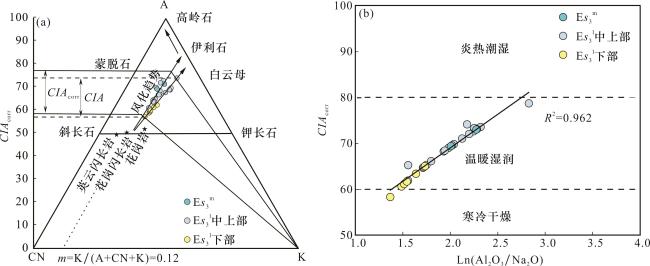
一般认为,CIA值在50~60之间,反映寒冷干燥的古气候;CIA值在60~80之间,反映温暖湿润的古气候;CIA值在80~100之间,则反映了炎热潮湿的古气候38。在利用CIA进行古气候示踪时,需要注意沉积物成岩过程中钾交代作用的影响,会导致CIA计算结果偏低,在A—CN—K(A=Al2O3,CN=CaO*+Na2O,K=K2O)图上表现出偏离风化趋势线,向K端元偏移[图3(a)]。因此,在使用CIA值判别古气候时,需要对CIA值进行校正,其校正后CIA值表示为CIA corr,校正结果如图5(a)所示,也可以通过PANAHI等39提出的对K的校正公式进行计算,其计算公式如下:
K2Ocorr=[m∙Al2O3+m∙(CaO*+Na2O)]/(1-m
图5 Es 3 m—l泥岩A—CN—K三角图(a)和Ln(Al2O3/Na2O)—CIA corr关系图(b)

Fig.5 A-CN-K triangle diagram(a) and relationship diagram between Ln(Al2O3/Na2O) and CIA corr(b)of mudstone in Es 3 m—l

式(2)中:m表示母岩中的比值,m=K2O/(Al2O3+CaO*+Na2O+K2O),可以通过A—CN—K图[图5(a)]上风化趋势线反向延长交于钾长石和斜长石连接线后,继续延长交于CN—K边界获得40。VON EYNATTEN等40认为Ln(Al2O3/Na2O)与化学风化趋势具有极好的相关性,也被用于研究古气候的变化。
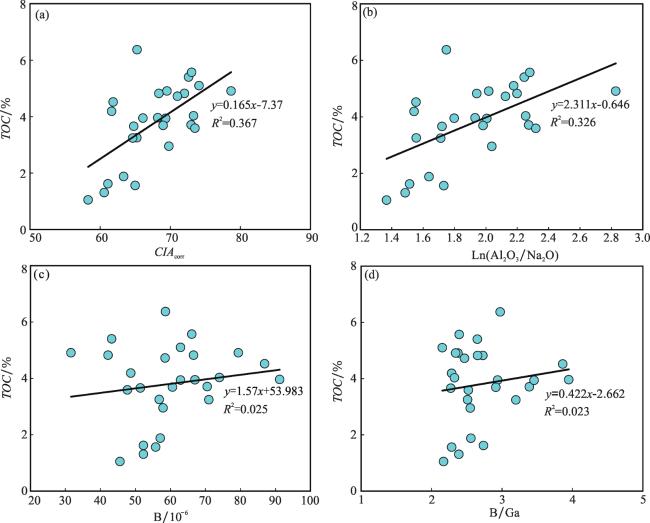
研究区Es 3 l下部泥岩CIA corr值在58.29~65.00之间,平均值为61.67;Es 3 l中上部泥岩CIA corr值在61.89~78.69之间,平均值为69.54;Es 3 m 2个泥岩样品CIA corr值分别为72.97和69.34。Es 3 m—l整体为温暖湿润的古气候,Es 3 l下部气候相对干旱,Es 3 l中上部和Es 3 m气候更加湿热,Ln(Al2O3/Na2O)与CIA corr具有极好的相关性[图5(b)]。随着CIA corr和Ln(Al2O3/Na2O)的增大,TOC含量均呈现明显的增高,TOC含量与CIA corr和Ln(Al2O3/Na2O)均具有良好的正相关关系[图6(a),图6(b)],说明更加湿热的古气候有利于有机质的富集。刘占红等42认为研究区湿热的古气候与优质烃源岩发育层段存在对应关系,此次研究结果也同样证明了这一观点。
图6 Es 3 m—l泥岩TOC与古气候[(a),(b)]、古盐度[(c),(d)]相关关系

Fig.6 The correlation between TOC and palaeoclimate[(a),(b)], palaeosalinity[(c),(d)] of mudstone in Es 3 m—l

4.2 古盐度

沉积时期水体盐度是影响有机质富集的重要因素43,由于生物对水体盐度耐受性的限制,生物物种的多样性会随着水体的盐度增加呈现先增加后减少的特征44,恢复沉积时期水体盐度对有机质富集具有重要意义。
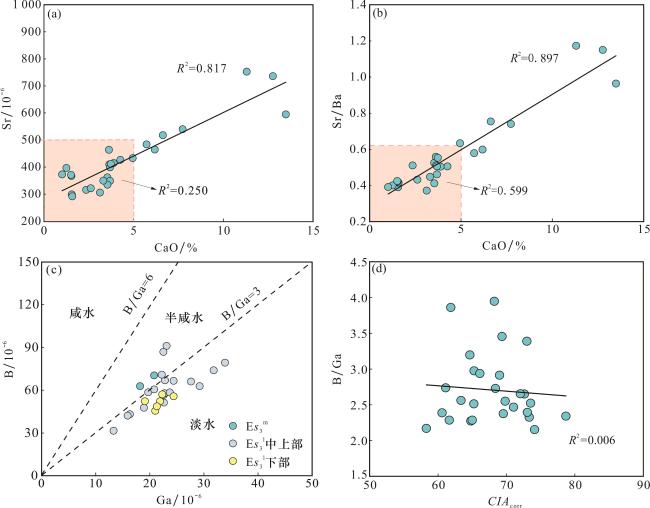
在元素地球化学研究中,常用Sr/Ba值判别古盐度,一般Sr2+主要被黏土矿物吸附或以与有机质结合的形式沉积,然而,在碳酸盐含量高的泥岩中,Sr2+会不同程度地取代Ca2+进入CaCO3晶格中45,少量碳酸盐的增加,会对黏土组分中Sr/Ba值产生较大的影响46。研究区沙三段泥岩样品CaO与Sr和Sr/Ba具有极好的正相关关系,相关系数R 2分别为0.817和0.897,当CaO含量低于5%,R 2均有明显降低(R 2值分别为0.250和0.559),但依然具有较高的相关性[图7(a),图7(b)]。HODELL等47认为Sr和Ca良好的相关性表明Ca是生物来源,陆源碎屑来源的Ca,具有低含量的Sr。研究区CaO对Sr/Ba判别盐度存在一定影响,因此不适合用于研究区古盐度的判断。
图7 Es 3 m—l泥岩CaO—Sr含量关系(a)与CaO—Sr/Ba关系(b)与B—Ga盐度判别关系(c)与古气候参数CIA corr与古盐度参数B/Ga相关关系(d)

Fig.7 Diagram of CaO-Sr content(a) and CaO-Sr/Ba(b) and discriminant diagram between B-Ga content and salinity(c), correlation between the paleoclimate parameters CIA corr and the paleo salinity parameters B/Ga(d) of mudstone in Es 3 m—l

此外,B含量也可作为水体盐度的判别,B对水体盐度敏感,水体中的B易被黏土矿物吸附,吸收的量与B的浓度有关,而水体中B的浓度是盐度的线性函数46。通过对现代沉积物的研究表明,淡水沉积物B含量小于44×10-6,海水沉积物大于92×10-6,半咸水沉积物介于(44~92)×10-6之间48。B/Ga值作为一种比B含量更加可靠的盐度参数,常用于古盐度的判别,Ga在水体中主要以氢氧化物的形式存在,溶解度较低,迁移能力较差,因此,B/Ga值越大盐度越高,B/Ga值小于3.3,介于3.3~6和大于6,分别指示淡水、半咸水和咸水环境46
研究区Es 3 l下部泥岩B含量为(45.6~57.1)×10-6,平均值为51.9×10⁻⁶;Es 3 l中上部泥岩B含量为(31.6~91.2)×10-6,平均值为61.8×10⁻⁶;Es 3 m 2个泥岩B含量分别为62.9×10⁻⁶和70.5×10⁻⁶。Es 3 l下部泥岩B/Ga值为2.17~2.74,平均值为2.41;Es 3 l中上部泥岩B/Ga值为2.15~3.95,平均值为2.73;Es 3 m 2个泥岩B/Ga值分别为3.39和4.46。Es 3 m—l整体盐度较低,Es 3 l下部为淡水环境,Es 3 l中上部为淡水—半咸水,Es 3 m为半咸水环境[图7(c)]。Es 3 m—l古气候参数CIA corr与古盐度B/Ga没有明显关系[图7(d)],说明古气候对水体盐度影响较弱。Es 3 m—l泥岩TOC含量与古盐度参数B含量和B/Ga相关关系均不明显,相关性低[图6(c),图6(d)],说明水体盐度对沙三段有机质富集的影响很小。前人1544在研究东濮凹陷沙三段时发现,其烃源岩发育于咸水环境,有机质富集程度随着盐度增大,呈现先增大后减小的趋势,而此次研究中未发现类似变化,这可能是由于在较低的盐度下,水体盐度变化范围小,对生物种类和丰度的影响不大。

4.3 古氧化还原条件

氧化还原条件是影响有机质保存的关键因素,沉积物中的氧化还原敏感元素(如V、Cr、Mo、Fe、U等)在有氧和缺氧条件下具有不同的化学性质49-51。前人52基于对海相的研究,利用微量元素比值的阈值划分沉积水体氧化还原条件。然而,在不同沉积体系中,这些阈值可能存在很大差异53,如湖泊沉积环境中的Cr和Co很容易受到陆源碎屑输入、成岩作用和沉积后再氧化的影响50
鉴于研究区微量元素比值法的阈值可能受陆源碎屑输入等影响,本文使用微量元素富集系数判断沙三段沉积期水体氧化还原环境。在氧化条件下的水体中U和Mo行为保守,U在氧化条件下,U4+主要以可溶性的 U O 2 ( C O 3 ) 3 4 -络合物形式存在,在Fe2+—Fe3+氧化还原界面附近被还原成U4+进入沉积物中54。Mo在氧化条件下,以稳定且基本不活泼的 M o O 4 2 -形式存在,在缺氧—硫化条件下, M o O 4 2 -在含H2S的环境中被活化,被还原转化为 M o O x S ( 4 - x ) 2 -(x=0~3),易被有机质或铁硫化合物络合或吸附进入沉积物中54。因此U和Mo都在缺氧条件下富集,但Mo富集则需要更强的还原环境。尽管现代湖泊水体中(除部分高盐湖泊外)U和Mo的浓度远低于海水55,但海洋和湖泊中U和Mo的富集机制相同,且前人50研究表明,Mo—U协变模式在湖相氧化还原条件判别中同样适用。使用微量元素富集系数X EFX代表U、Mo)表示U和Mo各自的富集程度,用于判别氧化还原条件,其中X EF=[(X/Al)sample/(X/Al)PAAS],(X/Al)sample表示样品中X和Al质量浓度的比值,(X/Al)PASS表示澳大利亚后太古宙页岩(PASS)元素X和Al比值41X EF<1表示亏损,X EF>1表示富集。此外,Corg/P摩尔比也是反映氧化还原条件的有效指标,Corg/P表示有机碳与元素P的摩尔比,计算公式为Corg/P=(TOC/12)/(P/30.97)56。在沉积水体中,生物死亡沉降后,含P有机质在沉积物和水界面附近迅速分解,P的再矿化或保存取决于底水氧化还原条件:在缺氧条件下,沉积有机质发生降解释放有机P并从孔隙水中扩散重新进入水体;而在氧化条件下,沉积物中Fe的氢氧化物吸附以及某些细菌和原生动物的多磷酸盐代谢有利于P的保存56。一般认为,在还原条件下Corg/P>100,在氧化条件下Corg/P<5056
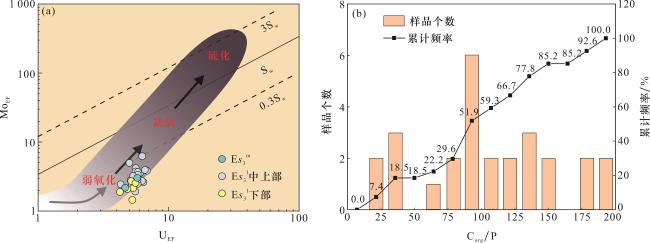
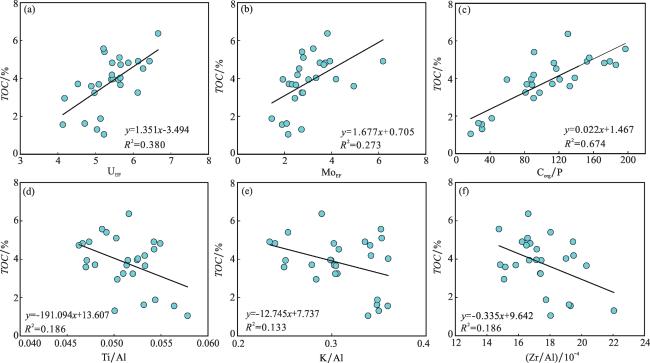
研究区Es 3 m 2个泥岩UEF值分别为4.53和5.60,MoEF值分别为2.18和3.02;Es 3 l中上部泥岩UEF值介于4.17~6.66之间,平均值为5.58,MoEF值介于1.93~6.18之间,平均值为3.34;Es 3 l下部泥岩UEF值在4.13~5.43之间,平均值为4.95,MoEF值介于1.46~2.72之间,平均值为2.15。Es 3 m—l泥岩所有样品UEF和MoEF值均大于1,相对PASS富集。从Mo—U共变模式图来看[图8(a)],样品主要落于弱氧化—缺氧之间,反映了较还原的底水环境,Es 3 l下部相比Es 3 l中上部和Es 3 m泥岩MoEF和UEF富集程度低。研究区Es 3 m—l泥岩Corg/P摩尔比在17.61~196.94之间,平均值为104.63,从频率分布直方图来看[图8(b)],约48.1%的样品Corg/P>100,约33.3%的样品Corg/P值介于50~100之间,约18.5%的样品Corg/P<50,反映Es 3 m—l底水以弱氧化—还原条件为主。Es 3 m—l泥岩TOC值随着UEF、MoEF和Corg/P值的增大而增大,均呈现较好的正相关关系[图9(a)—图9(c)],说明较还原的底水对有机质保存起到积极作用。
图8 Es 3 m—l泥岩Mo—U协变模式图(a)与Corg/P摩尔比频率分布直方图(b)

Fig.8 Covariant pattern diagram of Mo-U(a) and histogram of Corg/P molar ratio frequency distribution(b) of mudstone in Es 3 m—l

图9 Es 3 m—l泥岩TOC与氧化还原条件[(a)、(b)、(c)]与沉积速率(d)、(e)、(f)相关关系

Fig.9 Correlation between TOC and REDOX conditions[(a),(b),(c)] and deposition rates[(d),(e),(f)]of mudstone in Es 3 m—l

4.4 沉积速率

陆源碎屑输入会稀释有机质浓度,进而影响有机质的富集,沉积速率高低可以表征陆源碎屑的输入强度的高低,过低或过高的沉积速率都不利于有机质的富集814。研究表明,随着沉积速率的增加,TOC值与沉积速率呈现先增大后减小的趋势,过低的沉积速率会增加有机质降解的时间,过高的沉积速率会稀释有机质的浓度,只有适宜的沉积速率才有利于有机质的富集8-11。DING等9和CHEN等11分别对二连盆地和酒泉盆地白垩系沉积速率进行分析,认为有机质富集的最佳沉积速率分别为5 cm/ka和12.06 cm/ka。
沉积岩中的Ti主要存在于黏土、砂—粉砂级大小的重矿物颗粒中(如钛铁矿、金红石、辉石),Al存在于黏土、长石和其他铝硅酸盐中57,Ti/Al值越大,表明颗粒粒度越大,碎屑输入越强58。而云母黏土的输入或细粒钾长石的增加会导致K/Al值增加,K/Al也可以反映碎屑输入强度57。另外,Zr/Al与沉积速率也具有良好的正相关关系59。参数Ti/Al、K/Al和Zr/Al值越大,代表陆源碎屑输入越强、沉积速率越高。
研究区Es 3 m 2个泥岩样品Ti/Al值分别为0.048和0.047;Es 3 l中上部泥岩Ti/Al值介于0.046~0.055之间,平均值为0.051;Es 3 l下部泥岩Ti/Al值介于0.050~0.058之间,平均值为0.054。Es 3 m—l泥岩Ti/Al值均高于济阳凹陷沙三上段油页岩(Ti/Al平均值为0.046)14。前人21计算渤中凹陷沙三段平均沉积速率为19.62 cm/ka,此次计算出的沉积速率Es 3 m为10.9 cm/ka,Es 3 l中上部分别为13 cm/ka、9.2 cm/ka、11.2 cm/ka和11.3 cm/ka,Es 3 l下部为13.4 cm/ka(具体取值见表2),相比前人提出的有机质富集的最佳沉积速率,沙三段沉积速率处于较高水平。Es 3 m—l泥岩TOC含量与Ti/Al、K/Al和Zr/Al均呈现负相关关系[图9(d)—图9(f)],随着沉积速率的增大,TOC含量逐渐降低,表明Es 3 m—l泥岩较高沉积速率稀释了有机质浓度,不利于有机质的富集。

4.5 古生产力

初级生产力是有机质的主要物质来源,对沉积物中有机质的累积至关重要59。研究区沙三段烃源岩有机质类型以Ⅰ型为主,混杂少量Ⅱ120,油页岩中发现大量藻类化石,包括渤海藻属、粒面角凸藻、细瘤面锥藻等28。另外,烃源岩中高丰度的4-甲基甾烷,说明渤海藻属和副渤海藻属繁盛19。这些证据表明,沙三段沉积期水生藻类极其发育,水体初级生产力高。
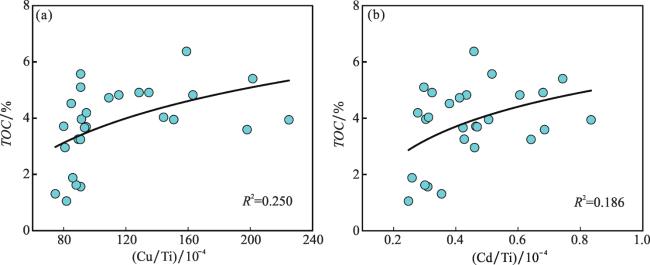
通过营养元素Cu和Cd含量可以反映古生产力的大小54,Cu和Cd含量越高表明古生产力越高,通过Cu/Ti和Cd/Ti值可以判断陆源输入的影响,对古生产力进行定性评价。研究区Es 3 l下部泥岩Cu/Ti值介于(74.6~94.6)×10-4之间,平均值为85.6×10-4;Es 3 l中上部Cu/Ti值介于(80.8~201.6)×10-4之间,平均值为121.6×10-4;Es 3 m2个泥岩样品Cu/Ti值分别为80.0×10-4和224.8×10-4。Es 3 l下部泥岩Cd/Ti值在(0.25~0.35)×10-4之间,平均值为0.29×10-4;Es 3 l中上部Cd/Ti值在(0.30~0.74)×10-4之间,平均值为0.48×10-4;Es 3 m 2个泥岩样品Cd/Ti值分别为0.46×10-4和0.83×10-4。Cu/Ti和Cd/Ti显示在Es 3 l下部古生产力较低,Es 3 l中上部古生产力逐渐增大。随着Cu/Ti值和Cd/Ti值的增大,TOC含量均出现升高的趋势[图10(a),图10(b)],表明Es 3 m—l泥岩有机质的富集受古生产力影响,随着古生产力的增大,后续TOC值的增加变得相对平缓。
图10 Es 3 m—l泥岩TOC与古生产力相关关系

Fig.10 Correlation between TOC and paleoproductivity of mudstone in Es 3 m—l

本文还通过2种有机碳法对Es 3 m—l泥岩古生产力进行定量恢复。根据SCHOEPFER等60推导出的生产力计算公式:
PROD prim=1 000×(104.1×TOC)/BAR 0.54
BAR=ρ×LSR
式(3)中:PROD prim表示古生产力,mg/(cm2∙ka),下文以PP 1表示;BAR表示沉积物堆积速率,g/(cm∙ka),BAR=ρ×LSR;ρ表示沉积物密度,g/cm3LSR表示沉积速率,cm/ka。
LIU等21根据TOC的定义推导出的古生产力计算公式:
PP=TOC×K×ρ×(1-φ)×L/(0.15×t
式(4)中:PP表示古生产力,g/(m2∙a),下文以PP 2表示;TOC表示残余有机碳,%;K为恢复系数,此处取1.19;ρ表示沉积物密度,g/cm3φ表示孔隙度,%;L表示地层沉积时的厚度,m;t表示沉积相应厚度L所需要的时间,ka;因此,L/t=LSR,可表示为沉积速率。泥岩的密度变化较小,此次计算密度ρ取2.50 g/cm3,孔隙度φ取0.062 5%,沉积速率取值详见表2
上述2种古生产力计算结果单位不同,为了便于比较,单位统一换算成g/(m2∙a)。结果表明:研究区Es 3 l下部古生产力PP 1值在201.5~804.2 g/(m2∙a)之间,平均值为371.3 g/(m2∙a);Es 3 l中上部PP 1值在632.1~1 242.7 g/(m2∙a)之间,平均值为924.6 g/(m2∙a);Es 3 m 2个样品PP 1平均值为820.7 g/(m2∙a);Es 3 l下部古生产力PP 2值在242.4~967.7 g/(m2∙a)之间,平均值为446.7 g/(m2∙a)之间;Es 3 l中上部PP 2值在467.6~1 426.8 g/(m2∙a)之间,平均值为860.7 g/(m2∙a);Es 3 m 2个样品平均值为718.3 g/(m2∙a),2种方法计算结果差别不大。LIU等21推导公式中沉积速率与TOC含量成反比,反映了高沉积速率对有机质浓度的稀释,并且考虑到烃源岩在生排烃过程中有机质的损耗,对原始有机质进行了恢复,计算结果相对研究区层位更加准确。Es 3 l下部古生力较低,Es 3 l中上部和Es 3 m古生产力较高,这与古生产力定性评价结果一致。
根据KELTS61对现代湖泊营养程度的划分,Es 3 m—l下部属于中—富营养湖泊,Es 3 l中上部属于富—超营养湖泊,Es 3 m属于富营养湖泊,其高古生产力为有机质富集提供了良好的物质基础。

5 有机质富集模式

渤中凹陷进入沙三段沉积期后,地壳拉张,裂陷加剧,湖盆面积扩大,水体加深,广泛发育半深湖—深湖相沉积,古气候由沙四段干旱炎热的亚热带气候逐渐转变为沙三段温暖湿润的亚热带气候192362。Es 3 l下部,古气候仍处于较为干旱炎热的气候,而Es 3 l中上部和Es 3 m气候转变为温暖湿润(图11),TOC含量和古生产力随着气候变得更加温暖湿润,均出现增大的趋势[图6(a),图6(b),图11]。湿热的气候有利于湖泊藻类发育,形成的高生产力,能够不断为沉积物输送有机质,对有机质富集起到重要作用。Es 3 l下部盐度较低,到Es 3 l中上部和Es 3 m盐度出现增大的趋势,在Es 3 l上部和Es 3 m为半咸水环境,研究区Es 3 m—l整体为淡水—半咸水环境(图11),古盐度与TOC相关性较小[图6(c),图6(d)],盐度的变化对有机质富集的影响不明显。前人2163研究认为渤中凹陷沙三段存在水体存在温度分层,分层的水体有利于形成还原环境。此次研究结果表明,研究区Es 3 m—l氧化还原条件存在波动,整体处于弱氧化—还原环境(图11),有利于有机质的保存[图9(a)—图9(c)]。沉积速率的增大可以减少有机质在沉积过程中暴露在氧气中的时间,但同时也会稀释有机质浓度,Es 3 l下部到Es 3 m沉积速率逐渐变小,TOC值增大(图11),沉积速率与TOC值呈现负相关关系[图9(d)—图9(f)],反映Es 3 m—l高沉积速率稀释了有机质的浓度,不利于有机质的富集。古生产力在Es 3 l下部处于较低水平,向Es 3 m出现逐渐增大的趋势(图11),古生产力为有机质富集奠定了物质基础,古生产力分析表明Es 3 l下部为古生产力较低,到Es 3 l中上部以后古生产力增大。
图11 研究区Es 3 m—l泥岩沉积环境及古生产力垂向演化特征

Fig.11 Vertical evolution characteristics of sedimentary environment and paleoproductivity of mudstone in Es 3 m—l in the study area

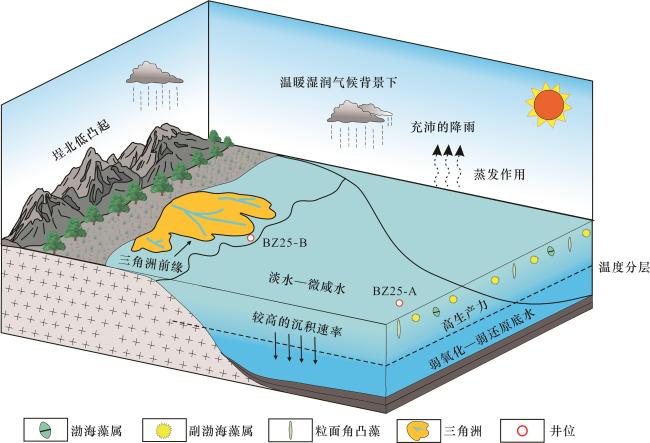
基于以上分析,结合前人对研究区沉积相的研究3264,建立了渤中凹陷西南部沙三中—下亚段泥岩有机质富集模式(图12):Es 3 l下部气候较为干旱,Es 3 l中上部开始气候变得温暖湿润,降雨量充沛,地表径流携带物源区风化产物汇入湖泊水体中,为湖泊生物提供充足的营养元素。在淡水—半咸水的湖泊水体环境中,水生藻类繁盛,形成富营养湖泊,具有较高的初级生产力,为有机质富集提供良好了的物质基础,藻类等初级生产者死亡后沉降进入沉积物中,有机质在弱氧化—还原条件下得到较好的保存,而陆源碎屑输入强度较大,高沉积速率稀释了有机质的浓度。此次研究表明,渤中凹陷西南部Es 3 m—l泥岩有机质富集受古气候、保存条件、沉积速率及古生产力的共同控制。
图12 研究区Es 3 m—l泥岩有机质富集模式

Fig.12 Organic matter enrichment model of mudstone in Es 3 m—l in the study area

6 结论

(1)渤中凹陷西南部Es 3 l下部气候条件较为干旱,沉积水体盐度较低,Es 3 l中上部和Es 3 m气候变得温暖湿润,水体盐度增大,Es 3 m—l整体为淡水—半咸水。Es 3 m—l时期底水保存条件存在波动,整体为弱氧化—还原条件,Es 3 l下部保存条件较差,Es 3 l中上部到Es 3 m保存条件变好。Es 3 m—l整体具有较高的沉积速率,Es 3 l下部到Es 3 m沉积速率呈下降趋势。
(2)古生产力计算结果表明:PP 1PP 2在Es 3 l下部较低,属于中—富营养湖泊,在Es 3 l中上部明显增加,属于富—超营养湖泊,Es 3 m属于富营养湖泊,古生产力出现降低的趋势,在Es 3 l中上部古生产力最高。
(3)渤中凹陷西南部沙三中—下亚段(Es 3 m—l)泥岩有机质含量整体较高,TOC含量介于1.05%~6.37%之间,平均值为3.80%,但有机质丰度差异较大,Es 3 l下部泥岩有机质富集程度较低,Es 3 l中上部到Es 3 m有机质较为富集。有机质富集受多种因素影响,古气候、氧化还原条件和古生产力参数均与有机质富集程度呈正相关,沉积速率与有机质富集程度呈负相关。温暖湿润的古气候、良好的保存条件和高古生产力是Es 3 m—l有机质富集的重要因素,而高沉积速率不利于有机质的富集,古盐度对有机质富集影响不大。
1
何登发,李德生,童晓光,等.中国沉积盆地油气立体综合勘探论[J].石油与天然气地质,2021,42(2):265-284.

HE D F, LI D S, TONG X G, et al. Integrated 3D hydrocarbon exploration in sedimentary basins of China[J]. Oil & Gas Geology,2021,42(2):265-284.

2
卢双舫,黄文彪,陈方文,等.页岩油气资源分级评价标准探讨[J].石油勘探与开发,2012,39(2):249-256.

LU S F,HUANG W B, CHEN F W, et al. Classification and evaluation criteria of shale oil and gas resources: Discussion and application[J]. Petroleum Exploration and Development,2012,39(2):249-256.

3
邹才能,杨智,崔景伟,等.页岩油形成机制、地质特征及发展对策[J].石油勘探与开发,2013,40(1):14-26.

ZOU C N, YANG Z, CUI J W, et al. Formation mechanism, geological characteristics and development strategy of nonmarine shale oil in China[J].Petroleum Exploration and De-velopment,2013,40(1):14-26.

4
王祥,刘玉华,张敏,等.页岩气形成条件及成藏影响因素研究[J].天然气地球科学,2010,21(2):350-356.

WANG X, LIU Y H, ZHANG M, et al. Conditions of formation and accumulation for shale gas[J].Natural Gas Geoscience,2010,21(2):350-356.

5
邹才能,赵群,董大忠,等.页岩气基本特征、主要挑战与未来前景[J].天然气地球科学,2017,28(12):1781-1796.

ZOU C N, ZHAO Q, DONG D Z, et al. Geological characteristics, main challenges and future prospect of shale gas[J]. Natural Gas Geoscience,2017,28(12):1781-1796.

6
DEMAISON G J, MOORE G T. Anoxic environments and oil source bed genesis[J]. AAPG Bulletin,1980,64(8):1179-1209.

7
PEDERSEN T F, CALVERT S E. Anoxia vs. productivity: What controls the formation of organic-carbon-rich sediments and sedimentary rocks?[J]. AAPG Bulletin,1990,74(4):454-466.

8
TYSON R V. Sedimentation rate, dilution, preservation and total organic carbon: Some results of a modelling study[J]. Organic Geochemistry,2001,32(2):333-339.

9
DING X, LIU G, ZHA M, et al. Relationship between total organic carbon content and sedimentation rate in ancient lacustrine sediments: A case study of Erlian Basin, northern China[J]. Journal of Geochemical Exploration,2015,149:22-29.

10
丁修建,柳广弟,查明,等.沉积速率与烃源岩有机质丰度关系——以二连盆地为例[J].天然气地球科学,2015,26(6):1076-1085.

DING X J, LIU G D, ZHA M, et al. Relationship between sedimentation rate and organic matter abundance of source rocks: A case study of Erlian Basin[J]. Natural Gas Geoscience,2015,26(6):1076-1085.

11
CHEN G, GANG W, TANG H, et al. Astronomical cycles and variations in sediment accumulation rate of the terrestrial Lower Cretaceous Xiagou Formation from the Jiuquan Basin, NW China[J]. Cretaceous Research,2020,109:104156.

12
ARTHUR M A, SAGEMAN B B. Marine black shales: Depositional mechanisms and environments of ancient deposits[J]. Annual Review of Earth & Planetary Sciences,1994,22(1):499-551.

13
张慧芳,吴欣松,王斌,等.陆相湖盆沉积有机质富集机理研究进展[J].沉积学报,2016,34(3):463-477.

ZHANG H F,WU X S,WANG B,et al. Research progress of the enrichment mechanism of sedimentary organics in lacustrine basin[J].Acta Sedimentologica Sinica,2016,34(3):463-477.

14
WU Z, ZHAO X, WANG E, et al. Sedimentary environment and organic enrichment mechanisms of lacustrine shale: A case study of the Paleogene Shahejie Formation, Qikou Sag, Bohai Bay Basin[J]. Palaeogeography, Palaeoclimatology, Palaeoecology,2021,573:1-21.

15
胡涛,庞雄奇,姜福杰,等.陆相断陷咸化湖盆有机质差异富集因素探讨——以东濮凹陷古近系沙三段泥页岩为例[J].沉积学报,2021,39(1):140-152.

HU T, PANG X Q, JIANG F J, et al. Factors controlling differential enrichment of organic matter in saline lacustrine rift basin: A case study of third member Shahejie Fm in Dongpu Depression[J].Acta Sedimentologica Sinica,2021,39(1):140-152.

16
白洋,谢宏,王孟斋,等.贵州铜仁坝黄牛蹄塘组黑色岩系有机质富集机理[J].地质科技通报,2022:1-13. DOI:10.19509/j.cnki.dzkq.2022.0128.

BAI Y, XIE H, WANG M Z, et al. Enrichment mechanism of organic matter in black rock series of the Niutitang Formation in Tongren Bahuang, Guizhou[J]. Bulletin of Geological Science and Technology,2022:1-13. DOI:10.19509/j.cnki.dzkq.2022.0128.

17
段玮,曾翔,蔡进功,等.渤海湾盆地东营凹陷沉积环境和古生产力对优质烃源岩形成的控制——以牛庄洼陷沙河街组为例[J].天然气地球科学,2022,33(11):1754-1767.

DUAN W, ZENG X, CAI J G, et al. Control of sedimentary environment and paleoproductivity on the formation of high-quality hydrocarbon source rocks in Dongying Sag: A case study of the Shahejie Formation in Niuzhuang Sag[J]. Natural Gas Geoscience,2022,33(11):1754-1767.

18
薛永安,王飞龙,汤国民,等.渤海海域页岩油气地质条件与勘探前景[J].石油与天然气地质,2020,41(4):696-709.

XUE Y A, WANG F L, TANG G M, et al. Geological condition and exploration prospect of shale oil and gas in the Bohai Sea[J]. Oil & Gas Geology,2020,41(4):696-709.

19
HAO F, ZHOU X, ZHU Y, et al. Lacustrine source rock deposition in response to co-evolution of environments and organisms controlled by tectonic subsidence and climate, Bohai Bay Basin,China[J]. Organic Geochemistry,2011,42(4):323-339.

20
姜雪,刘丽芳,孙和风,等.气候与构造控制下湖相优质烃源岩的差异分布——以渤中凹陷为例[J].石油学报,2019,40(2):165-175.

JIANG X, LIU L F, SUN H F, et al. Differential distribution of high-quality lacustrine source rocks controlled by climate and tectonics: A case study from Bozhong Sag[J].Acta Petrolei Sinica,2019,40(2):165-175.

21
LIU W, YE L, WANG Z, et al. Formation mechanism of organic-rich source rocks in Bozhong Sub-basin, Bohai Bay Basin, China[J]. Arabian Journal of Geosciences,2019,12(16):1-12.

22
刘伟.渤中凹陷湖相优质烃源岩形成机理与发育模式研究[D].武汉:长江大学,2020:54-69.

LIU W. Study on the Formation Mechanism and Development Model of Lacustrine High Quality Source Rocks in Bozhong Sub-basin[D]. Wuhan: Yangtze University,2020:54-69.

23
耿名扬,陈少平,刘丽芳,等.渤中凹陷古近系优质烃源岩沉积古环境与发育模式[J].东北石油大学学报,2021,45(3):10-21.

GENG M Y, CHEN S P, LIU L F, et al. The palaeolake environment and development model of Paleogene high quality source rocks in the Bozhong Depression[J]. Journal of Northeast Petroleum University,2021,45(3):10-21.

24
YIN J,XU C,HAO F,et al. Controls on organic matter enrichment in source rocks of the Shahejie Formation in the southwestern Bozhong Sag,Bohai Bay Basin,China[J]. Palaeogeography, Palaeoclimatology, Palaeoecology,2020,560:1-24.

25
薛永安,王奇,牛成民,等.渤海海域渤中凹陷渤中19-6深层潜山凝析气藏的充注成藏过程[J].石油与天然气地质,2020,41(5):891-902.

XUE Y A, WANG Q, NIU C M, et al. Hydrocarbon charging and accumulation of BZ19-6 gas condensate field in deep buried hills of Bozhong Depression, Bohai Sea[J]. Oil & Gas Geology,2020,41(5):891-902.

26
HSIAO L Y, GRAHAM S A, TILANDER N. Stratigraphy and sedimentation in a rift basin modified by synchronous strike‐slip deformation: Southern Xialiao Basin, Bohai, Offshore China[J]. Basin Research,2010,22(1):61-78.

27
QI J, YANG Q. Cenozoic structural deformation and dynamic processes of the Bohai Bay Basin Province, China[J]. Marine and Petroleum Geology,2010,27(4):757-771.

28
邓运华,李建平.渤中25-1油田勘探评价过程中地质认识的突破[J].石油勘探与开发,2007,34(6):646-652.

DENG Y H, LI J P. Breakthroughs of geological concepts in exploration and evaluation of BZ25-1 field[J]. Petroleum Exploration and Development,2007,34(6):646-652.

29
吴磊,徐怀民,季汉成.渤海湾盆地渤中凹陷古近系沉积体系演化及物源分析[J].海洋地质与第四纪地质, 2006,26(1):81-88.

WU L, XU H M, JI H C. Evolution of sedimentary system and analysis of sedimentary source in Paleogene of Bozhong Sag, Bohai Bay[J]. Marine Geology & Quaternary Geology,2006,26(1):81-88.

30
郝芳,蔡东升,邹华耀,等.渤中坳陷超压-构造活动联控型流体流动与油气快速成藏[J].地球科学,2004,29(5):518-524.

HAO F, CAI D S, ZOU H Y, et al. Overpressure-tectonic activity controlled fluid flow and rapid petroleum accumulation in Bozhong Depression, Bohai Bay Basin[J]. Earth Science,2004,29(5):518-524.

31
刘占红.黄河口凹陷层序地层与旋回地层研究及烃源岩形成条件分析[D].北京:中国地质大学(北京), 2007:7-13.

LIU Z H. Sequence Stratigraphy, Cyclostratigraphy and the Forming Conditions of Hydrocarbon Source Rocks in Huanghekou Depression[D]. Beijing: China University of Geosciences (Beijing),2007:7-13.

32
黄凯,杨喆,胡勇,等.渤海湾盆地渤中凹陷25-1油田沙三段近岸水下扇沉积特征[J].东北石油大学学报,2017,41(4):32-42.

HUANG K,YANG Z,HU Y,et al.Sedimentary characteristics of nearshore subaqueous fan of the third member of Shahejie Formation in Bozhong Sag 25-1 oil field of Bohaiwan Basin[J]. Journal of Northeast Petroleum University,2017,41(4):32-42.

33
庄新兵,邹华耀,姜雪,等.黄河口凹陷湖相烃源岩发育机制[J].科技导报,2010,28(22):48-54.

ZHUANG X B, ZOU H Y, JIANG X, et al. Development mechanism of lacustrine source rocks in Yellow River[J]. Science & Technology Review,2010,28(22):48-54.

34
NESBITT H W, YOUNG G M. Early Proterozoic climates and plate motions inferred from major element chemistry of lutites[J]. Nature,1982,299(5885):715-717.

35
NESBITT H W, YOUNG G M. Prediction of some weathering trends of plutonic and volcanic rocks based on thermodynamic and kinetic considerations[J]. Geochimica et Cosmochimica Acta,1984,48(7):1523-1534.

36
WOLLAST R, CHOU L. Surface reactions during the early stages of weathering of albite[J]. Geochimica et Cosmochimica Acta,1992,56(8):3113-3121.

37
MCLENNAN S M, HEMMING S, MCDANIEL D K, et al. Geochemical approaches to sedimentation, provenance, and tectonics[J]. Special Papers of the Geological Society of America,1993,284:21-40.

38
FEDO C M, NESBITT H W, YOUNG G M. Unraveling the effects of potassium metasomatism in sedimentary rocks and paleosols, with implications for paleoweathering conditions and provenance[J]. Geology,1995,23(10):921-924.

39
PANAHI A, YOUNG G M, RAINBIRD R H. Behavior of major and trace elements (including REE) during paleoproterozoic pedogenesis and diagenetic alteration of an Archean granite near Ville Marie, Québec, Canada[J]. Geochimica et Cosmochimica Acta,2000,64(13):2199-2220.

40
VON EYNATTEN H, BARCELÓ- VIDAL C, PAWLOWSKY-GLAHN V. Modelling compositional change: The example of chemical weathering of granitoid rocks[J]. Mathematical Geology,2003,35(3):231-251.

41
TAYLOR S R, MCLENNAN S M. The Continental Crust: Its Composition and Evolution: An Examination of the Geochemical Record Preserved in Sedimentary Rock[M]. Oxford: Blackwell Scientific Publications,1985.

42
刘占红,李思田,辛仁臣,等.地层记录中的古气候信息及其与烃源岩发育的相关性——以渤海黄河口凹陷古近系为例[J].地质通报,2007,26(7):830-840.

LIU Z H, LI S T, XIN R C, et al. Paleoclimatic information in stratigraphic records and its relation to the formation of hydrocarbon source rocks: A case study of the Paleogene strata in the Huanghekou sub-basin of the Bohai Bay Basin, China[J]. Geological Bulletin of China,2007,26(7):830-840.

43
郑荣才,杨梅青.鄂尔多斯盆地长6油层组古盐度研究[J].石油与天然气地质,1999,20(1):20-25.

ZHENG R C, LIU M Q. Study on palaeosalinity of Chang 6 oil reservoir set in Ordos Basin[J].Oil & Gas Geology,1999,20(1):20-25.

44
WANG Q, JIANG F, JI H, et al. Effects of paleosedimentary environment on organic matter enrichment in a saline lacustrine rift basin: A case study of Paleogene source rock in the Dongpu Depression, Bohai Bay Basin[J]. Journal of Petroleum Science and Engineering,2020,195:1-12.

45
VAHRENKAMP V C, SWART P K. New distribution coefficient for the incorporation of strontium into dolomite and its implications for the formation of ancient dolomites[J]. Geology,1990,18(5):387-391.

46
WEI W, ALGEO T J. Elemental proxies for paleosalinity analysis of ancient shales and mudrocks[J]. Geochimica et Cosmochimica Acta,2020,287:341-366.

47
HODELL D A,CHANNELL J E T,CURTIS J H,et al. Onset of “Hudson Strait” Heinrich events in the eastern North Atlantic at the end of the middle Pleistocene transition(∼640 ka)?[J]. Paleoceanography, 2008,23,PA4218.

48
明承栋,侯读杰,赵省民,等.内蒙古东部索伦地区中二叠世哲斯组古环境与海平面相对升降的地球化学记录[J].地质学报,2015,89(8):1484-1494.

MING C D, HOU D J, ZHAO X M, et al. The geochemistry records of paleoenvironment and sea-level relative movement of Middle Permian Zhesi Formation in eastern Inner Mongolia[J]. Acta Geologica Sinica,2015,89(8):1484-1494.

49
WANG N, LI M, TIAN X, et al. Climate-ocean control on the depositional watermass conditions and organic matter enrichment in Lower Cambrian black shale in the Upper Yangtze Platform[J]. Marine and Petroleum Geology,2020,120:1-12.

50
HE J, DING W, JIANG Z, et al. Mineralogical and chemical distribution of the Es3 L oil shale in the Jiyang Depression, Bohai Bay Basin (East China): Implications for paleoenvironmental reconstruction and organic matter accumulation[J]. Marine and Petroleum Geology,2017,81:196-219.

51
施辉,李宗星,彭博,等.柴东欧南凹陷上石炭统克鲁克组构造背景、物质来源及沉积环境: 来自细粒沉积岩元素地球化学的证据[J].天然气地球科学,2022,33(10):1554-1570.

SHI H, LI Z G, PENG B, et al. The tectonic setting, material source and paleoenvironment of the Upper Carboniferous Keluke Formation in the Ounan Depression of the eastern Qaidam Basin: Evidence from element geochemistry of fine-grained sedimentary rocks[J].Natural Gas Geoscience,2022,33(10):1554-1570.

52
JONES B, MANNING D A. Comparison of geochemical indices used for the interpretation of palaeoredox conditions in ancient mudstones[J].Chemical geology,1994,111(1-4):111-129.

53
ALGEO T J, LI C. Redox classification and calibration of redox thresholds in sedimentary systems[J]. Geochimica et Cosmochimica Acta,2020,287:8-26.

54
TRIBOVILLARD N, ALGEO T J, LYONS T, et al. Trace metals as paleoredox and paleoproductivity proxies: An update[J]. Chemical geology,2006,232(1-2):12-32.

55
CHAPPAZ A, GOBEIL C, TESSIER A. Controls on uranium distribution in lake sediments[J]. Geochimica et Cosmochimica Acta,2010,74(1):203-214.

56
ALGEO T J,INGALL E.Sedimentary Corg:P ratios,paleo-cean ventilation, and Phanerozoic atmospheric pO2[J]. Palaeogeography,Palaeoclimatology,Palaeoecology,2007,256(3-4): 130-155.

57
RIMMER S M, THOMPSON J A, GOODNIGHT S A, et al. Multiple controls on the preservation of organic matter in Devonian-Mississippian marine black shales: Geochemical and petrographic evidence[J]. Palaeogeography, Palaeoclimatology, Palaeoecology,2004,215(1-2):125-154.

58
MURPHY A E, SAGEMAN B B, HOLLANDER D J, et al. Black shale deposition and faunal overturn in the Devonian Appalachian Basin: Clastic starvation, seasonal water-column mixing, and efficient biolimiting nutrient recycling[J]. Paleoceanography,2000,15(3):280-291.

59
CHEN G, GANG W, LIU Y, et al. Organic matter enrichment of the Late Triassic Yanchang Formation (Ordos Basin, China) under dysoxic to oxic conditions: Insights from pyrite framboid size distributions[J]. Journal of Asian Earth Sciences,2019,170:106-117.

60
SCHOEPFER S D, SHEN J, WEI H, et al. Total organic carbon, organic phosphorus, and biogenic barium fluxes as proxies for paleomarine productivity[J]. Earth-Science Reviews,2015,149:23-52.

61
KELTS K. Environments of deposition of lacustrine petroleum source rocks: An introduction[J].Geological Society,London, Special Publications,1988,40(1):3-26.

62
何仕斌,朱伟林,李丽霞.渤中坳陷沉积演化和上第三系储盖组合分析[J].石油学报,2001,22(2):38-43.

HE S B, ZHU W L, LI L X. Sedimentary evolution and Neogene reservoir-seal assemblage analysis of Bozhong Depression[J]. Acta Petrolei Sinica,2001,22(2):38-43.

63
刘伟,王振奇,叶琳,等.渤海湾盆地渤中坳陷沙一段与沙三段古湖泊水体分层新证据[J].天然气地球科学, 2020,31(10):1428-1436.

LIU W, WANG Z Q, YE L, et al. New evidence of water stratification in the paleolakes of the first and third members of Shahejie Formation in Bozhong Depression, Bohai Bay Basin[J]. Natural Gas Geoscience,2020,31(10):1428-1436.

64
徐伟,李正宇,刘艺萌,等.渤中25-1油田沙三段重力流沉积模式及油气地质意义[J].沉积学报,2018,36(3):557-569.

XU W, LI Z Y, LIU Y M, et al. Depositional models and petroleum geological significance of gravity flows deposits of the third member of the Shahejie Formation in Bozhong 25-1 Oil Field, Bohai Sea area[J]. Acta Sedimentologica Sinica,2018,36(3):557-569.

Outlines

/