


0 引言
天然气碳同位素组成主要受原始母质类型、沉积环境、成熟度等因素影响[1-2],但天然气生成后的运移过程会导致碳同位素发生分馏[3-4],尤其是甲烷分子碳同位素具有较大的分馏系数,其同位素分馏现象在页岩气研究中多有报道[5-7]。页岩气在页岩多孔介质中的流动时受扩散、渗流以及吸附—解吸等作用的影响,其甲烷的同位素分子(13CH4、12CH4)在吸附性能、扩散性能方面均存在明显差异,造成在页岩气流动传质过程中甲烷碳同位素组成发生分馏。WANG等[6]对鄂尔多斯盆地三叠系延长组页岩进行解吸发现 值随解吸时间和温度的增加具有逐渐变高的规律,而在页岩岩心甲烷高压饱和—再解吸过程中发现,早期甲烷碳同位素组成具有明显变轻的趋势[8],二者得到的认识明显不同。为了进一步明确页岩气在页岩运移流动过程中其甲烷碳同位素组成的变化规律,深化碳同位素组成分馏机理,开发了一维流动甲烷同位素分馏实验装置及在线同位素监测方法,并在此基础上开展甲烷碳同位素动力学分馏实验对比研究,以期为页岩气的勘探开发提供基础支撑。
1 实验方法
1. 1 实验材料与装置
实验过程中使用高纯He(99. 999%)以及5% CH4+95%He的混合气体,并采用高纯(99.999%)CO2作为工作参考气,其同位素比值δ13C=-20.3‰。实验时需要使用5Å分子筛(60~80目),HP Plot Q型色谱柱(30 m×0. 32 mm×20 µm,美国惠普公司),流量控制器(Alicat Scientific)等材料。实验仪器采用Trace GC型气相色谱仪(美国Thermo公司),MAT253稳定同位素质谱仪(Thermo Fisher公司),电子轰击(EI)离子源,电子能量100 eV,发射电流1. 5 mA,加速电压10 kV。
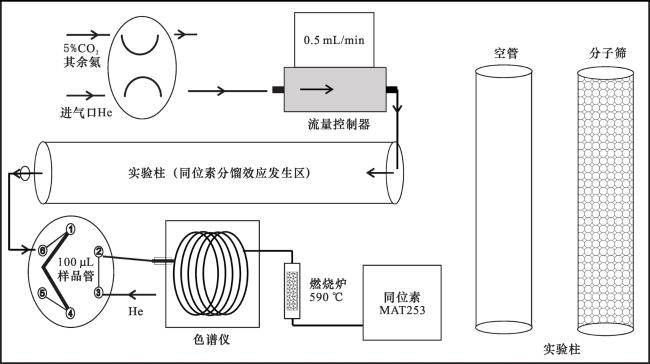
自研的甲烷同位素分馏模拟实验装置如图1所示:①同位素发生分馏的实验柱为内径6 mm的石英玻璃管,长度均为1 m;5Å分子筛以粉装方式充填石英管,两端使用石英棉封口;②四通阀用于高纯He气和5%CH4+95%He的混合气的气路切换;③实验柱出气端连接具有自动化气体取样功能的六通阀—定量采样环的组合(体积50 μL);④色谱—同位素质谱分析系统,用于实时监控碳同位素组成的变化。
1. 2 实验方法
将甲烷同位素分馏模拟实验装置与GC-IRMS同位素分析仪进行有效衔接,使实验模拟与同位素检测均在连续流动模式下同步在线进行。甲烷碳同位素值相对于同位素国际标准VPDB,表示为δ13C(VPDB)值,甲烷浓度由同位素信号响应的峰面积比值计算得到,实验介质5%CH4+95%He混合气的甲烷碳同位素组成为 =-30. 5‰±0. 2‰。
首先进行空柱模拟实验,用高纯氦气冲洗实验柱,直至同位素质谱仪检测不到本底杂质组分的干扰,确保实验柱空腔中处于稳定的高纯He的氛围中,然后再按照以下步骤开展甲烷同位素分馏模拟实验:①调整流量控制器使气体流速保持均匀为0.5 mL/min;②转化四通阀至5%CH4+95%He混合气,并将六通阀置于取样状态,实验柱流出的气体经六通阀取样管至放空口;③启动检测程序,每隔2.5 min(因CH4色谱分离需要约2 min)六通阀按照设定切换至送样状态,载气He依次流经图1中的②、①、④和③,将采样管中的待测气体送入色谱—同位素质谱分析系统,检测其碳同位素比值 。
然后利用分子筛填充的实验柱进行模拟实验,实验步骤如下:①将实验柱填充60~80目5Å分子筛(置于250 ℃加热去气20 h),计算出粉装空隙体积为4. 4 mL,对应于24%的孔隙度。在实验柱的末端填充石英棉塞,将填充材料固定,以便起到过滤的作用。②将分子筛实验柱接入同位素分离实验装置,高纯氦气冲洗实验柱30 min,然后调整柱头压力和流量控制器使气体流速稳定在0. 5 mL/min,后续步骤与空柱实验相同。
甲烷碳同位素分馏模拟实验过程中的检测均在连续流模式下自动进行,由软件按照时间序列依次设定,并与色谱—质谱分析相匹配,实现了甲烷碳同位素比值的实时监测,同时为消除同位素质谱仪对碳同位素比值测定的稳定性和线性的影响,定时穿插工作参考气测定,对检测结果进行实时校正。
2 结果与讨论
2. 1 甲烷同位素空柱分馏实验
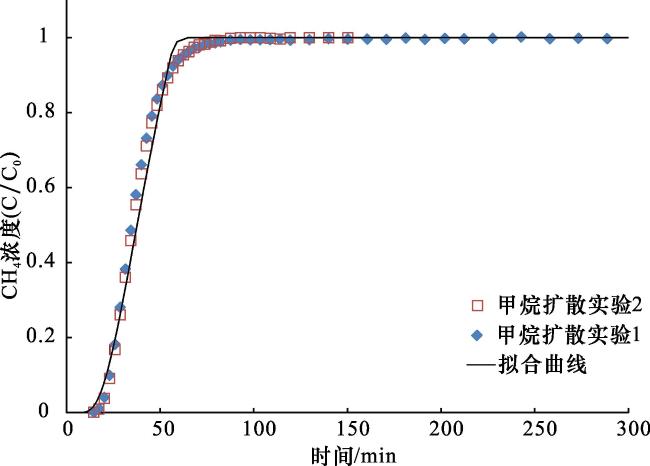
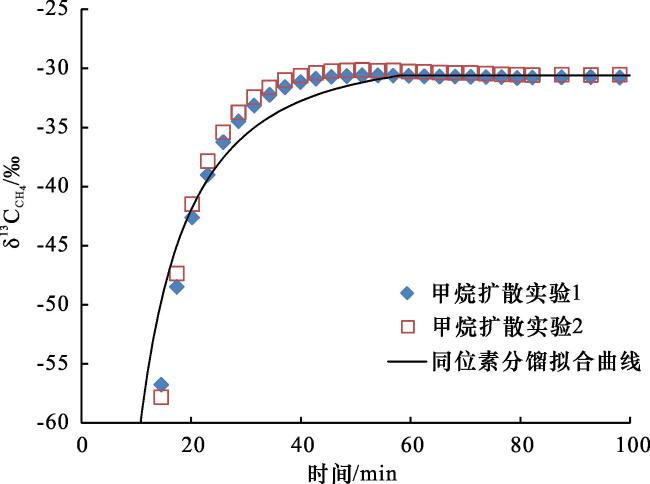
在相同条件下进行了甲烷同位素空柱分馏平行实验,标记为实验1和实验2。甲烷同位素分馏空柱实验中,将甲烷含量5%的气体流入空管中,设定其流速为0. 5 mL/min,实验开始后直到时间为14.5 min左右才初次检测到甲烷浓度及其同位素比值。由于开始时注入的气体流速很低,且在1 m长的空管中已充满He气,因此由扩散作用引起在空管的前端逐渐形成甲烷的浓度梯度变化,进而甲烷的浓度梯度变化造成其同位素发生明显的分馏作用。两次实验初次检测到 值均小于-55‰(图3),对应甲烷的浓度低于0.05%(图2),而后测得的甲烷浓度与甲烷同位素组成同步增加,1 h后甲烷浓度梯度消失,甲烷含量接近混合气原始浓度,其甲烷碳同位素测定值为-30. 7‰,与实验使用的混合气的原始甲烷碳同位素组成特征相一致,说明在此过程中甲烷碳同位素组成发生负向偏移。空柱实验对应于单一扩散因素下甲烷碳同位素分馏作用,甲烷在流动过程中受控于扩散作用逐渐形成浓度梯度,12CH4与 13CH4扩散性能的差异造成越靠前流出的气体越富集12CH4,形成与浓度梯度同向变化的同位素分馏现象,并随浓度梯度消失最终达到原始甲烷碳同位素比值。
同位素分馏的模拟实验设计符合一维柱体扩散—对流耦合传质方程,因此依据质量守恒定律,可用菲克第二扩散定律进行描述:
式中:x为柱体距离,cm;t为流动时间,s;C为扩散物质的体积浓度,v/v;D为扩散系数,cm2/s。式(1) 的解吸解为高斯误差函数[9],即:
初始条件、边界条件分别为:当t<0时C(0,t)=0,t≥0时C(0,t)=C 0,任意时刻t,C(∞,t)=0。
柱体空管的一维扩散实验是基于连续流模式,需要在式(2) 中引入气体流动速率的参数v。设流体平均速度为v(cm/min),体积流速为F(mL/min),则:v=F/(A*θ),A=柱体横截面面积(cm2),θ=孔隙度(%),引入速度参数,可将式(2) 变换为:
值可以转化为13CH4与12CH4的比值R,利用 数据,使用方程(3)以同样方法拟合得到 13CH4的分子扩散系数D(13CH4)=6.512×10⁻⁵ cm2/s,D(13CH4)与D(12CH4)的比值0.993 4,即为一维流动同位素分馏实验中甲烷同位素分馏系数。应用式(3) 计算得到甲烷碳同位素组成随时间变化的拟合曲线(图3),与两次甲烷扩散实验的检测结果具有很好的吻合度,表明基于流动传质方程可以对甲烷的同位素分馏进行定量表述,对页岩气多尺度渗流作用下甲烷碳同位素的变化规律研究具有很好的借鉴意义。
2. 2 甲烷同位素分子筛填充柱分馏实验
实验柱填充60~80目5Å分子筛后计算出粉装空隙体积为4. 4 mL(孔隙度约相当于24%),填充柱孔隙空间充满He气。分子筛填充柱分馏实验中气体的流动主要受连续的吸附—解吸过程影响,当甲烷含量5%的气体流入填充柱中,同样也存在扩散作用,实验初期填充柱孔隙空间的扩散作用造成甲烷碳同位素组成较原始值明显偏负,最低接近-40‰(图4);随后甲烷碳同位素组成快速变重,最大值达到-25‰,相对甲烷碳同位素的原始值偏高5‰,而后甲烷碳同位素组成逐渐变轻,最终填充柱分子筛固定相和流动相之间CH4吸附—解吸处于动态平衡,得到的甲烷同位素组成检测结果恢复到初始值。分子筛填充柱实验甲烷同位素组成随时间连续变化的过程中出现明显的“拐点”,与空管扩散模拟实验中甲烷碳同位素单调变化的现象明显不同。CH4气体在分子筛填充柱中的流动实际上受到渗流、扩散和吸附—解吸的共同影响,需要指出的是12CH4相对于13CH4分子运动性更强,它首先占据分子筛的吸附位,从而造成13CH4先溢出,使甲烷碳同位素组成快速变重,并超过甲烷碳同位素组成的原始值。
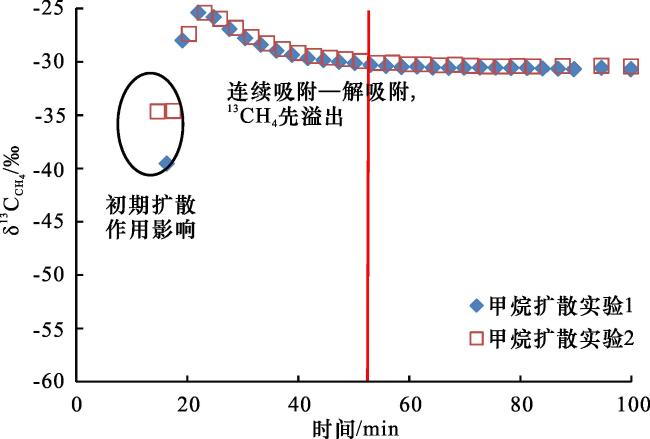
甲烷碳同位素分馏模拟实验是基于一维流动传质过程,通过空管、分子筛填充柱的对比实验,明确了扩散、吸附—解吸附过程对甲烷同位素组成具有较大的分馏效应,而达西流属于黏滞流动不会引起碳同位素组成的分馏[10]。多重影响因素的叠加效应造成同位素比值变化曲线的“拐点”现象,揭示了影响同位素组成控制因素的此消彼长作用过程。页岩气在页岩多孔介质中的流动,受纳米孔隙的扩散、裂隙渗流以及吸附—解吸等作用的共同影响,使页岩气开发生产甲烷同位素也应具有双向变化的特征,相应同位素变化拐点的识别对页岩气开发状态具有重要的示踪意义。
3 结论
(1)开发了一维流动甲烷同位素分馏实验装置及在线同位素监测方法,其中5Å分子筛填充实验柱对应于连续吸附—解吸附为主的流动过程,其同位素变化曲线先变重后变轻,呈现明显的拐点;分子筛吸附位上明显的逆同位素效应使流出CH4碳同位素组成快速变重,相对其原始值偏重可达5‰,而后甲烷碳同位素逐渐变轻至原始比值。
(2)空柱实验对应单一扩散因素下甲烷碳同位素分馏作用,结果表明流动过程中与浓度梯度相对应甲烷碳同位素组成逐渐变重;通过一维对流—扩散数学模型对实验过程中同位素分馏进行量化,可以很好地拟合和解释单一扩散因素作用下甲烷碳同位素分馏实验数据,并获得实验中甲烷碳同位素的分馏系数。
(3)受单一因素控制的同位素分馏是单调变化的,多因素影响下的同位素变化曲线往往呈现出拐点的特征。页岩气在页岩多孔介质中的流动,受纳米孔隙的扩散、裂隙渗流以及吸附—解析附等作用的共同影响,使页岩气开采过程中甲烷同位素也应具有双向变化的特征,相应同位素变化拐点的识别对页岩气开发状态具有重要的示踪意义。
 甘公网安备 62010202000678号


