


0 引言
叠合盆地前陆冲断带一直是全球油气勘探和研究的热点,也是中国陆上主要的油气资源勘探领域之一[1,2,3],如塔里木盆地库车山前冲断带的克拉2气田[4],准噶尔盆地西北缘冲断带的克拉玛依油田、南缘冲断带的独山子油田以及近期GT1井的战略突破[5,6,7],还有柴达木盆地西南缘[8]及四川盆地西北缘[9]的发现等。然而这类地区通常具有多旋回构造—沉积演化,构造变迁复杂的特征,从而使得多套烃源岩层系在空间上叠置。因多期构造运动对油气藏的改造,进而造成多个期次的油气成藏,形成“复合含油气系统” [10]。其中,多套烃源岩的发育以及油气藏的多期调整改造致使不同时代的油气源混合和改造普遍[11],也使得原油的分类和成因研究成为重点、难点及热点[12,13]。
准噶尔盆地阜康断裂带是指盆地南缘东段的博格达山山前陆褶皱冲断带地区[14],隶属北天山山前冲断带[15],受海西、燕山、喜马拉雅等多期次构造运动叠加影响[16],属于典型的前陆盆地冲断褶皱带[17],油气资源发育[18],且存在古生代到新生代的多套烃源岩,为典型的复合含油气系统[19,20,21,22,23,24]。前人对阜康及其周缘的原油类型及成因提出了不同观点,有学者认为原油主要来自二叠系平地泉组烃源岩[25],还有学者认为存在其他烃源岩供烃,如石炭系、二叠系、三叠系和侏罗系烃源岩生成的原油都有发现[6,26,27,28]。这些争议给准确认识油气成藏规律,指导勘探部署带来了困难。当前,随盆地西北缘和南缘前陆冲断带的屡获突破,关于阜康断裂带的勘探和研究工作越来越迫切。
鉴于此,为加强对这些问题的理解与认识,本文选取阜康断裂带及其周缘不同类型的原油,开展原油的有机地球化学特征分析,进行油源对比,以细化研究区的油气来源及混源油分析,总结不同类型原油的平面分布规律,分析其成因,探索勘探启示意义。
1 地质背景和样品方法
本文研究区西至阜康凹陷,东至吉木萨尔凹陷,北至北三台凸起,南至阜康断裂带,研究范围包括西泉鼻隆、甘河油田、三台—北三台油田及吉木萨尔凹陷4个区块,总面积约为4 800 km2(图1)。阜康断裂带位于新疆北天山山脉的博格达山山前,为准噶尔盆地南缘冲断带的二级构造,主要由一系列近东西走向的断裂组成[6,16]。对应博格达山北缘弧形形态可将阜康断裂带分为3段,弧顶部位对应为中段,两翼分别为西段和东段[29,30]。研究区受海西、燕山、喜马拉雅等多期次构造运动叠加影响,主要可分为海西运动期前陆盆地演化阶段、印支运动期泛盆演化阶段、燕山运动期振荡演化阶段以及喜马拉雅运动期类前陆演化阶段[16,31]。阜康断裂带的构造变形过程极为复杂,不仅影响了烃源岩的沉积及发育,同时对圈闭的演化及油气成藏破坏和调整改造起到了重要的影响[32,33]。研究区的主要供烃凹陷由老至新发育了石炭系、二叠系、三叠系和侏罗系4套烃源岩[26,34,35]。
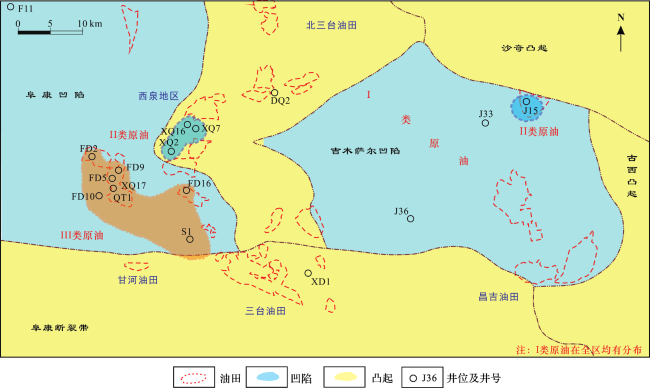
选取了研究区19口井典型原油样品进行分析,覆盖阜康断裂带东西段:西泉地区6口、吉木萨尔凹陷6口、甘河油田2口、三台油田6口。同时为进行油源对比,还收集了4组研究区的典型油源样品,包括石炭系烃源岩、二叠系芦草沟组烃源岩、二叠系平地泉组烃源岩及侏罗系原油,对其干酪根碳同位素、原油全油碳同位素和生物标志物特征进行研究。在研究方法上,本文工作主要采用有机地球化学方法对研究区原油的碳同位素和生物标志物地球化学特征进行分析。
2 原油地球化学特征与族群分类
2.1 原油碳同位素
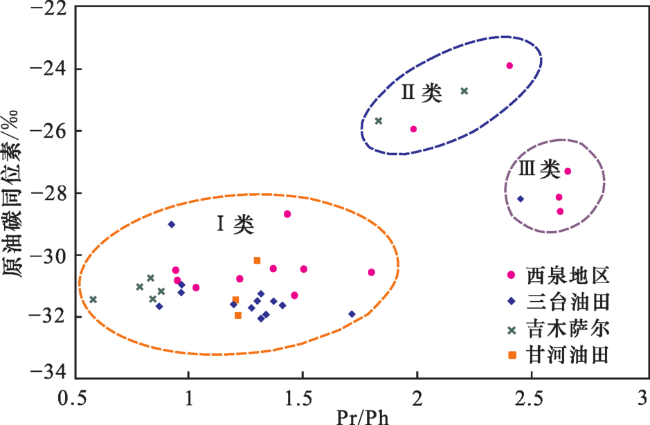
研究区的原油全油碳同位素值主要分布在-22‰~-33‰之间,并可将其分为3类:小于-30‰、大于-27‰和介于二者之间(图2)。具体而言,西泉地区的原油碳同位素变化大,这3类原油都有发现;三台地区的原油碳同位素值整体小于-27‰,吉木萨尔地区和甘河地区的原油碳同位素值整体介于-30‰~-32‰之间。
2.2 原油芳烃
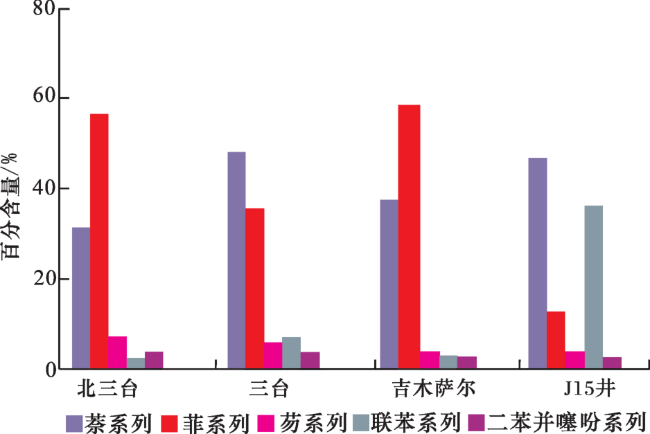
阜康断裂带及其周缘原油的芳烃组成共检测到菲、芴、联苯、萘及二苯并噻吩系列化合物,整体以菲和萘系列丰度最高,而联苯系列变化大为特征(图3)。具体而言,北三台和吉木萨尔地区的原油都以菲系列含量最高,芴系列次之;而三台地区和J15井的萘系列最高,但二者的主要区别在于联苯系列的含量,三台地区低于10%,而J15井高达40%。这些特征反映出原油成因的差异。
2.3 原油生物标志物
在所有原油样品中检测到了丰富的生物标志物,除了正构烷烃、类异戊二烯烃外,也检测到了丰富的萜烷、藿烷及甾烷类化合物,且呈现出较为明显的差异。
在C20—C21—C23三环萜烷组成特征上,C20三环萜烷相对含量集中于20%~40%之间,少数样品含量高达60%~80%;C21三环萜烷的相对含量与C20的分布情况类似,集中于30%~40%之间,少数样品低于20%;C23的含量相对稳定,分布于20%~40%之间。根据C20—C21—C23三环萜烷组成特征,可将研究区原油分成2类[图5(a)]。
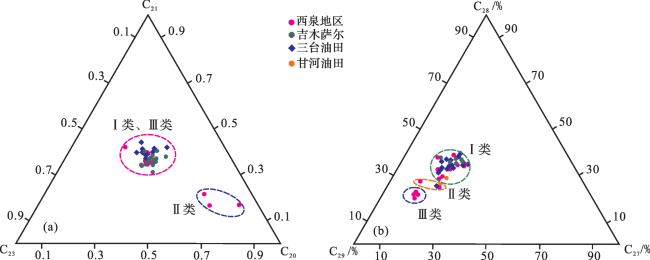
原油规则甾烷C27—C28—C29的分布型式相对多样[图5(b)],整体以C29占主导,其中C27含量介于10%~30%之间,C28含量介于20%~40%之间,C29含量介于40%~70%之间。具体而言,西泉地区的原油C27规则甾烷从20%~40%都有分布,C28含量介于20%~40%之间,C29含量介于40%~70%之间,体现出多样成因。吉木萨尔和三台地区分布较为集中,与西泉地区不同的是C28含量介于30%~40%之间,C29含量介于40%~50%之间。三台地区的C28含量介于20%~40%之间,C29含量介于40%~60%之间。甘河地区的C27含量介于20%~30%之间,C28含量介于20%~30%之间,C29含量介于50%~60%之间。根据C27—C28—C29甾烷组成特征,可将研究区原油分成3类[图5(b)]。
2.4 原油族群划分
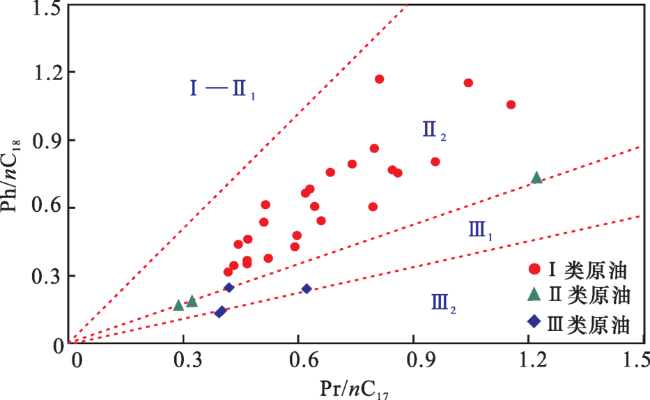
综合以上对研究区原油地球化学特征的分析,可将其划分为三大类(图6)。
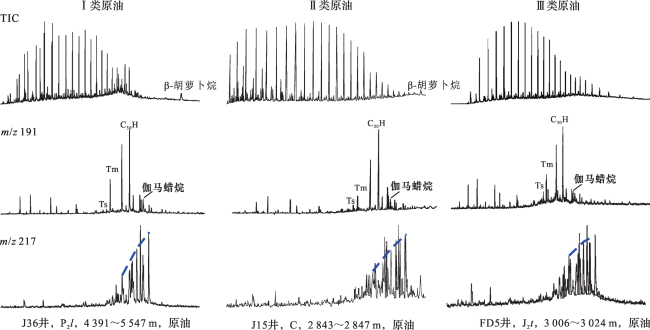
Ⅰ类原油:碳同位素值较低(小于-28‰),类异戊二烯烷烃相对丰度较高,其中Pr/nC17值和Ph/nC18值均分别为0.6和0.4,姥植比介于0.5~1.8之间;β-胡萝卜烷丰度较高,β-胡萝卜烷/nC25值平均达0.11,表明生烃母质形成于较封闭的湖相还原环境中,保存条件良好。这类原油的芳烃组分以萘、菲系列化合物为主,两者含量之和占多环芳烃85%以上,其他系列化合物含量较低,为1%~9%。在萜烷组成中,三环萜烷相对较高,约为40%,其中C21、C20、C23呈山峰型,五环萜烷以C30藿烷为主,其他藿烷Ts、C29Ts、C30重排藿烷含量均较低,而伽马蜡烷含量较高,伽马蜡烷/C31藿烷值在0.3以上。在甾烷组成中以C29和C28甾烷为主,C27甾烷较低,C27—C28—C29呈上升型,表现出生油母质为湖泊相中低等水生生物。这些原油在不同地区之间还有细微差异。
Ⅱ类原油:碳同位素值较高,大于-28‰,与Ⅰ类原油区别明显,表明生烃母质存在明显区别。这类原油的类异戊二烯烷烃相对丰度较高,Pr/nC17值较Ph/nC18高,Pr/Ph值在1.7~2.5之间;β-胡萝卜烷含量极低。该类原油芳烃组成中以萘系列、联苯系列为主,联苯系列含量高达30%~40%,菲系列含量低。在萜烷组成中,三环萜烷呈C21高,C20、C21、C23呈山峰型分布;Ts含量稍高;含有伽马蜡烷。甾烷以C29为主,C27甾烷含量较Ⅰ类原油低,C27—C28—C29呈上升型,其生物标志物特征与Ⅰ类原油有相似之处。
Ⅲ类原油:碳同位素值较以上2类原油高,分布在-29‰~-26.5‰之间,其类异戊二烯烷烃相对丰度不高,Pr/nC17值远远高于Ph/nC18值,姥植比大于2.5;不含β-胡萝卜烷,反映生烃母质偏氧化环境。在萜烷组成中,三环萜烷含量以C21最高,C20、C21、C23呈山峰型分布;Ts含量稍高;伽马蜡烷含量低于前2类原油。甾烷组成中甾烷以C29为主,C27甾烷较Ⅰ类原油低,C27—C28—C29呈上升型;重排甾烷含量普遍较高。
3 油源对比与原油成因分析
3.1 油源对比
3.1.1 I类原油
如上所述,研究区Ⅰ类原油的地球化学特征典型表现为较低的姥植比和较低的碳同位素值,对比前人研究结果[23,24],具有二叠系烃源岩的特征,因此将I 类原油样品稳定碳同位素与二者的稳定碳同位素进行对比(图7)。结果表明,吉木萨尔凹陷、西泉地区、三台油田以及甘河油田大部分原油稳定碳同位素值分布在-29.5‰~-32‰之间(图7),与二叠系生油岩稳定碳同位素分布范围较为一致,且二叠系烃源岩母质类型主要为Ⅱ型。通过稳定碳同位素可初步推测阜康断裂带大部分原油应来自二叠系生油岩,仅有少部分原油样品稳定碳同位素值分布在石炭系稳定碳同位素区间,以及石炭系与二叠系碳同位素过渡区间,这些少部分原油可能来自石炭系生油岩。
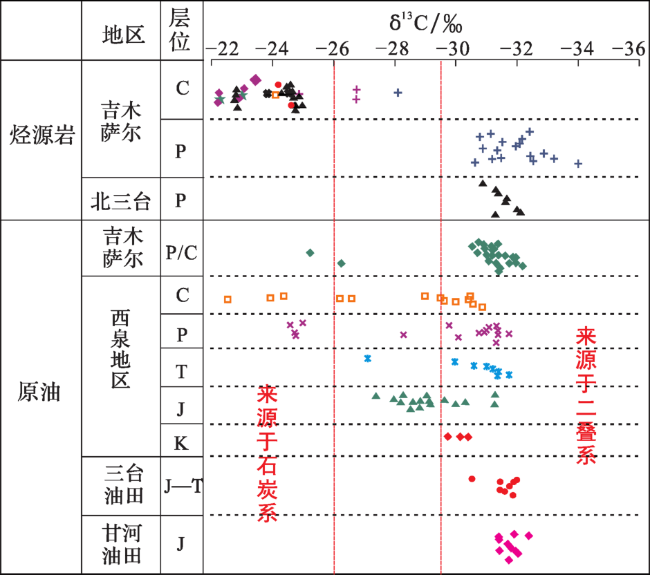
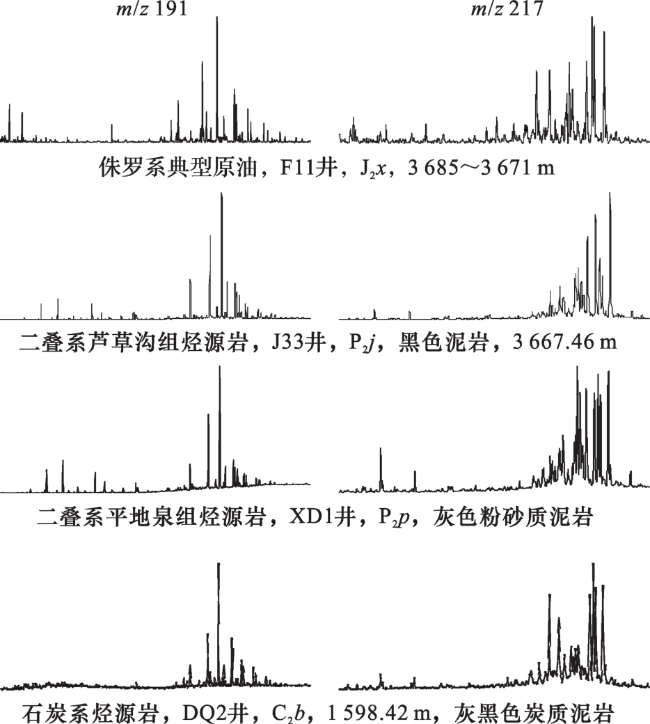
尽管都为I类原油,但构造背景及源储的远近关系不同,研究区不同构造单元下的原油来源也有所差异,即吉木萨尔凹陷与甘河油田、三台油田及西泉鼻隆原油来源可能不是同一凹陷同一套生油岩。为了进一步落实不同构造单元下的原油来源及烃源岩差异,分别从生物标志物对这类原油进行精细对比。具体而言,吉木萨尔凹陷中I类原油与其邻近的泥岩段的规则甾烷C27—C28—C29分布特征相同,均呈上升型分布,伽马蜡烷含量较高(图6),说明储集层中的原油主要来自邻近或与其紧密接触的烃源岩中,都为二叠系芦草沟组。
三台凸起地区分布的Ⅰ类原油稳定碳同位素分布在-30.5‰~-32.5‰之间,姥植比介于0.8~1.7之间。甾烷以C29、C28甾烷为主,C27、C28、C29呈上升型;三环萜烷含量相对较高,C19很低,C19/C21值一般小于0.2,C20—C21—C23呈C21高,C20、C23低的典型山峰型特征;C24四环萜烷相对较低,C24四环/C26三环值一般小于1.1,大致在0.8~1.1之间,与其他类型原油也有明显区别;在五环萜烷的分布中,Ts、C29、C30重排藿烷比较低,Ts/Tm值小于0.4;伽马蜡烷较高,伽马蜡烷通常与C31藿烷的高度相当,伽马蜡烷/C30藿烷值在0.12~0.25之间,伽马蜡烷是盐湖或水体高盐度沉积环境的标志性生物标志物,其通常与较高的β-胡萝卜烷相对应,反映强还原的咸水环境;妊烷、高妊烷含量较高,表明中二叠统泥岩与三台凸起的Ⅰ类原油具有亲源性(图6,图8)。因此,认为三台油田Ⅰ类原油同样来自二叠系生油岩,三台油田对应的二叠系生油岩为平地泉组生油岩。
综合以上研究,发现I类原油及烃源岩具有典型的C20—C21—C23三环萜烷山峰型构型,代表高等植物的三环萜烷C19含量很低,规则甾烷C27、C28、C29呈上升型,伽马蜡烷含量相对较高,Ts较Tm低等典型的二叠系生油岩的生物标志物特征,来源为中二叠统烃源岩。同时也发现了吉木萨尔凹陷的以二叠系芦草沟组为主力烃源岩,三台凸起及西泉鼻隆的Ⅰ类原油主要来自阜康凹陷二叠系平地泉组生油岩。
3.1.2 II类原油
从层位分布角度来说,Ⅱ类原油主要分布在石炭系,少部分分布在二叠系,且在西泉地区Ⅱ类原油主要分布在石炭系尖灭线附近,因此不能排除会有二叠系生油岩生成的原油通过不整合进入到石炭系储层中。原油稳定碳同位素相对生物标志物受运移过程色层效应等次生因素影响较小,Ⅱ类原油母质类型主要为石炭系腐殖型干酪根无可置疑。因此,认为Ⅱ类原油主要来自石炭系生油岩,同时可能混入了少量来自二叠系烃源岩生成的原油。
需要说明的是,这类原油中的部分样品,如J15井的石炭系原油芳烃中联苯含量很高(可达40%,图3),反映了其成因的复杂性,还需待更多的数据积累后作进一步的深入分析。
3.1.3 III类原油
研究区范围内目前发现的Ⅲ类原油主要分布在西泉地区阜东斜坡侏罗系。Ⅲ类原油与其他2类原油最大区别表现在姥植比上,普遍大于2.5,反映生油母质沉积环境为氧化环境。而侏罗系烃源岩的典型特征为高姥植比且碳同位素较高,且阜康凹陷侏罗系发育3套烃源岩,其中侏罗系八道湾组已经进入成熟演化阶段,其排出的原油极有可能充注到阜东斜坡有利储集带,因此推测Ⅲ类原油可能来自侏罗系烃源岩。但从生物标志物组成来看,应还有二叠系烃源岩的贡献。
具体而言,在生物标志物组成上,III类原油中甾烷以C29、C28甾烷为主,C27、C28、C29呈上升型;三环萜烷含量相对较高,C19含量很低,C19/C21值一般小于0.25,呈C21高,C20、C23低的典型山峰型分布;C24四环萜烷相对较低,其丰度与C26三环萜烷单个化合物高度相仿;在五环萜烷的分布中,Ts、C29、C30重排藿烷比较低,Ts/Tm值小于0.6;伽马蜡烷较高,伽马蜡烷/C30藿烷值在0.13~0.23之间,伽马蜡烷是盐湖或水体高盐度沉积环境的标志性生物标志物,其通常与较高的β-胡萝卜烷相对应,反映强还原的咸水环境;妊烷、高妊烷含量较高(图6)。相比而言,来自侏罗系原油如F9井生物标志物特征表现为:甾烷以C29甾烷为主,C27、C28、C29呈反“L”型;三环萜烷含量相对较高,C19含量很高,C19/C21值大于1,呈三环萜烷C21、C20、C23呈低幅下降型;伽马蜡烷含量很低(图8)。
结合上述特征,通过将Ⅲ类原油与二叠系来源原油及侏罗系来源原油的地球化学特征分别进行精细油油对比,可发现研究区III类原油的高伽马蜡烷、三环萜烷山峰型构型、规则甾烷上升型等特征与侏罗系来源原油生物标志物特征相差很大,反而与Ⅰ类原油(二叠系来源)更为相似,而稳定碳同位素及姥植比值介于侏罗系来源原油与二叠系来源原油值之间。据此,综合从稳定碳同位素、姥植比以及生物标志物分析,认为Ⅲ类原油为侏罗系与二叠系生油岩混源原油。
3.2 原油成因及平面分布特征
综合上述分析,可见Ⅰ类原油来自二叠系,分布在研究区绝大部分井区,覆盖了准东南部大部分区块。Ⅱ类原油主要来自石炭系烃源岩,同时混入了少量来自二叠系的原油,由于石炭系烃源岩在阜康断裂带分布比较局限,Ⅱ类原油仅分布在北三台凸起西部与吉木萨尔凹陷J15井区。Ⅲ类原油为侏罗系与二叠系来源混合原油,来自二叠系生油岩的比例应该更高些,主要分布在西泉鼻隆南斜坡、三台凸起西斜坡,即与阜康凹陷的过渡带(图1)。
这种原油分布特征与生烃凹陷密切相关,体现了源控论的特征。在具体位置上油气藏和油气点位于那些相对高的、靠近烃源区的、保存条件好的各类构造圈闭或地层岩性圈闭中,体现了油气向高部位运移的一般规律,同时也体现了保存条件对油气聚集成藏具有重要作用。
3.2.1 油气分布明显受各时代生烃凹陷的控制
充足的烃源岩是形成油气聚集的物质基础[6,37]。准噶尔盆地东部阜康断裂带及其邻区已经确定的生烃凹陷有五彩湾—大井凹陷,生烃层位为平地泉组和滴水泉组(局限于五彩湾凹陷);吉木萨尔凹陷,生烃层位为中二叠统芦草沟组;博格达山前凹陷,生烃层位为中二叠统芦草沟组;阜康凹陷,生烃层位为侏罗系煤系地层、三叠系小泉沟群、二叠系平地泉组、可能还有相当于滴水泉组的石炭系[27,28]。在各生烃凹陷中或临近地区都已找到相应的油气田(藏),在五彩湾—大井凹陷找到了平地泉组自生自储的火烧山油田;在五彩湾凹陷找到了石炭系自生自储的五彩湾气藏;在吉木萨尔凹陷找到了梧桐沟组油藏;在阜康凹陷找到了F4井、F5井三工河组油藏、在其临近地区找到了平地泉组生烃梧桐沟组、韭菜园子组和石炭系储油的沙南油田和侏罗系自生自储的彩南油田;在阜康断裂带和三台—北三台凸起西南缘找到了阜康凹陷侏罗系和博格达山前凹陷芦草沟组烃源混生的油气藏[27]。而在烃源条件差的石树沟凹陷、石钱滩凹陷、梧桐窝子凹陷罕见油气显示或无显示[28]。因此,对今后勘探来说首要工作就是确定潜在烃源岩及原油的分布范围,在此基础上确定有利勘探区域。
3.2.2 油气聚集在隆起的各类圈闭
前人研究表明,准东油气聚集对保存条件要求甚高[16,29]。大中型油气藏均分布在隆起不高不低的各类圈闭中,这体现了油气向高部位运移的一般规律,也体现了保存条件的重要性[38]。这类圈闭地层比较齐全,断裂发育但断开层位低,有利于油气的保存,如火烧山油田、彩南油田、沙南油田和北三台油田。而在隆起较高的圈闭中油气难于聚集,尽管它们也位于烃源区或油气运移的指向区,如沙丘河背斜、C6井东断鼻、沙丘断背斜、北三台凸起顶部和古牧地背斜。这些隆起较高的构造地层剥蚀严重,有些目的层或断层直接出露地表,有些目的层与白垩系底砾岩接触,丧失了封盖条件。这些背斜只能是油气散失的通道,如沙丘河背斜侏罗系的油苗,沙丘断背斜、北三台凸起顶部白垩系中的油气显示。在确定烃源岩及原油分布的基础上,进一步缩小范围至隆起中并寻找有利圈闭,从而寻找油气藏。
4 结论
(1)准噶尔盆地东部阜康断裂带及邻区的原油类型可分为3类。Ⅰ类原油在整个研究区都有分布,源自中二叠统(芦草沟组、平地泉组),且研究区内由东到西、由南到北原油成熟度逐渐增高;Ⅱ类原油来自石炭系烃源岩,主要分布于北三台凸起西部与吉木萨尔凹陷J15井区;Ⅲ类原油分布在西泉鼻隆南斜坡和三台凸起西斜坡,为侏罗系与二叠系原油的混源。
(2)3类原油的分布及成因可归纳为油气分布明显受各时代生烃凹陷的控制,不同生烃凹陷的原油成熟度不同;且油气大多聚集在隆起的各类圈闭。据此,建议对研究区的勘探应以烃源岩分布为基础,在隆起及稳定的构造环境中寻找大中型油气藏。
 甘公网安备 62010202000678号


